✦ The Inner Compass Course

Prepare seriously.
Integrate deeply.
Change lastingly.

A 12-module course for adults who want to approach psychedelic therapy with the rigor it deserves. Evidence-informed, clinically grounded, written without hype.

12modules
60original illustrations
6integration frameworks
Lifetimeaccess
$97 one-time
Lifetime access · No subscription
  • 12 comprehensive modules — prep through year-one integration
  • 60 original clinical illustrations
  • All exercises fully written out — not just described
  • Medicine-specific guidance for psilocybin, ayahuasca, MDMA, ketamine, and ibogaine
  • IFS, somatic, and ACT frameworks explained and applied
  • Trauma-informed throughout
  • Downloadable PDF bundle of all 12 modules
  • Free updates as content expands
Get instant access →
Or read Module 1 completely free — no email required.
Evidence-informed, not hype-driven Written for people doing serious work Veteran-founded and operated No paid rankings. No affiliate medicine content.

This course was written for a specific kind of person.

Not for the casually curious. For the person who has decided to take this seriously — and wants the resources to match that decision.

This course is for you if

  • You're preparing for a retreat and want to arrive genuinely ready — not just intellectually familiar
  • You've had a session and the integration is harder or more confusing than expected
  • You carry trauma history and want a preparation resource that doesn't pretend that's simple
  • You're a veteran considering ibogaine, psilocybin, or MDMA — with or without an organization like VETS Inc. or Heroic Hearts
  • You've read the basic articles and want something more substantive — with clinical frameworks actually explained
  • You want a resource to return to across the full year of integration

This course is not for you if

  • You're looking for validation that psychedelics are a shortcut or a guaranteed cure — this course says otherwise clearly
  • You want a quick overview — these modules are substantive and expect your full attention
  • You haven't done the readiness work yet — the contraindications section will tell you whether now is the right time
  • You're looking for trip reports or experiential guidance rather than clinical preparation

Twelve modules. No filler.

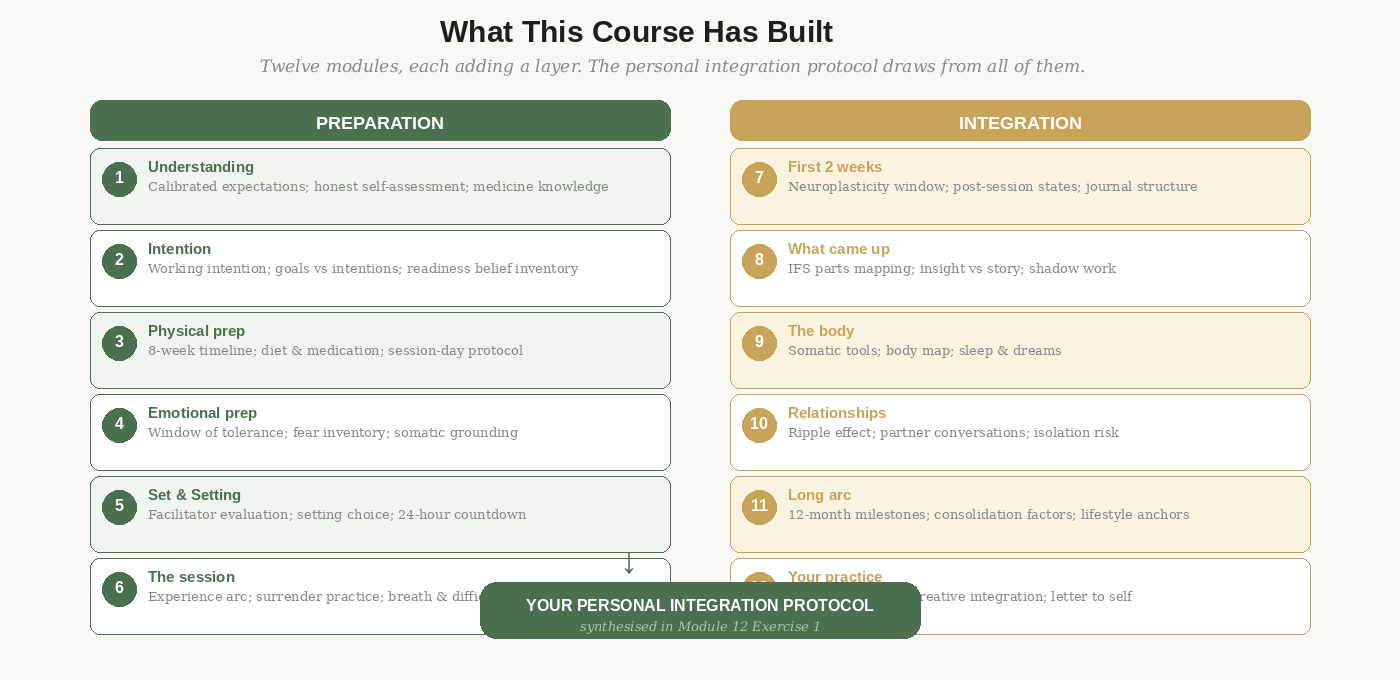
Six modules on preparation — covering everything from medicine pharmacology to emotional readiness to the 24 hours before your session. Six modules on integration — from the first two weeks through the full year.

Module 1 — Preparation
Understanding What You're Getting Into
What psychedelic therapy actually is and isn't. Medicine profiles for all five major compounds. A rigorous readiness self-assessment. Contraindications addressed honestly.
All 5 medicinesReadiness assessmentContraindications
Module 2 — Preparation
Setting Your Intention
Why intention matters mechanistically — not spiritually. The goals/intentions/outcomes distinction. The intention spectrum. A 5-stage intention-setting process built on ACT and neuroscience.
ACT frameworkNeuroplasticity2 exercises
Module 3 — Preparation
Physical Preparation — The Body Is Not Optional
Medicine-specific dietary and substance guidance. The MAOI interaction web for ayahuasca. The medication decision framework. An 8-week preparation timeline you actually use.
MAOI interactionsMedication tapering8-week timeline
Module 4 — Preparation
Emotional and Psychological Preparation
The Window of Tolerance. Working with pre-session fear. The surrender principle. Trauma considerations. The somatic grounding sequence — built to be automatic by retreat day.
Trauma-informedSomatic groundingFear inventory
Module 5 — Preparation
Set and Setting — The Two Variables That Matter Most
The research on why set/setting outweigh dose. A detailed facilitator vetting checklist. Setting format comparison. The 24-hour pre-session protocol. Facilitator conversation guide.
Facilitator vettingRed flagsSetting formats
Module 6 — The Session
Inside the Session — Navigating the Experience
The experience arc by medicine. The surrender principle in practice. Productive difficulty vs overwhelm — how to distinguish them in real time. When and how to signal the facilitator.
Experience arcDifficulty navigationBreath as tool
Module 7 — Integration
The Integration Window — The First Two Weeks
The neuroplasticity window in clinical detail. The full post-session state spectrum. The integration paradox — who to talk to. The 30-day journaling template and Three Questions practice.
Neuroplasticity30-day templatePost-session states
Module 8 — Integration
Working With What Came Up
The IFS model applied to integration. Insight vs story. Shadow material. Spiritual emergence vs spiritual emergency. When to work with a therapist, coach, or neither. Parts mapping exercise.
IFS frameworkShadow workParts mapping
Module 9 — Integration
The Body in Integration
Why integration is not primarily cognitive. Five somatic tools: movement, breathwork, cold exposure, TRE, Somatic Experiencing. Sleep and dreams as integration material. The body map exercise.
Somatic ExperiencingTREBody map
Module 10 — Integration
Relationships and Integration
How change ripples through every relationship. The disclosure timeline for partners and family. The full spectrum of partner reactions. The isolation risk. A structured relationship conversation guide.
Partner communicationDisclosure timingIsolation risk
Module 11 — Integration
The Long Arc — Months 1 through 12
What integration looks like at 30, 90, 180, and 365 days. What makes insights consolidate vs fade. Spiritual bypass. Working with regression. The lifestyle anchor system. The 12-month map.
12-month arcRegressionLifestyle anchors
Module 12 — Integration
Building Your Integration Practice
Synthesizing all twelve modules into your personal integration protocol. Creativity in integration. The support system map. Integration as ongoing orientation. A letter to yourself — to read in six months.
Personal protocolSupport systemLetter to self

Built to be genuinely better.

This course exists because nothing like it existed. The preparation guides were too shallow. The integration resources were too general. This is what we wanted when we needed it.

📖

12 substantive modules

Each module is 3,500–4,500 words of serious, evidence-informed content. Clinical frameworks named and explained. Research referenced accurately. Honest about what's uncertain.

🎨

60 original illustrations

Every module includes five original clinical diagrams — the experience arc by medicine, the Window of Tolerance, the IFS parts model, the somatic tools, the 12-month arc. Built to clarify, not decorate.

✍️

Fully written exercises

Every exercise is completely written out — not "do a journaling practice" but the actual prompts, structure, timing, and guidance for what to do with what comes up. Usable independently.

💊

Medicine-specific throughout

Psilocybin, ayahuasca, MDMA, ketamine, and ibogaine each have distinct pharmacological profiles, risks, and integration patterns. This course treats them differently because they are different.

🎖️

Veteran-informed

This site was built by a veteran who has done this research. The ibogaine and MDMA content for TBI and PTSD reflects the actual research — including the 2024 Stanford Nature Medicine study.

📄

Downloadable PDF bundle

All 12 modules as professionally formatted PDFs. Print them, annotate them, work through them in order. The course portal lets you read online; the PDFs let you take it anywhere.

What people are saying

From people who did the work.

"

I've read probably a dozen articles and two books on preparation. Nothing came close to the depth of Module 3 alone — the MAOI interaction content probably kept me safe. I wish I'd found this before my first ceremony.

M
Michael R.
Ayahuasca retreat, Peru · Combat veteran
"

The integration modules are what I didn't know I needed. I'd had three sessions before finding this — and realized I'd been skipping the most important part entirely. Module 8 on shadow work changed how I relate to what came up.

S
Sarah K.
Psilocybin therapy · Treatment-resistant depression
"

As someone with a significant trauma history, I was genuinely nervous about whether this was safe for me. Module 4 addressed that more honestly than anything else I'd read — including the clinical research papers. It helped me make an informed decision, not just a hopeful one.

J
Jamie T.
MDMA therapy preparation · PTSD history
"

The partner communication module alone was worth the price. My wife didn't understand what I was doing or why. The disclosure timeline and the conversation guide gave me a way to bring her in without overwhelming her. Our relationship is genuinely better for it.

D
David L.
Ketamine-assisted therapy · Ibogaine preparation
"

I'm an integration coach and I've been recommending this to every client doing retreat preparation. The IFS and somatic modules are the most accessible explanations of those frameworks I've encountered — and I've been trained in both.

R
Rachel M.
Certified Integration Coach · IFS Practitioner
"

The ibogaine cardiac risk section is the most clearly written explanation of why screening matters that I've seen anywhere — including content from the clinics themselves. This course saved me from going to a facility that wasn't screening properly.

T
Thomas W.
Army veteran · Ibogaine research · TBI history

Start with Module 1.
It's completely free.

No email required. No account. Read the full first module right now — and decide if this is the right resource for your preparation.

Full course: $97 one-time · Lifetime access
Read Module 1 free →
or
Get all 12 modules now — $97

Frequently asked.

Who wrote this course?
The Inner Compass Course was written by the team at Inner Compass — a psychedelic therapy resource site founded by a US veteran. The content draws on primary research from Johns Hopkins, MAPS, Imperial College London, and the broader psychedelic science literature, as well as clinical frameworks including IFS, Somatic Experiencing, and ACT. It has been reviewed for pharmacological accuracy.
Do I need to have a session booked to use this course?
No. The preparation modules are useful whether you're actively planning a retreat or still in the research phase. Module 1 specifically helps you assess readiness — including whether now is the right time. Many people work through the first half of the course before deciding on a program.
Is this only for psilocybin, or does it cover other medicines?
All five major medicines are covered: psilocybin, ayahuasca, MDMA, ketamine, and ibogaine. The course is explicit that these have meaningfully different pharmacological profiles, risks, and integration patterns — and treats them differently throughout. The ibogaine content includes the cardiac risk information and the 2024 Stanford/Nature Medicine veteran TBI research.
I have a trauma history. Is this course appropriate for me?
Yes — and Module 4 specifically addresses trauma history, the Window of Tolerance, what to tell your facilitator, and how to assess your own readiness when carrying significant trauma. The course is trauma-informed throughout. It does not minimize complexity or assume a wellness-seeker audience.
What's the refund policy?
30 days, no questions asked. If you work through the material and it's not what you needed, email courses@mindsawaken.com within 30 days of purchase for a full refund.
Can I access this on my phone?
Yes. The course portal is fully mobile-responsive. You can read modules on any device. The PDF downloads work on any device too — most people use the portal on their computer and download PDFs to annotate on tablet or print.
Is this a replacement for working with a therapist or integration coach?
No — and it says so explicitly. Module 8 includes a clear framework for when you need a therapist, when a coach is appropriate, and when self-directed integration is sufficient. This course provides structure and frameworks; for people with significant trauma histories or complex material, it is a complement to professional support, not a substitute.
$97
Lifetime access
Get the course →