The Voice in Your Head
There's a voice that lives inside you. You know the one. It speaks in the quiet moments—when you're getting ready in the morning, when you've made a mistake, when you're trying to fall asleep at night. It has opinions about everything: how you look, what you said, what you should have done differently, why you're not measuring up.
You're not good enough. Everyone else has it figured out. You should be further along by now. You're too sensitive, too emotional, too much. Or maybe you're not enough—not smart enough, not attractive enough, not successful enough.
This voice is so familiar that you might not even notice it anymore. It's like background music you've learned to tune out, except you haven't really tuned it out. It's shaping your choices, coloring your experiences, keeping you small.
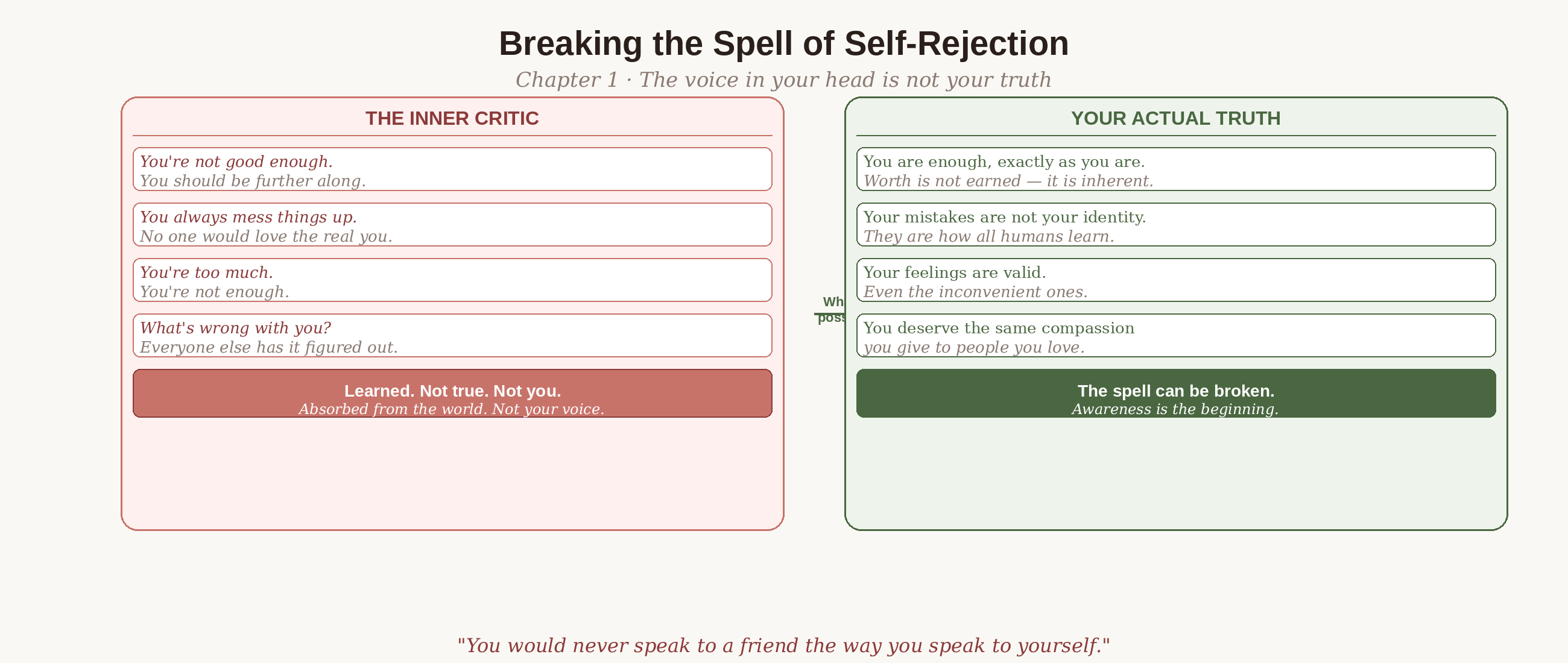
The Inner Critic is not your voice — it is a collection of messages absorbed from the world.
I call this voice the Inner Critic, though it has many names. Some call it the inner judge, the saboteur, the voice of fear. Whatever you call it, it's the primary obstacle to self-love. And here's the challenging truth: that voice isn't actually you.
It's a collection of messages you've absorbed over a lifetime—from parents who projected their own fears onto you, from a culture that profits from your insecurity, from experiences that taught you that love was conditional. The Inner Critic was created to protect you, to help you fit in and avoid rejection. But somewhere along the way, it became the very thing causing you pain.
Sarah, a woman who came to one of my workshops, shared this with the group: "I realized I would never speak to another human being the way I speak to myself. If I talked to my daughter the way I talk to me, it would be abuse. But somehow, I've convinced myself I deserve it, that it's motivating me to be better."
Her words hung in the air, and I watched heads nod around the circle. We've all done this. We've all believed that harshness is the path to improvement, that if we just criticize ourselves enough, we'll finally transform into someone lovable.
But it doesn't work that way.
The Spell We're Under
Self-rejection operates like a spell—an enchantment we've been under so long we think it's reality. The spell tells us that we need to earn love, that worthiness is something we achieve rather than something we inherently possess. It tells us that there's something fundamentally wrong with us that needs to be fixed before we can be accepted.
This spell is reinforced everywhere we look. Advertisements tell us we're incomplete without certain products. Social media shows us curated perfection and calls it real life. Diet culture promises that we'll finally be happy when we're smaller. Hustle culture insists we're only valuable when we're productive. The self-help industry itself sometimes perpetuates the message that we're broken and need fixing.
The spell of self-rejection thrives on comparison. We measure ourselves against others and always come up short. We see someone's success and make it mean something about our failure. We see someone's beauty and make it evidence of our inadequacy.
But here's what breaks my heart: while we're busy rejecting ourselves, we're missing our own precious, unrepeatable lives. We're so focused on who we think we should be that we can't see who we actually are. We're so busy performing for an imaginary audience that we forget to show up for ourselves.
The Cost of Self-Rejection
Self-rejection doesn't just hurt—it has real consequences in our lives. It keeps us from taking risks because we're terrified of confirming our worst beliefs about ourselves. It keeps us in relationships where we're not valued because we don't believe we deserve better. It keeps us from speaking our truth because we've decided our voice doesn't matter.
Self-rejection makes us people-pleasers, chronic overachievers, perfectionists who are never satisfied. It makes us invisible, always accommodating others' needs while ignoring our own. It keeps us stuck in jobs that drain us, relationships that diminish us, lives that don't reflect who we really are.
Marcus, a veteran I worked with, put it this way: "I've spent my whole life trying to prove I'm worthy of being here. But no matter what I accomplish, it never feels like enough. I'm exhausted from running a race that has no finish line."
That exhaustion is the body's wisdom, telling us that something is deeply wrong. We weren't meant to live this way—constantly at war with ourselves, constantly trying to earn what is already ours by birthright.
The First Glimpse of Freedom
Breaking the spell of self-rejection begins with awareness. Not the harsh, judgmental awareness that the Inner Critic specializes in, but a gentle, curious awareness that simply notices: Oh, there's that voice again.
When you start paying attention, you might be shocked by how often and how harshly you criticize yourself. You might notice the voice:
When you look in the mirror
When you make a mistake at work
When you compare yourself to others on social media
When you set a boundary and then feel guilty
When you're trying something new and struggling
When you're celebrating a success (and the voice immediately discounts it)
The practice isn't to fight with the voice or try to make it go away. The practice is simply to notice it and recognize: This is not the truth about me. This is just a voice I learned.
This distinction is everything. When you can separate yourself from the Inner Critic, you create space. And in that space, something new becomes possible.
I remember the first time I caught myself mid-criticism and actually paused. I was standing in front of my closet, running late for a meeting, and the voice was relentless: Nothing looks good on you. You've gained weight. You look unprofessional. Everyone will judge you.
But this time, instead of spiraling, I stopped. I took a breath. And I said out loud to my empty bedroom: "Thank you for sharing, but I don't need that right now."
It felt absurd. It felt revolutionary. It was the tiniest act of self-love, but it cracked something open in me. I realized that I could have a different relationship with that voice. I didn't have to believe everything it said.
A New Relationship with Yourself
Breaking the spell of self-rejection is the beginning of coming home to yourself. It's the moment you realize you have a choice in how you treat yourself. You can continue the pattern of criticism and rejection, or you can choose something radically different: compassion.
This doesn't mean pretending everything is perfect or bypassing real growth edges. It means meeting yourself with kindness in the midst of imperfection. It means treating yourself the way you'd treat someone you deeply love.
Imagine for a moment: What would change if you spoke to yourself the way you speak to your best friend? What would be possible if you met your struggles with gentleness instead of judgment? What might your life look like if you believed, truly believed, that you are worthy of love exactly as you are?
These aren't rhetorical questions. They're invitations into a different way of being. And the beautiful, terrifying truth is that this way is available to you right now. Not when you lose weight, not when you achieve more, not when you finally get it all together. Now.
The journey to radical self-love begins here—with the simple recognition that you deserve to be treated with kindness, especially by yourself.
Meeting Your Inner Critic
Allow 15–20 min. Bring a journal.
Find a quiet space where you won't be interrupted. Bring a journal or some paper with you.
Step 1: Listen Close your eyes and bring to mind a recent moment when your Inner Critic was particularly loud. Maybe it was this morning, maybe it was last week. Don't judge yourself for having these thoughts—just notice them.
What does the voice say? Write down the actual words, as harsh as they might be. Let them out of your head and onto the page.
Step 2: Get Curious Read what you've written. Now ask: Where did I first learn to speak to myself this way?
Does the voice sound like someone from your past? A parent, a teacher, a peer who bullied you? Does it echo messages you received from culture, media, or religion?
You're not trying to blame anyone. You're simply recognizing that this voice came from somewhere outside you. You absorbed it, but it's not originally yours.
Step 3: Respond with Compassion On a new page, write a response to the Inner Critic from your wisest, most compassionate self—the part of you that sees clearly and loves unconditionally.
Let your compassionate self speak truth. What does that voice need to hear? What would kindness say in response to criticism?
Step 4: A Daily Check-In For the next week, set a gentle reminder on your phone three times a day. When it goes off, simply pause and ask yourself: What is the Inner Critic saying right now?
Just notice. No need to fix anything. Awareness itself is the beginning of transformation.
In the next chapter, we'll explore where these patterns of self-rejection come from and begin the sacred work of healing the wounds that keep us from loving ourselves fully. But for now, simply acknowledging the voice—and recognizing it's not the truth of who you are—is enough.
You're already on your way home.