You Were Born Whole
None of us were born believing we were unworthy. This is important to understand. If you've ever spent time with a toddler, you know this is true. Toddlers are utterly unselfconscious. They dance with wild abandon, not caring who's watching. They declare their needs loudly and without apology. They believe they are the center of the universe, and they're not embarrassed about it. They don't wake up wondering if they're good enough today.
Watch a two-year-old for five minutes. When they fall down, they might cry, but they don't make it mean something about their worth. When they want something, they ask for it directly. When they're angry, they express it. When they're joyful, their whole body shows it. They don't check the mirror and catalog their flaws. They don't second-guess their right to take up space, to make noise, to express their feelings. They just are—fully, completely, unapologetically themselves.
That was you once. That uninhibited, authentic, self-assured little person was your original nature. That's who you were before the world taught you otherwise.
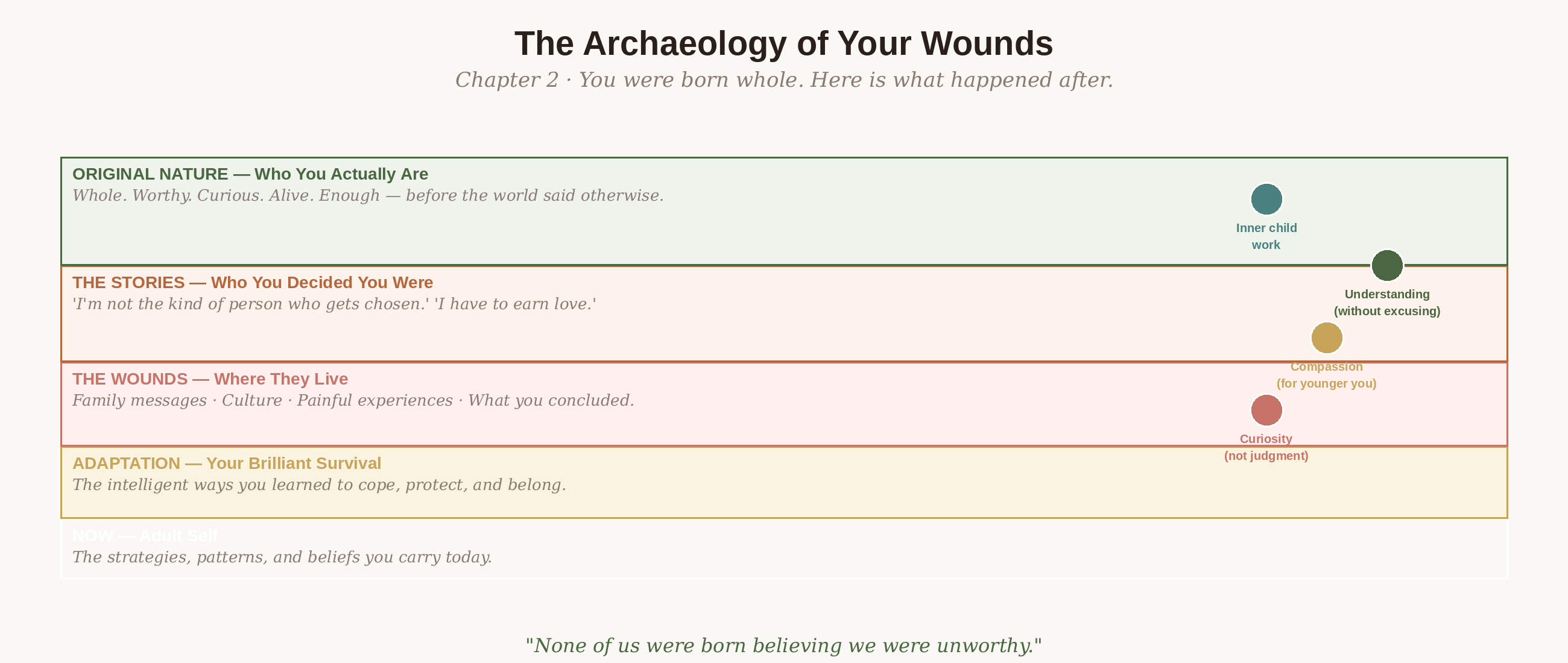
Understanding the origins of self-rejection — without excusing anyone — is one of the most freeing things you can do.
Somewhere between that natural self-love and adulthood, something happened. We learned to hide, to diminish, to doubt ourselves. We learned that love was conditional, that acceptance came with requirements. We learned to perform, to achieve, to earn our worthiness instead of simply claiming it as our birthright. We learned to split ourselves into acceptable and unacceptable parts, showing some and hiding others.
But here's what I want you to hear, really hear: you didn't lose that wholeness because something was wrong with you. You learned to hide it because the people and systems around you couldn't hold all of who you were. And you, being brilliantly adaptive and wanting desperately to be loved, learned to survive by becoming what seemed to be wanted.
The Many Sources of Wounding
The messages that taught us to reject ourselves came from everywhere. Some were loud and obvious—a parent's cruel words, a bully's taunts, a teacher's dismissal. Others were subtle, almost invisible—the things that went unsaid, the love that came with conditions, the parts of yourself that seemed to make people uncomfortable.
From our families, we learned the rules of love. Perhaps your parents were warm and affectionate, but only when you achieved or behaved a certain way. Perhaps you learned that love was a reward for good grades, for being quiet, for not causing problems. Perhaps love felt unpredictable—present and warm one moment, withdrawn and cold the next—so you learned to walk on eggshells, constantly reading the room and adjusting yourself to maintain connection.
Maybe you were compared to siblings and found wanting. "Why can't you be more like your sister?" Maybe emotions were treated as inconvenient or inappropriate, so you learned to bury your feelings and put on a happy face. Maybe your parents never said directly that you weren't good enough, but you noticed how your mother talked about her own body with disgust, and you absorbed the lesson that bodies are shameful things to be controlled and criticized. Maybe you watched your father sacrifice everything for his career, and you learned that your desires and dreams don't matter as much as duty and responsibility.
From culture, we absorbed messages about what it means to be valuable, to matter, to belong. If you grew up in a culture that prizes thinness, you may have learned your body is a problem to solve, evidence of your lack of discipline and worth. If you grew up where masculinity meant suppressing emotions, you may have learned that vulnerability makes you weak, that real strength means suffering in silence. If you grew up where success is measured by wealth and status, you may have learned that who you are isn't enough—only what you achieve matters.
The advertising industry alone has spent billions teaching you that you're incomplete, that happiness is always one product away. Buy this car and you'll feel confident. Use this cream and you'll be beautiful. Wear these clothes and you'll finally belong. Social media trained you to compare your messy, complicated reality to everyone else's carefully curated highlight reel. The news cycle kept you anxious and afraid, convinced the world isn't safe enough for you to be fully yourself.
From painful experiences, we drew conclusions about our worth that have shaped us ever since. Maybe you were bullied in school, targeted for being different, and you decided that being visible means being in danger. So you learned to make yourself small, to blend in, to never stand out. Maybe you experienced rejection—romantic, social, professional—and the pain was so sharp you decided it's safer not to try, not to hope, not to risk your heart again.
Maybe someone you trusted violated that trust—a parent, a teacher, a religious leader, a partner—and you learned that letting people close is dangerous, that vulnerability is a weakness others will exploit. Maybe you failed at something important, and instead of seeing it as one moment in time, one experience among many, you made it mean something about your fundamental value. You weren't someone who failed; you were a failure. The experience defined you.
Maybe you were told you were "too sensitive," "too loud," "too much," and you learned to shrink yourself to fit into spaces that were never designed for your fullness. Or maybe you were told you were "too quiet," "too shy," "not enough," and you learned that who you naturally are is disappointing.
From religion or spiritual communities, some of us absorbed the deepest wounds of all. Perhaps you were taught that you were born sinful, fundamentally flawed, stained by original sin. Perhaps you learned that your body is dirty, your desires are selfish, your very humanity is something to transcend rather than embrace. Perhaps you were taught that God's love was conditional on your behavior, that you had to earn divine acceptance through perfect obedience, and you spent years terrified you could never be good enough.
I want to be clear: I'm not saying religion is bad or that all spiritual teaching is harmful. Many people find profound comfort, meaning, and community in their faith. But for many of us, the message we received—whether intended or not—was that we needed to earn love, that we were broken and needed fixing, that our worthiness was always in question. And that's a heavy burden for anyone to carry, especially a child.
The Brilliant Logic of Survival
Here's something I've discovered through my own healing and through working with others: beneath every pattern of self-rejection is a wound. And beneath that wound is usually a child who just wanted to be loved and did whatever they could to get it.
Think about the ways you reject yourself now. Why do you criticize your body so harshly? Why do you look in the mirror and mentally catalog everything that's wrong? Probably because at some point, you learned that your body wasn't acceptable, and some part of you believed that if you could just fix it, punish it into submission, reshape it into something more acceptable, you'd finally be worthy of love and belonging.
Why do you push yourself to exhaustion, always doing more, never resting, treating yourself like a machine that should run without maintenance? Probably because you learned early that your worth comes from what you produce, and you're terrified that if you stop performing, proving your value, you'll be abandoned or deemed worthless.
Why do you hide your true feelings, even from people who claim to love you? Why do you say "I'm fine" when you're falling apart inside? Probably because you learned that expressing your authentic emotions led to rejection, punishment, or dismissal. You learned that being real was too dangerous, that people couldn't handle the truth of who you are.
Why do you say yes when you mean no, putting everyone else's needs ahead of your own? Why do you exhaust yourself taking care of others while ignoring your own wellbeing? Probably because you learned that your value lies in being helpful, accommodating, easy. You learned that having needs makes you a burden, that love must be earned through service and self-sacrifice.
These patterns aren't character flaws. They're not evidence that something is wrong with you. They're survival strategies. They're the brilliant, creative ways you learned to cope with impossible situations when you were too young to have any real power.
Jessica shared something in one of my workshops that stopped everyone in their tracks. She said, "I realized I've spent my entire adult life trying to be invisible because when I was a kid, visibility meant my father's rage. If he noticed me, I was in danger. I learned to be quiet, to anticipate everyone's needs before they voiced them, to never take up space or draw attention. It kept me safe then. But now I'm forty-three years old, living alone, and I still make myself small in rooms where no one is actually threatening me. I'm still that terrified little girl, protecting myself from a danger that no longer exists."
Her eyes filled with tears as she continued, "I've been angry at myself for being a doormat, for not speaking up, for letting people walk all over me. But really, I've just been trying to survive. That little girl in me is still working so hard to keep us safe."
This is the heartbreak of unhealed wounds. They keep us responding to old threats that no longer exist, fighting old battles that have long since ended, trying to earn love from people who are no longer even in our lives. We're still operating from the survival strategies of childhood, not realizing we're free now. Not realizing we have choices and power we didn't have then.
The Stories That Became Your Identity
Once we absorbed these wounds, we created stories to make sense of them. Stories about who we are, how the world works, what we can expect from life and love. These stories felt true because our brains are brilliant at confirmation bias—we found evidence everywhere to support them.
The stories might sound like this:
"I'm not the kind of person who gets chosen. I'm always the backup, never the first choice. There's something about me that makes people settle for me rather than truly want me."
"I have to work twice as hard as everyone else to be valued, and even then, it might not be enough. Nothing comes easily to me. I have to earn everything."
"If people really knew me—the messy, broken, damaged parts I keep hidden—they'd leave. So I have to keep performing, keep pretending, keep the mask firmly in place."
"I'm too damaged for real love. My past has ruined me. No one could want me if they knew everything I've been through."
"I'm only lovable when I'm useful, when I'm taking care of others, when I'm giving. The moment I need something, people disappear. My needs are too much."
"There's something fundamentally wrong with me that I can't quite fix, no matter how hard I try. Everyone else has it figured out, but I'm still struggling with basics."
These stories feel like facts. We've lived with them so long that they're woven into our sense of self, our identity. We've gathered years of evidence that seems to prove they're true. Every time someone doesn't choose us, every time we have to work hard, every time someone leaves, every time we need something and feel like a burden—it confirms the story.
But here's what changed for me when I started doing this work, what cracked open a door I didn't even know was there: I realized these aren't facts. They're interpretations. They're the meaning a child made of painful experiences when they didn't have the wisdom, perspective, or cognitive development to understand what was really happening.
And if they're just stories—interpretations rather than truths—then we can write new ones.
Not by pretending the painful things didn't happen. Not by bypassing the real impact of our wounds or engaging in toxic positivity. But by recognizing that we have power now that we didn't have then. We can choose a different meaning. We can reinterpret the evidence. We can decide who we want to be moving forward.
The Hidden Strengths
I need to say something that might sound strange, so please stay with me: sometimes our wounds carry gifts.
Before you bristle at that, before you think I'm suggesting you should be grateful for your pain, let me be absolutely clear—I'm not saying the wounding was good. I'm not suggesting you should thank the people who hurt you. Harm is harm, and what happened to you shouldn't have happened. You deserved better.
But in responding to those wounds, in finding ways to survive and cope and keep going, you often developed strengths and capacities you might not have otherwise. And recognizing those strengths doesn't diminish the wrongness of what hurt you. It doesn't justify the pain. It simply acknowledges the resilience and creativity you brought to impossible situations.
Maybe you learned to be deeply empathetic because you had to become so attuned to others' emotions to stay safe. You learned to read micro-expressions, to sense shifts in energy, to know what someone was feeling before they said a word. That's a profound gift, even though you wish you'd learned it a different way.
Maybe you developed rich creativity and imagination because you needed an escape, a way to build worlds where you had control and safety and beauty. Your art, your writing, your daydreams weren't just coping mechanisms—they were evidence of your spirit refusing to be crushed.
Maybe you became resourceful, able to make something from nothing, because you had to. Maybe you learned to read people with uncanny accuracy. Maybe you developed a dark sense of humor that helps you find lightness in difficult moments. Maybe you became fiercely independent because you learned you could only truly rely on yourself.
These gifts don't justify the wounding. They don't make it okay. They don't mean you needed to be hurt to become who you are. But they do reveal something important: you're not just damaged. You're not just a collection of wounds and coping mechanisms. You're also incredibly strong. You survived. You adapted. You found beauty and meaning in dark places. You kept going when giving up would have been easier.
And now, you get to choose: Do you want to keep operating from those survival patterns, running on automatic, letting old wounds drive your life? Or do you want to reclaim those gifts and use them consciously, from a place of choice rather than compulsion?
Coming Home to Your Younger Self
One of the most powerful healing practices I've ever encountered is what many therapists call "inner child work." When I first heard about it, I'll admit, I thought it sounded a bit ridiculous. Talk to my younger self? Imagine comforting a child version of me? It seemed abstract, maybe even self-indulgent.
But when I actually tried it, when I stopped intellectualizing and allowed myself to really do the practice, something profound shifted.
Here's what I've learned: this isn't just psychological metaphor or creative visualization. When we encounter situations that trigger old wounds, we don't just remember being a child—we quite literally feel like children again. Suddenly we're not a capable adult; we're seven years old and terrified of abandonment. We're twelve and certain we don't belong anywhere. We're fifteen and convinced we're fundamentally unlovable.
Our adult minds know intellectually that we're safe now, that we have resources and choices we didn't have then. But our nervous systems, our emotional selves, our bodies are still responding to that original wound as if it's happening right now. The past isn't just memory; it's alive in our present responses.
The practice of inner child work is simple but profound: we turn toward those younger versions of ourselves with the compassion, presence, and unconditional love they needed then but didn't receive. We become for ourselves the loving adult we deserved.
I'll never forget the first time I really did this practice with full presence and intention. I closed my eyes and imagined myself at seven, sitting at that kitchen table, surrounded by my model airplane parts. I could see him so clearly—the concentration on his face, the careful way he was handling the tiny pieces, the pride in his eyes as he worked. And then I watched as my father dismissed him, watched his face fall, watched the light go out. I could feel the shame washing over him, the belief forming in real-time: What I build doesn't matter. What I love doesn't matter. I don't matter.
And then I imagined my adult self—the me I am now, with all the wisdom and perspective I've gained through years of living—pulling up a chair beside him. My younger self looked up, surprised and a little wary. I didn't try to fix anything or explain it away. I didn't tell him, "Oh, Dad was just tired, it's not a big deal," because to that seven-year-old, it was a big deal. It hurt. His passion had been dismissed, and that mattered.
So I just sat with him. I looked into his eyes and said, "I see what just happened. I see how excited you were about your airplane. I see that you're hurt right now. And I want you to know: what you build is amazing. Your passion is a gift. What you love matters so much. You matter. And I'm so sorry no one told you that in this moment."
He started to cry—and so did I. Not sad tears exactly, but tears of recognition. Of homecoming. Of finally, finally being seen. That little boy had been waiting for someone to really see him, to validate his pain, to tell him he wasn't wrong to feel hurt. And the person who could finally do that was me.
I said, "I'm here now. I'm not going anywhere. I see you, and I love you exactly as you are."
And something shifted. Something that had been frozen in time began to thaw. A part of me that had been waiting for external validation could finally relax, because I was giving it to myself.
Understanding Doesn't Equal Excusing
As we do this archaeological work, as we excavate our wounds and understand their origins, we inevitably encounter the people who hurt us. Parents, teachers, partners, institutions, cultural systems. And we face a choice about what to do with that understanding.
Some of us have been taught that understanding means excusing. That if we understand why our parents hurt us—because they were hurt themselves, because they were doing the best they could with the tools they had—then we have to let them off the hook. We have to pretend it didn't affect us. We have to maintain relationships that continue to harm us. We have to forgive and forget and move on.
But that's not what I'm suggesting. That's not what healing requires. Understanding the source of our wounds doesn't make those wounds less real or less painful. Your pain is valid. What happened to you mattered. The fact that your parents were wounded themselves doesn't erase the impact of how they treated you. You deserved better. Full stop.
At the same time, understanding can sometimes soften the sharp edges of our pain in a way that helps us heal. When we recognize that the people who hurt us were often acting out their own unhealed trauma, when we see that they were passing down patterns they themselves inherited, it can create a bit of space. Not space to excuse them, but space to stop taking it so personally.
Your mother's criticism of your body probably had everything to do with how she was taught to hate her own body, how she learned that a woman's worth is tied to her appearance, how she internalized decades of misogynistic messaging about women's bodies. It probably had very little to do with you. Your father's emotional distance probably had everything to do with how he learned that men don't express feelings, that vulnerability is weakness, that love is shown through providing rather than presence. It probably had very little to do with your lovability.
The bullies who tormented you in school were probably acting out pain they didn't know how to process, trying to feel powerful in the only way they knew how. The teacher who dismissed your dreams was probably passing down their own disappointments. The culture that told you that you weren't enough was sick itself, not wise.
This doesn't make it okay. It doesn't mean you owe anyone forgiveness or reconciliation. It doesn't mean you have to maintain relationships with people who continue to harm you. Boundaries are love, and protecting yourself is not only acceptable but necessary.
But it can help you stop carrying the burden of believing their treatment of you was evidence of your worth. It wasn't. It was evidence of their pain, their limitations, their own unhealed wounds.
And perhaps most importantly, as we uncover these wounds, we also have to extend that same compassion to ourselves. We have to forgive ourselves for all the ways we've rejected ourselves, for all the years we spent believing we weren't enough, for all the harm we've done to ourselves through neglect and harsh self-criticism and denying our needs.
We were doing the best we could with what we knew. We were trying to survive. We were protecting ourselves in the only ways we knew how. And now we know better. Now we can do better. Now we can choose to treat ourselves with the kindness we always deserved.
Bringing All of Yourself Home
The goal of this archaeological work isn't to erase your past or pretend it didn't shape you. The goal isn't to reach some state of perfect healing where the wounds no longer matter. The goal is integration—bringing all the parts of yourself into the light, honoring your whole story, and choosing to move forward with compassion for all of who you are.
You are not just your wounds. But you're also not separate from them. You're not divided into a "good self" that you show the world and a "bad self" that you hide. You're a whole person whose experiences—painful and joyful, shameful and triumphant, traumatic and transformative—have all contributed to who you are today.
When you can hold your full story with tenderness, when you can look at the wounded parts of yourself with the same compassion you'd offer a dear friend, when you can say, "Yes, that happened, and it hurt, and I survived, and all of me is welcome here"—that's when real transformation becomes possible.
This is the foundation we're building for radical self-love. Because you can't genuinely love yourself if you're rejecting huge parts of your experience. You can't embrace your wholeness while pushing away the parts that feel too messy, too painful, too shameful. You have to bring it all to the table—the shame, the fear, the grief, the anger, the parts you wish weren't true—and meet it all with the most radical acceptance you can muster.
From that place of acceptance, from that place of integration, you can finally stop running from yourself. You can finally lay down the exhausting burden of trying to earn your worthiness. You can finally come home.
Creating Your Healing Map
Allow 15–20 min. Bring a journal.
This practice invites you to gently explore the origins of your self-rejection. Please go slowly with this work. Be kind to yourself. If anything feels too overwhelming, pause. Consider doing this work with a therapist or trusted guide. Healing doesn't have a timeline, and there's no rush. Your wounds have waited this long; they can wait a bit longer while you gather the resources and support you need.
You'll need some paper, colored pencils or markers if you have them, and quiet, uninterrupted time. Create a space where you feel safe. Maybe light a candle or play gentle music. This is sacred work.
Part One: The Timeline of Messages
Draw a horizontal line across your paper—this is your life timeline. Mark your current age at the right end, and zero (birth) at the left. Divide it into sections representing different periods of your life: ages 0-5, 6-10, 11-15, 16-20, and so on up to now.
Now, thinking back through your life, note on the timeline when you received significant messages about your worth, your acceptability, or your lovability. These might be specific moments that stand out in sharp relief (like my dinner table story), or they might be ongoing experiences that lasted months or years (like being constantly compared to a sibling).
For each message, write down:
What age you were
What the message was (what you learned about yourself)
Where it came from (a specific person, your family system, culture, an experience)
Don't try to capture everything. Just the moments or patterns that feel significant when you think about them now. The ones that still echo in your self-talk today. The ones that shaped your sense of who you are.
Part Two: Finding the Pattern
Step back and look at your timeline. What themes emerge? What patterns do you notice? Sometimes we receive the same core message in different forms throughout our lives, and recognizing that pattern can be illuminating.
Now complete this sentence: "The story I learned about myself is..."
Maybe it's "I'm only valuable when I'm useful to others." Maybe it's "I'm too much for people to handle, so I need to make myself small." Maybe it's "I'm not the kind of person who gets chosen, who matters, who belongs." Maybe it's "There's something fundamentally wrong with me that needs to be fixed."
Whatever it is, write it down clearly and honestly. This is the belief you've been carrying, often unconsciously. And now that you can see it, now that you can name it, you can begin to question whether it's actually true.
Part Three: Meeting a Younger You
Choose one moment from your timeline—perhaps the earliest one you remember, or the one that feels most tender when you think about it. The one where you can still feel the sting.
Close your eyes. Take a few deep breaths. Let your body settle.
Now imagine yourself at that age. Really picture it. Where were you? What were you wearing? What did you look like? How did your body feel? What was happening around you? Let the scene come alive in your imagination.
See if you can feel what that younger version of you was feeling. Don't judge it or try to change it. Just notice. Were you scared? Ashamed? Angry? Sad? Confused? Let it be whatever it was.
Now imagine your current self—the you that you are right now, with all the wisdom and perspective you've gained—approaching that younger version of you. What does your younger self need in this moment? What would have helped?
You might sit beside them. You might hold their hand. You might just be present with them in their pain.
And then, speaking out loud or in your journal, tell them:
Let yourself feel whatever arises. If tears come, let them. If anger surfaces, allow it. If you feel nothing yet, that's okay too. This practice deepens over time.
Part Four: A Letter of Understanding
Write a letter to yourself from your wisest, most compassionate perspective—from the part of you that can see clearly, that understands context, that holds you with unconditional love.
In this letter, acknowledge:
The wounds you've carried and how heavy they've been
The ways you've been protecting yourself and why that made sense
The strength it took to survive everything you've been through
The gifts you've developed along the way
Your readiness now to heal and what that means
End your letter with this: "You are worthy of love. You always have been. Nothing you've been through has changed that truth."
Part Five: Daily Compassion Practice
For the next week, each time you notice the Inner Critic speaking—each time you catch yourself in harsh self-judgment—pause and ask yourself: "How old do I feel right now?"
Often, you'll realize you feel young. You feel like a child who's scared or hurt or ashamed. When you recognize this, place your hand on your heart—physically connect with yourself—and say out loud or silently:
This simple gesture of self-compassion, repeated over time, begins to rewire the old patterns. You're teaching your nervous system that it's safe now, that you're no longer alone, that the danger has passed.
In the next chapter, we'll explore the transformative practice of radical forgiveness—both forgiving others and, most importantly, forgiving ourselves. We'll discover how forgiveness isn't about excusing harm but about releasing the grip of resentment so we can finally be free.
The healing has begun. You're doing this. Trust the process. Trust yourself.