There's a story I heard once that changed how I think about forgiveness. A monk and his student were traveling together when they came to a river. At the riverbank stood a young woman in fine clothes, clearly distressed about crossing without ruining her dress. Without a word, the monk lifted her and carried her across. On the other side, she thanked him and went on her way.
The student was scandalized. Their order forbade touching women. He stewed in silence for hours as they walked. Finally, unable to contain himself, he said, "How could you carry that woman? You know it's against our vows!"
The monk looked at him calmly and replied, "I set her down hours ago. Why are you still carrying her?"
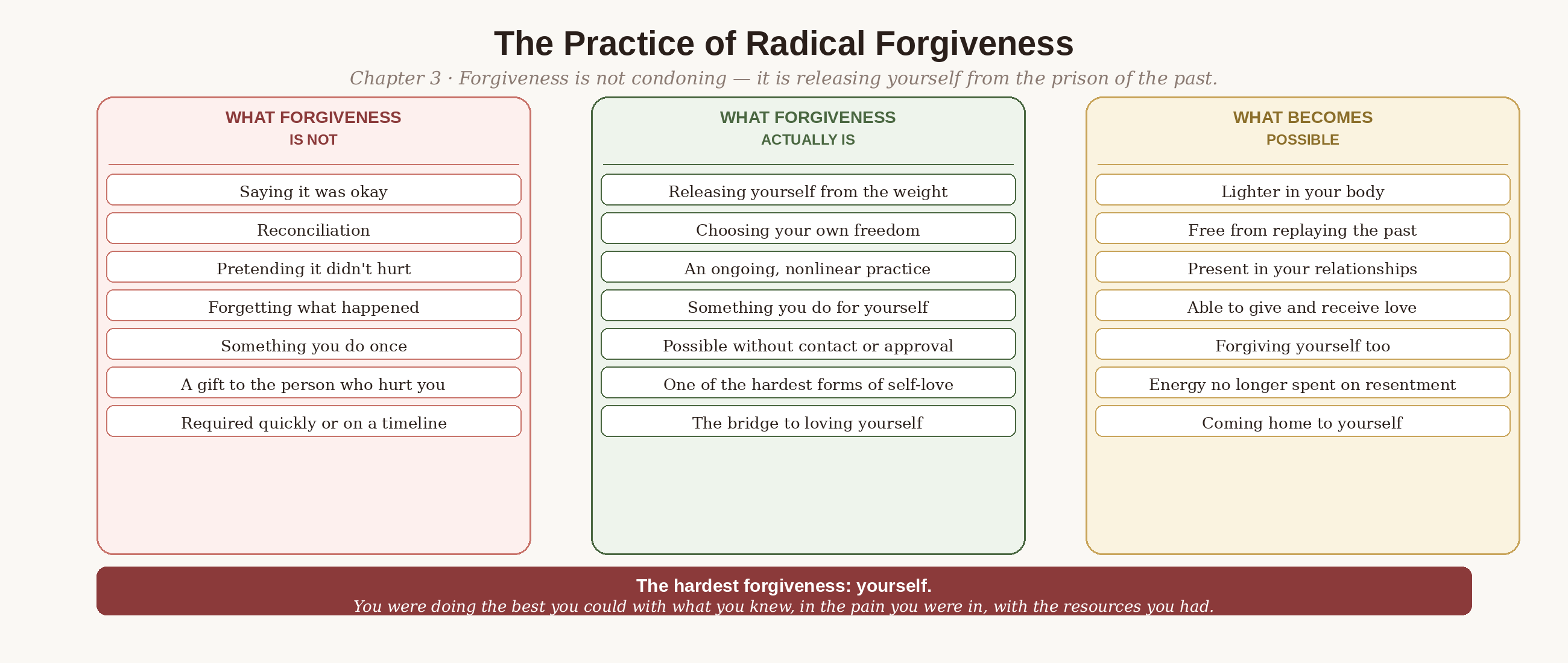
Forgiveness is not condoning. It is choosing your own freedom.
This is what unforgiveness does. We carry people, situations, hurts, and betrayals long after the moment has passed. We carry them in our bodies, in our thoughts, in the way we move through the world. And the weight grows heavier with each passing year.
Maybe you're carrying your parents' criticism from childhood. Maybe you're carrying a betrayal from a former friend. Maybe you're carrying your own mistakes—the things you said, the choices you made, the person you were when you didn't know better. Maybe you're carrying all of it, a lifetime of resentments and regrets, and you're so used to the weight that you've forgotten what it feels like to be free.
What Forgiveness Isn't
Before we talk about what forgiveness is, we need to be absolutely clear about what it isn't. Because there's so much misunderstanding around this word, so much pressure to forgive before we're ready, so many ways we've been taught to bypass our pain in the name of forgiveness.
Forgiveness is not saying what happened was okay. It's not minimizing your pain or pretending you weren't hurt. It's not excusing harmful behavior or letting people off the hook for their actions. If someone hurt you, that hurt was real. That hurt mattered. Forgiveness doesn't erase that truth.
Forgiveness is not reconciliation. You can forgive someone and never speak to them again. You can forgive someone and maintain firm boundaries. You can forgive someone and still remove them from your life. Forgiveness happens in your heart; reconciliation requires the other person to change. These are not the same thing.
Forgiveness is not forgetting. You don't need to develop amnesia about what happened. The experiences that hurt you are part of your story, and remembering them helps you protect yourself, make wiser choices, recognize patterns. "Forgive and forget" is a saying, not a requirement.
Forgiveness is not weakness. It doesn't mean you're a doormat or that you're letting people walk all over you. It doesn't mean you're naive or that you haven't learned from your experiences. In fact, forgiveness requires tremendous strength—the strength to feel your pain fully and still choose to release it.
Forgiveness is not something you do for the person who hurt you. This is crucial. You're not forgiving them to make them feel better or to give them peace. You're forgiving them because carrying resentment is poisoning your life, and you deserve to be free.
And perhaps most importantly, forgiveness is not a one-time event. It's not something you do once and check off your list. It's a practice, a choice you may need to make again and again, especially in the beginning. Some days you'll feel like you've forgiven. Other days the anger will surge back. Both are normal. Both are part of the process.
The Prison of Resentment
Here's what I learned the hard way: holding onto resentment is like drinking poison and expecting the other person to die.
The people we resent rarely know we're resenting them. And even if they do know, our resentment doesn't change them. It only changes us. It makes us bitter, guarded, unable to trust. It keeps us stuck in the past, reliving old hurts instead of creating new experiences. It narrows our world, closing us off from connection and joy because we're afraid of being hurt again.
Resentment is also exhausting. It takes energy to hold onto anger, to rehearse grievances, to maintain the walls we've built to protect ourselves. That energy could be used for creation, for love, for building the life we actually want. Instead, we spend it maintaining our hurt, tending to our wounds, keeping alive the very thing that's killing us.
And here's the cruelest part: the longer we hold onto resentment, the more it becomes part of our identity. We become "the person whose father never supported them" or "the person who was betrayed" or "the person who can't trust anyone." The hurt becomes so familiar that we don't know who we'd be without it. Letting it go feels dangerous, like losing a part of ourselves.
But what we're actually losing is the wounded part. The part that's been frozen in time, still living in that old moment. And what we gain is ourselves—free, whole, able to move forward.
The Courage to Feel It All
Before you can forgive, you have to feel. This is where a lot of teachings on forgiveness go wrong. They want you to skip over the anger, the hurt, the rage, and jump straight to compassion and understanding. But forgiveness that bypasses genuine feeling isn't forgiveness—it's spiritual bypassing. It's pretending you're okay when you're not. And it doesn't work.
You have to let yourself be angry. You have to let yourself grieve what you lost, what was taken from you, what you deserved but never received. You have to feel the full weight of the betrayal, the abandonment, the harm. You have to stop making it smaller than it was, stop minimizing your pain to make others comfortable.
This is the work that comes before forgiveness. You have to honor your pain. You have to give it space. You have to stop rushing yourself to "get over it" or "move on" before you've actually processed what happened. Because unfelt emotions don't disappear. They just go underground, where they leak into everything—your relationships, your self-worth, your ability to trust and be vulnerable.
Feel it all. Rage, grief, disappointment, betrayal—whatever is there. Let it be messy. Let it be huge. Let it be exactly what it is. This isn't self-indulgence; it's self-honoring. This is you taking your own experience seriously, treating your pain as valid, refusing to minimize what you've been through.
And only after you've felt it, only after you've let the wave of emotion move through you, can you begin to consider forgiveness.
Forgiving Others: Releasing the Grip
Once you've honored your pain, once you've let yourself feel the full weight of what was done to you, you can begin the work of forgiveness. And it starts with a question: Are you willing to put down what you've been carrying?
Notice I said "willing," not "able." You might not feel able yet. You might not know how. But are you willing? Is there a part of you, even a small part, that's tired of carrying this weight? That wants to be free?
If the answer is yes—even a tentative, uncertain yes—that's enough to begin.
Forgiving others doesn't mean you're saying what they did was okay. It means you're choosing to release the grip that resentment has on your life. You're choosing to stop letting their actions continue to harm you. You're choosing freedom over being right.
This is where understanding can help, but only after you've felt your feelings. When you can look at the people who hurt you and see them as flawed humans—wounded themselves, doing the best they could with limited tools—it becomes a little easier to put down the anger. Not because they deserve your forgiveness, but because you deserve peace.
Your father who criticized you was probably criticized himself. He was probably taught that love means pushing people to succeed, that affection makes people soft. He probably never learned how to express warmth without it feeling vulnerable and dangerous. This doesn't make his criticism okay. But it helps you see that it wasn't really about you. It was about his limitations, his fears, his own unhealed wounds.
Your partner who betrayed you was probably acting out their own pain, their own fear of intimacy, their own unaddressed trauma. This doesn't excuse the betrayal. But it helps you stop personalizing it, stop making it mean something about your worthiness of love.
The friend who abandoned you when you needed them most probably didn't have the capacity to show up. Maybe they were overwhelmed by their own life. Maybe they didn't know how to be present with pain. Maybe your need triggered their own unprocessed wounds. This doesn't make their absence okay. But it helps you see that people can only give what they have.
Understanding context doesn't erase harm. But it can soften the sharp edges enough that you can begin to release your grip.
Forgiveness is saying: "What you did hurt me. It wasn't okay. I deserved better. And I'm choosing to release you from my heart not because you've earned it, but because I refuse to let what you did continue to poison my life. I'm setting you down. I'm walking forward. You don't get to live rent-free in my mind anymore."
This doesn't happen all at once. You might need to forgive someone a hundred times before it sticks. You might have days where you think you've forgiven them, and then something triggers the memory and the anger floods back. That's normal. Forgiveness is a practice, not a destination. Each time you choose it again, it gets a little easier.
The Hardest Forgiveness: Yourself
But here's what I've learned in my own journey and through working with others: the hardest person to forgive is often yourself.
We carry our own mistakes like scarlet letters. The relationships we ruined. The opportunities we squandered. The people we hurt. The times we didn't show up. The versions of ourselves we're ashamed of. We replay these moments endlessly, each replay digging the groove of shame deeper.
"How could I have been so stupid?" "Why didn't I see it coming?" "I should have known better." "I can't believe I did that." "I'll never forgive myself for..."
We hold ourselves to standards we'd never apply to anyone else. We show others compassion for their mistakes but offer ourselves only criticism. We understand when others fall short, but judge ourselves mercilessly for our own humanity.
I spent years berating myself for staying too long in a relationship that wasn't good for me. "How could you be so weak?" the voice in my head demanded. "Everyone could see she wasn't right for you. Why couldn't you?" I was so angry at myself for not being stronger, smarter, more self-aware. I carried that shame like a badge of failure.
It wasn't until my therapist asked a simple question that something shifted. She said, "What were you getting from that relationship that you needed at the time?"
I started to answer defensively, to say I wasn't getting anything, that's why it was so stupid to stay. But then I paused. And I realized: I was getting companionship when I felt desperately lonely. I was getting someone who showed up when my life felt chaotic. I was getting moments of tenderness when I felt unworthy of love. It wasn't healthy love. It wasn't sustainable. But at that time in my life, it was what I could receive. It was what I thought I deserved.
Understanding that didn't make my choices wise. But it made them human. It helped me see that I wasn't weak or stupid—I was wounded and trying to heal in the only ways I knew how. I was doing the best I could with the tools and awareness I had at the time.
And that's the key to self-forgiveness: understanding that you did the best you could with what you knew, with what you had, with who you were at that moment. You can't judge your past self with the wisdom you have now. That's not fair. Your past self didn't have access to your current understanding. They were working with limited information, unhealed wounds, and patterns they hadn't yet recognized.
Self-forgiveness is saying: "I made mistakes. I hurt people. I hurt myself. I wish I had done things differently. And I also recognize that I was doing the best I could with what I had at the time. I was surviving. I was trying. I was human. And I refuse to carry shame for being imperfect."
This doesn't mean you don't take responsibility for your actions. It doesn't mean you don't make amends where possible. It doesn't mean you don't learn and grow and commit to doing better. It means you extend to yourself the same grace you'd offer a dear friend who was struggling.
Making Peace with Your Choices
Part of self-forgiveness is making peace with the path you've taken. Not the path you wish you'd taken, not the path you think you should have taken, but the actual, messy, imperfect path that brought you here.
You might wish you'd left that job sooner, stood up for yourself more, chosen different partners, pursued different dreams. You might look back at your younger self and think, "If only you'd known then what you know now." But you didn't know. You couldn't have known. You can only see the lessons from the other side of having lived them.
Every choice you made—even the ones that look like mistakes now—taught you something. Every detour, every wrong turn, every seeming failure contributed to who you are today. The question isn't "Why did I make such bad choices?" The question is "What did I learn? How did those experiences shape me? What wisdom do I carry now because of what I lived through?"
I used to torture myself about the years I spent in a career that didn't fulfill me. "You wasted so much time," the inner critic said. "You could have been doing what you really loved." But those years taught me about showing up even when it's hard, about finding meaning in unexpected places, about the strength I had that I didn't know I possessed. Those years weren't wasted—they were necessary. I wasn't ready before then. I needed to learn what I learned.
Making peace with your choices means accepting that your life is what it is, not what you wish it had been. It means releasing the fantasy of the alternative path and fully inhabiting the one you're on. It means trusting that even the hard parts, even the parts you wish you could change, have value and meaning.
This isn't about being grateful for trauma or pretending everything happens for a reason. Some things that happen are just cruel and meaningless. But it is about choosing to extract meaning, choosing to grow, choosing to let your experiences shape you into someone wiser and more compassionate rather than someone bitter and closed off.
The Practice of Forgiveness
So how do you actually do this? How do you move from understanding that forgiveness might be helpful to actually feeling free?
It starts with a decision. Not a feeling—feelings come and go—but a decision. You decide that you want to be free more than you want to be right. You decide that you want peace more than you want revenge. You decide that you want to move forward more than you want to stay stuck in the past.
And then you begin the practice.
Sometimes it helps to write a letter you'll never send. Pour out everything you've never said—the anger, the hurt, the disappointment, all of it. Don't censor yourself. Let it be messy and raw and completely honest. And then, in the same letter or a separate one, write what you wish you'd received. Write the apology you never got, the acknowledgment you deserved. Give yourself what the other person couldn't give you.
Some people find it helpful to have a conversation in their imagination. Sit across from an empty chair and imagine the person who hurt you sitting there. Tell them everything you need to say. And then sit in the other chair and respond as them—not as they probably would respond, but as the wisest, most healed version of them might. Let them say the things you needed to hear. Let them take responsibility. Let them acknowledge your pain.
This might sound silly, but it's powerful. You're not waiting for the other person to give you closure. You're giving it to yourself.
Others find ritual helpful. Write what you're forgiving on paper and burn it, watching it transform to ash. Carry a stone representing your resentment and then throw it into a river, letting it be carried away. Create some physical act that represents putting down what you've been carrying.
And some people simply practice saying it: "I forgive you. I release you. I set us both free." Say it out loud, even if you don't fully believe it yet. Say it as a prayer, as an intention, as a commitment to your own healing. Say it until the words stop feeling foreign and start feeling true.
Forgiveness as an Ongoing Practice
Here's what I wish someone had told me earlier: forgiveness isn't a one-time event. It's not something you do once and then it's done. It's a practice you return to again and again.
You might forgive someone and truly feel at peace. And then months later, something will remind you of what they did, and the anger comes flooding back. This doesn't mean you didn't really forgive them. It means you're human. It means the wound is deep. It means you need to forgive them again.
Think of forgiveness like washing dishes. You don't wash them once and then they're clean forever. You wash them, use them, and then wash them again. Each time you choose forgiveness, you're washing away the residue of resentment. Each time you release the grip of anger, you're creating a little more space for peace.
Some wounds require daily forgiveness. Some require hourly forgiveness. And that's okay. You're not failing. You're practicing.
What Freedom Feels Like
When you finally release the weight of resentment, when you genuinely forgive—whether it's others or yourself—there's a lightness that's hard to describe.
It's not that the past disappears or that the hurt never happened. It's that it no longer has a grip on you. You can remember without being pulled back into that moment. You can acknowledge what happened without it defining you. You can see the people who hurt you without needing anything from them—not an apology, not acknowledgment, not revenge. You're free because you've stopped waiting for them to give you something they may never be able to give.
When I finally forgave myself for the years I spent believing I was unlovable, when I finally stopped punishing myself for my past mistakes and choices, something in me softened. I could look in the mirror with kindness. I could make mistakes without it triggering a shame spiral. I could be imperfect and still feel worthy.
The energy I'd been using to maintain my resentment—toward myself and others—was suddenly available for other things. For creating. For connecting. For actually living instead of just surviving. I didn't realize how much energy it was taking to hold onto all that hurt until I put it down.
And perhaps most surprisingly, forgiveness made me stronger, not weaker. I wasn't walking around with all those open wounds anymore, so I wasn't as defensive. I could hear feedback without hearing attack. I could be vulnerable without feeling exposed. I could trust without being naive because I'd learned to trust myself first—to trust that I could handle whatever came, that I didn't need other people's behavior to be perfect for me to be okay.
This is the gift of forgiveness. Not that it erases the past or makes everything okay, but that it frees you to be fully present in your life. It lets you stop living in what was and start living in what is. It lets you stop being defined by your wounds and start being defined by your wholeness.
The Bridge to Self-Love
Forgiveness is the bridge between understanding your wounds and truly loving yourself. You can't love yourself while holding yourself hostage to your past. You can't embrace who you are while hating who you were. You can't be whole while rejecting pieces of your story.
Self-love requires that you forgive yourself for being human. For making mistakes. For not knowing better. For hurting others when you were hurt. For taking so long to learn lessons you wish you'd learned sooner. For all the ways you weren't perfect, weren't enlightened, weren't who you wish you'd been.
And self-love requires that you forgive others—not for their sake, but for yours. Because carrying resentment keeps you tethered to the past. It keeps you in relationship with people you may never see again. It keeps old wounds fresh instead of letting them heal.
When you forgive, you're saying: "I am larger than what happened to me. I am more than my wounds. I am not defined by how I was treated or what I've done. I am a whole person, complex and imperfect, worthy of love exactly as I am. And I refuse to let the past dictate my present any longer."
This is how forgiveness becomes an act of radical self-love. You're choosing yourself. You're choosing freedom. You're choosing to write the next chapter of your story instead of endlessly rereading the old ones.
You're coming home to yourself, piece by piece, memory by memory, wound by wound. And with each act of forgiveness, you're clearing the path a little more.
Your Forgiveness Journey
Allow 15–20 min. Bring a journal.
This practice will guide you through the process of forgiveness—both forgiving others and forgiving yourself. Go at your own pace. If any part feels too intense, pause. Come back to it when you're ready. Forgiveness can't be rushed.
Part One: Who Are You Carrying?
Find a quiet space. Take out your journal or some paper.
Make a list with two columns. In the first column, write down the names of people you're holding resentment toward. Don't censor yourself—if someone comes to mind, write them down. Parents, partners, friends, colleagues, acquaintances. Anyone.
In the second column, briefly note what you're carrying about them. What did they do? What hurt? You don't need details—just enough to name it.
Now look at your list. Notice how it feels to see these names and hurts written down. Does your chest tighten? Does your jaw clench? Just notice.
Part Two: Honoring Your Anger
Choose one person from your list—maybe the one that brings up the strongest feeling right now.
Set a timer for 10 minutes. During this time, write a letter to them that you will never send. This is your space to be completely honest. Say everything you've never said. Express all the anger, hurt, betrayal, disappointment. Don't be nice. Don't be fair. Don't worry about their perspective. This is about you giving voice to your pain.
Write without stopping until the timer goes off. If you run out of things to say, keep writing anyway. Sometimes the deepest truths emerge when we push past the surface.
When you're done, take a few deep breaths. Notice how your body feels. Has anything shifted? Sometimes expressing anger can feel like a release. Sometimes it brings up more. Both are okay.
Part Three: The Letter You Wish You'd Received
Now, on a fresh page, write the response you wish you'd gotten from this person. Write the apology you deserved. Write them taking full responsibility. Write them acknowledging your pain, validating your feelings, expressing genuine remorse.
Write them saying everything you needed to hear—everything that would have made it better, everything that would have helped you heal.
This might feel uncomfortable. "But they didn't say these things," you might think. "They probably never will." That's okay. You're not waiting for them anymore. You're giving yourself what they couldn't give you.
Part Four: The Decision to Release
Read both letters—the one expressing your anger and the one you wish you'd received.
Now ask yourself honestly: Are you willing to put this down? Not "Have you put it down?" or "Have they earned your forgiveness?" but simply: Are you willing?
If the answer is no, that's okay. Honor that. Maybe you're not ready yet. Maybe you need more time to feel your feelings. Maybe this person is still actively harming you and forgiveness right now would be premature. Listen to your truth.
If the answer is yes—even a tentative yes—write this statement:
Say it out loud. Feel the words in your mouth. Notice what happens in your body when you say them. Do they feel true? Do they feel like a lie? Do they feel like something you're growing into? All of these are fine.
If the words don't feel true yet, say them anyway. Say them as an intention, as a commitment to your healing, as a practice. "I am learning to forgive. I am willing to forgive. I choose to work toward forgiveness."
Part Five: Forgiving Yourself
Now it's time for the hardest part. Make a new list of things you're holding against yourself. Mistakes you've made. People you've hurt. Choices you regret. Times you disappointed yourself. Times you didn't live up to your own standards.
Write them all down. Be specific. Be honest.
Now, for each item on the list, complete this sentence: "At that time, what I needed was..." or "At that time, I was trying to..."
For example:
This isn't about making excuses. It's about understanding context. It's about seeing your past self with compassion instead of contempt.
Part Six: A Letter to Your Past Self
Choose one item from your list—perhaps the one you've judged yourself most harshly for.
Write a letter to the version of yourself who made that choice, who did that thing. Write from your current self to your past self with all the compassion you can muster.
Tell them what they needed to hear. Tell them you understand. Tell them they were doing their best. Tell them they're forgiven. Tell them they're still worthy of love despite their mistakes.
This might make you cry. Let it.
Part Seven: Your Forgiveness Practice
For the next 30 days, begin each morning by saying out loud:
Each time you catch yourself in self-criticism, pause and ask: "How old do I feel right now?" Then say to that part of yourself: "I forgive you. I love you. You're doing your best."
Keep your list somewhere accessible. As you work through forgiving others and yourself, you might notice the grip loosening. Some items might fall away naturally. Others might require regular, repeated forgiveness. That's the practice.
Part Eight: The Ritual of Release
When you feel ready—it might be days or weeks from now—create a small ritual to mark your commitment to forgiveness.
This might be:
Burning your letters and watching the smoke carry away what you're releasing
Tearing them into tiny pieces and burying them or throwing them into water
Creating a piece of art that represents forgiveness
Planting something that symbolizes your new growth
Make it meaningful to you. Make it mark this moment of choosing freedom.
In the next chapter, we'll explore how to befriend your body—perhaps the relationship most in need of healing and forgiveness for many of us. We'll discover how to treat your body with the reverence it deserves, not as an enemy to control but as a home to cherish.
The forgiveness is unfolding. You're releasing what's been holding you back. Trust this process. Trust yourself.