The Body You've Been Fighting
There's a particular cruelty in the way we've been taught to relate to our bodies. We're told to love ourselves while simultaneously being sold endless products and programs to "fix" what's supposedly wrong with us. The message is clear: your body is a problem that needs solving, an enemy to be conquered, a project that requires constant optimization.
For some of us, the war with our bodies started early. Maybe you were the chubby kid, the scrawny kid, the tall awkward one, the short one, the one whose body developed differently or at a different pace than others. Maybe you learned that bodies are something to be ashamed of, hidden, controlled. Maybe you learned that your worth was tied to how your body looked, how it performed, what it could do.
For others, the battle began later—after injury, after illness, after aging, after trauma. After the body stopped cooperating with our demands, stopped looking the way we wanted, stopped functioning the way it once did.
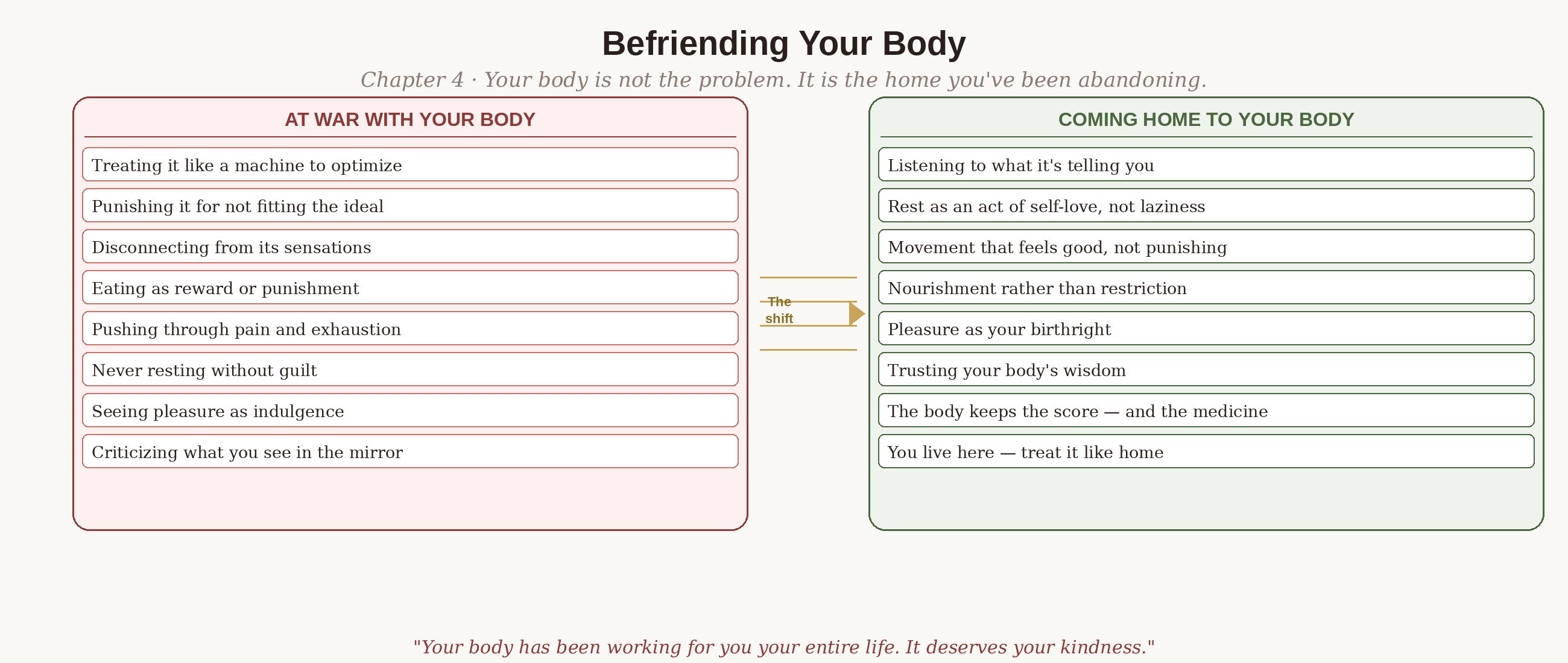
Your body has been working for you your entire life. It deserves your kindness.
And for many of us, we've never actually been at peace with our bodies. We've spent our entire lives treating them as objects to be managed rather than homes to be cherished. We've pushed through pain, ignored signals, demanded performance without rest or care. We've criticized every perceived flaw, mourned every change, resented every limitation.
I spent decades at war with my body. I pushed it to perform, criticized its appearance, ignored its needs. I treated it like a machine that should run without maintenance, like an enemy that needed to be controlled. The idea of actually befriending my body, of treating it with tenderness and respect, felt foreign. Weak, even.
But here's what I've learned: you cannot truly love yourself while hating your body. Your body isn't separate from you—it is you. The war you're waging against your body is a war against yourself. And here's the truth that the diet industry, the fitness industry, and yes, much of the self-help industry doesn't want you to know: your body doesn't need to be fixed. It needs to be befriended.
The Messages We've Absorbed
The war with our bodies didn't start with us. We inherited it. We learned it from a culture that profits from our insecurity, from systems that teach us our bodies are never quite right as they are.
We learned that certain bodies are valuable and others aren't. That thin is better, that muscular is powerful, that tall is desirable, that young is beautiful, that able-bodied is the standard. We learned that our bodies need to be controlled, disciplined, perfected. That natural processes like aging, gaining weight, developing wrinkles, or losing hair are failures rather than simply being human.
Men, we learned that our bodies are tools. We're supposed to be strong, capable, impervious to pain. We learned to push through discomfort, to ignore our body's signals, to treat exhaustion as weakness. "Man up." "Walk it off." "Don't be soft." We learned that caring about our appearance is vain, but that we should still somehow be muscular and fit. We learned that our bodies exist to perform, to provide, to protect—not to be felt, not to be tender with, not to actually live in.
Women, you learned that your bodies are objects. That your worth is tied to how you look, how much space you take up, how closely you match impossible standards. You learned that your body's natural processes—menstruation, pregnancy, menopause, aging—are problems to be hidden or solved. You learned to constantly monitor how you look, to shrink yourself, to make yourself palatable. You learned that your body isn't really yours—it's subject to everyone else's opinions, judgments, and entitlement.
All of us, regardless of gender, learned that bodies are something to transcend rather than inhabit. That being "in your head" is somehow more evolved than being "in your body." That physical sensation, physical pleasure, physical need are base and unimportant compared to mental achievement.
We learned to override our body's signals. To eat when we're not hungry, to not eat when we are. To stay awake when we're exhausted. To sit still when we need to move. To be quiet when we want to scream. To numb ourselves when feelings become too intense.
And underneath all of this, many of us carry specific wounds. Bodies that were violated, hurt, shamed. Bodies that experienced trauma and never felt safe again. Bodies that carry the memory of pain, of being touched without consent, of being hit or harmed. Bodies that learned very early that the world isn't safe, that being in a body means being vulnerable to harm.
Is it any wonder we're at war with our bodies? Is it any wonder we struggle to treat them with love?
Your Body as Home
But here's the truth that our culture doesn't want you to know: your body is not your enemy. It's not a problem to be solved or a machine to be optimized. Your body is your home. It's the only home you'll ever truly have.
Your body has carried you through everything you've survived. Every heartbreak, every disappointment, every moment of joy, every achievement—your body was there. When you were terrified, your body held you. When you were grieving, your body contained your tears. When you were celebrating, your body felt the joy.
Your body is not working against you. Even when it hurts, even when it's sick, even when it doesn't look or function the way you want—it's doing its absolute best to keep you alive. Your heart beats without you telling it to. Your lungs breathe. Your immune system fights off countless threats you never even know about. Your body is working tirelessly on your behalf, every single moment.
Think about that. Right now, as you're reading this, your body is performing millions of functions to keep you alive. It's pumping blood, filtering toxins, healing cuts, fighting off germs, digesting food, generating energy. It's doing all of this without your conscious effort, without your permission, without praise or acknowledgment.
And how do we repay this incredible gift? By criticizing it. By demanding it look different. By ignoring its needs. By treating it like an enemy.
What would it mean to treat your body like the miracle it is? What would it mean to treat it like home?
The Body Keeps the Score
There's a reason the phrase "the body keeps the score" has resonated with so many people. Our bodies hold our history. They remember what we try to forget. They carry the weight of unprocessed trauma, unspoken emotions, unhealed wounds.
That tension in your shoulders? It might be years of carrying stress you never released. That tightness in your chest? It might be grief you never let yourself fully feel. That pain in your back? It might be the weight of responsibility you've been carrying alone.
Our bodies speak to us constantly. But we've learned not to listen. We've learned to override the signals, to push through the discomfort, to medicate the symptoms without addressing the cause.
We numb ourselves with food, with alcohol, with endless distraction. We push ourselves past exhaustion because rest feels like failure. We ignore pain until it becomes unbearable. We treat our body's signals as inconveniences rather than as vital information.
But our bodies are wise. They know things our minds want to deny. They know when we're in danger even when we tell ourselves everything is fine. They know when we need rest even when we insist we can keep going. They know when we're holding onto emotions we need to release.
Learning to befriend your body means learning to listen to it again. To trust its signals. To honor its needs. To recognize that physical sensation carries information, not just inconvenience.
When your body tenses up around a certain person, that's information. When your body relaxes in certain environments, that's information. When your body craves rest or movement or touch or solitude—that's information. Your body is always communicating. The question is: are you listening?
The Specific Battles
For those of us who are men, the war with our bodies often centers on strength and control. We learned that showing physical weakness is showing character weakness. We learned to push through pain, to never admit when we're hurt, to treat our bodies like machines that should perform regardless of how we feel.
Maybe you've pushed yourself past injury because admitting you need rest felt like failure. Maybe you've ignored chronic pain because acknowledging it felt weak. Maybe you've numbed emotions with work, with exercise, with alcohol because feeling them in your body felt dangerous.
Many men carry their bodies with a kind of rigid control—shoulders back, chest out, jaw tight, ready for threat. We learned to be vigilant, to take up space in a way that says "don't mess with me," to armor ourselves against vulnerability. Our bodies become weapons or shields rather than places we actually live.
And if you've served in the military, experienced combat, or worked in high-stress environments, this is amplified. Your body learned to be constantly alert, constantly ready, never fully safe. That hypervigilance served you when threat was real. But it's exhausting to carry it when threat has passed.
For those who are women, the war often centers on appearance and size. You learned that your body is never quite right—always too much or not enough. Too fat or too thin. Too curvy or not curvy enough. Too tall, too short, too this, too that. You learned to constantly monitor how you look, to shrink yourself, to take up less space.
Maybe you've spent decades dieting, constantly trying to change your body into something more acceptable. Maybe you've developed complicated relationships with food and eating. Maybe you've learned to dress to hide rather than to express. Maybe you've internalized the male gaze so deeply that you can't even see yourself without evaluating how you'd be judged.
And for all of us, regardless of gender, if you've experienced trauma—physical abuse, sexual violence, serious illness, injury—your relationship with your body carries that weight. Your body might not feel safe. It might feel like a site of pain rather than a home. It might feel like something that was taken from you, violated, broken.
Befriending a body that has been hurt is complex work. It requires patience and often professional support. But it's possible. Your body is not ruined. It's not broken beyond repair. It survived. And it deserves your compassion, not your contempt.
Coming Back to Your Body
Befriending your body isn't about achieving some perfect relationship where you love how you look every single day. It's not about never feeling frustrated with limitations or pain. It's not another program to follow or another standard to meet. It's about fundamentally shifting from seeing your body as a problem to be fixed to seeing it as a home to be honored. From treating it as an object to experiencing it as yourself.
This shift starts with presence. With actually being in your body rather than just living in your head. For many of us, we spend most of our lives dissociated from our bodies. We live from the neck up, treating our bodies as vehicles that carry our heads around. We're so in our thoughts, in our plans, in our worries, that we're barely present in our physical experience.
Coming back to your body means noticing physical sensation without judgment. The feeling of your feet on the ground. The rise and fall of your breath. The temperature of the air on your skin. The sensation of your clothes, the beating of your heart, the movement of your muscles.
It means checking in throughout the day: How does my body feel right now? Not "what do I think about my body" but "what am I feeling in my body?" Tightness, ease, hunger, fullness, tension, relaxation, pain, pleasure, energy, fatigue.
It means beginning to honor your body's needs instead of constantly overriding them. Resting when you're tired instead of pushing through. Eating when you're hungry and stopping when you're satisfied. Moving when you need movement. Being still when you need stillness.
It means speaking to your body differently. Not "Why can't you look better?" but "Thank you for carrying me." Not "You're broken" but "You're doing your best." Not "You're my enemy" but "You're my home."
The Practice of Embodiment
Embodiment—actually living in your body rather than just thinking about it—is a practice. It doesn't happen all at once. It happens through small, repeated moments of presence and choice.
It happens when you pause during a stressful day and take three deep breaths, feeling your lungs expand and contract. It happens when you eat a meal slowly, actually tasting the food, noticing the textures and flavors. It happens when you move your body in ways that feel good rather than punishing—stretching, walking, dancing, whatever brings a sense of aliveness.
It happens when you notice tension and consciously release it. When you feel emotion and let it move through your body rather than pushing it down. When you honor your need for rest, for touch, for solitude, for movement—whatever your body is asking for.
For some, embodiment practices look like yoga, tai chi, martial arts, or dance—movement practices that require presence and body awareness. For others, it's mindful walking, swimming, gardening, or any activity that brings you into physical presence.
For many men especially, reconnecting with the body requires allowing softness. Allowing vulnerability. Allowing sensation without immediately having to do something about it or control it. It requires releasing the armor, even just for moments, and experiencing what it's like to be in a body that doesn't have to be ready for threat.
This might mean allowing yourself to cry when you're sad—actually feeling the physical release of tears rather than swallowing them down. It might mean allowing yourself to feel fear or tenderness without labeling it as weakness. It might mean discovering that being present in your body includes a range of sensations you've been taught to suppress.
Your Body's Wisdom
As you begin to befriend your body, you might discover something surprising: your body is wise. It knows things. It has intelligence that your mind doesn't.
Your body knows when you're around someone who isn't safe, even when your mind wants to give them the benefit of the doubt. It knows when you're in the wrong job, the wrong relationship, the wrong situation—even when logically everything looks fine.
Your body knows what it needs for healing. When you're exhausted, it tells you to rest. When you're depleted, it tells you what kind of nourishment you need. When you're holding emotions you need to release, it creates tension or pain or restlessness.
Learning to trust your body's wisdom means learning to feel again. To let physical sensation inform your decisions. To honor gut feelings and instincts that don't always make logical sense but turn out to be accurate.
It means asking your body questions and listening for the answers. Not "What do I think about this?" but "How does my body feel when I consider this option?" Does it feel expansive or contracted? Relaxed or tense? Open or closed?
Your body will tell you the truth if you learn to listen. It doesn't lie the way your mind can. It doesn't rationalize or justify or make excuses. It just feels. And that feeling is information.
Healing the Wounds Your Body Carries
If your body has been hurt—through abuse, trauma, violence, violation—befriending it requires gentle, patient work. You can't rush this. You can't force yourself to feel safe before you actually do. And you especially can't shame yourself for not being "healed" yet, as if your trauma response is just another thing about you that needs fixing.
Healing often requires professional support—therapists trained in somatic work, bodywork practitioners who understand trauma, communities where you can safely be in your body with others. This isn't work you have to do alone, and needing support doesn't mean you're broken.
But even as you're doing that deeper work, you can begin now to treat your body with the compassion it deserves. To recognize that your body survived. That it protected you as best it could. That the ways it learned to hold tension, to freeze, to shut down, to armor itself—these were brilliant survival strategies, not flaws that need correcting.
Your body isn't broken. It's wounded, yes. It carries pain, yes. But it's also incredibly resilient. It's already healing. Every time you choose presence over dissociation, every time you choose gentleness over criticism, every time you choose to honor your body's needs—you're participating in that healing.
Healing doesn't mean the pain disappears. It doesn't mean your body will be exactly as it was before. It means you stop being at war with your body for what it's been through. It means you stop blaming it for being hurt. It means you recognize that your body is not the problem—the harm that was done to it was the problem. And you don't need to fix what was never broken in the first place.
Movement as Medicine
One of the most powerful ways to befriend your body is through movement. Not punishing exercise designed to "fix" your body or compensate for what you ate. Not movement that comes with shame or obligation. But movement that feels good, that brings aliveness, that reconnects you with the joy of having a body.
This might be dancing alone in your living room. It might be walking in nature. It might be swimming, stretching, playing a sport you loved as a kid. It might be gentle movement practices like yoga or tai chi. It might be strength training where you marvel at what your body can do rather than using it as punishment for not being good enough yet.
The key is finding movement that feels like a celebration of your body rather than a punishment for it. Movement that makes you feel more alive in your skin. Movement that brings pleasure or peace or a sense of capability—not movement that you force yourself through because you believe your body needs correcting.
For many of us, especially if we've been taught that our bodies are problems, reclaiming joyful movement is radical. We've made exercise about calories burned or muscles built or weight lost. We've forgotten that movement can be play. That it can be about feeling good in the moment, not achieving some future result.
Watch children move. They don't exercise—they play. They run because running feels good. They jump because jumping is fun. They spin until they're dizzy and laugh about it. They're in their bodies without self-consciousness, without agenda, without judgment.
What would it mean to move like that again? To move for the sheer pleasure of having a body that can move?
Nourishment, Not Punishment
The same shift applies to how we feed our bodies. So many of us have complicated, painful relationships with food. We use it to punish or reward ourselves. We restrict it or binge on it. We count calories and macros and points, turning every meal into a math problem rather than nourishment.
Befriending your body means learning to feed it with kindness. To eat food that nourishes and also brings pleasure. To listen to your body's hunger and fullness cues rather than external rules about what and when and how much you should eat.
This doesn't mean never eating foods you've labeled as "bad." It means releasing the morality we've attached to eating. Food isn't good or bad. You're not good or bad based on what you eat. Food is just food—fuel and pleasure and culture and connection.
It means eating when you're hungry, stopping when you're full, and not making it more complicated than that. It means noticing how different foods make you feel and honoring that information. It means allowing yourself to enjoy eating rather than approaching every meal with anxiety or guilt.
For many people, healing their relationship with food requires professional help—nutritionists who understand intuitive eating, therapists who treat eating disorders, communities that support body liberation. If your relationship with food is painful, please seek support. You don't have to figure this out alone.
Rest as Resistance
In a culture that glorifies hustle and productivity, rest is a radical act. Especially for men, who've been taught that rest is laziness, that pushing through exhaustion is strength, that worth comes from constant doing.
But your body needs rest. It needs sleep—real, sufficient, quality sleep. It needs breaks throughout the day. It needs downtime that isn't productive, that doesn't accomplish anything except allowing your nervous system to settle.
Rest is when your body heals. It's when your brain consolidates memories and processes emotions. It's when your muscles repair and your immune system strengthens. Rest isn't optional—it's essential. And treating it as a luxury you can't afford is treating your body with contempt rather than care.
Learning to rest without guilt is part of befriending your body. It means recognizing that you're a human being, not a machine. That you have limits, and honoring those limits is wisdom, not weakness. That your worth isn't determined by your productivity.
It means creating space in your life for genuine rest—not just collapse after pushing yourself too hard, but intentional, restorative rest. Time when you do nothing. Time when you just be. Time when your body can fully relax because it's not being demanded to perform.
Pleasure as Birthright
One of the most revolutionary aspects of befriending your body is reclaiming pleasure. Many of us have learned that pleasure is frivolous, indulgent, something we don't deserve or shouldn't prioritize. We've learned to be suspicious of what feels good.
But pleasure is your birthright. Your body is designed to experience pleasure—the warmth of sunlight on your skin, the taste of delicious food, the feeling of being held, the satisfaction of a good stretch, the joy of moving to music you love.
Pleasure isn't something you have to earn. It's not a reward for good behavior or achievement. It's a fundamental part of being alive in a body.
Reclaiming pleasure means allowing yourself to notice and savor what feels good. The softness of your sheets. The smell of coffee. The feeling of warm water in a shower. The pleasure of your own touch, without it having to lead anywhere or mean anything.
It means recognizing that your body is not just a tool for accomplishing tasks—it's a site of experience, of sensation, of aliveness. And part of loving yourself is allowing yourself to feel good, to experience pleasure without shame or guilt.
Your Body, Your Home
At the end of the day, befriending your body is about coming home to yourself. It's about recognizing that you are not separate from your body—you are your body, and your body is you.
This body, with all its imperfections and limitations, with its scars and its pain, with its beauty and its strength—this is your home. The only one you'll ever have. And it deserves to be treated as such.
Not with violence or contempt. Not with constant criticism or impossible demands. But with the care and respect and tenderness you'd show any home you loved.
This doesn't mean you'll love every aspect of your body every day. It doesn't mean you won't have days when you're frustrated with pain or limitations. It doesn't mean you can't want to improve your health or change things about how you live in your body.
It means you stop treating your body as a problem that needs solving. You stop being at war with the very thing that keeps you alive. You stop believing that you need to earn the right to be kind to your body by first making it acceptable. You start treating it as it is—as your home, as yourself.
Because radical self-love isn't possible while you're treating your body like a project that will finally be complete when you reach some arbitrary standard. You can't love yourself while being at war with your body. The path to self-love requires befriending the body that carries you through this life—not in the future when it's "better," but right now, exactly as it is.
And it starts now. With this breath. With this moment of presence. With the simple choice to be kind to the body that has carried you this far. Not because it's perfect. Not because it's fixed. But because it's yours, and it's never needed fixing in the first place.
Befriending Your Body
Allow 15–20 min. Bring a journal.
This practice will help you begin to shift your relationship with your body from criticism to care, from enemy to ally, from object to home.
Part One: Body Inventory Without Judgment
Find a comfortable position—sitting or lying down. Close your eyes if that feels safe, or keep them softly focused on one spot.
Starting with your feet and moving up through your body, simply notice physical sensation. Not judging it, not trying to change it—just noticing.
What do your feet feel like? Your legs? Your hips, belly, chest, shoulders, arms, hands, neck, face?
Notice areas of tension, ease, pain, comfort, warmth, coolness. Just notice. If your mind starts judging ("My stomach is too big," "My shoulders are so tight"), gently return to simply noticing sensation.
This is about reclaiming presence in your body. About actually inhabiting it rather than thinking about it.
Part Two: Thank You, Body
Make a list of things your body does for you or has done for you. Not how it looks, but what it does. For example:
My heart beats without me telling it to
My body carried me through [a specific difficult time]
My legs let me walk
My hands let me create things
My body fought off illness
My lungs breathe even when I'm not paying attention
My body holds my emotions when they're too big
My senses let me experience the world
Write at least ten things. Let yourself feel genuine appreciation for your body's work.
Part Three: A Letter to Your Body
Write a letter to your body. Start with "Dear Body," and then speak to it honestly.
You might acknowledge the ways you've been at war with it: "I'm sorry I've criticized you so harshly. I'm sorry I've ignored your needs. I'm sorry I've treated you like an enemy."
You might acknowledge what it's been through: "Thank you for surviving [specific experiences]. Thank you for carrying me through the hardest times."
You might express your commitment: "I'm learning to treat you with kindness. I'm learning to listen to you. I'm learning to honor your needs."
Let it be honest. Let it be tender. This is a conversation between you and the home you've been living in.
Part Four: Body Scan for Needs
Several times throughout today, pause and ask your body what it needs right now. Not what your mind thinks it should need, but what your body is actually asking for.
Does it need:
Movement or rest?
Food or water?
Fresh air?
Touch (self-touch counts)?
To stretch or change position?
To release emotion (cry, scream into a pillow, shake it out)?
Warmth or coolness?
Honor at least one need each time you check in. Prove to your body that you're listening, that its needs matter.
Part Five: Pleasure Practice
Once a day for the next week, do something that brings your body pleasure. Not something that will change how it looks or improve its performance—just something that feels good.
This might be:
Taking a warm bath or shower and really savoring the sensation
Eating something delicious slowly, paying attention to every bite
Stretching in ways that feel satisfying
Getting a massage or doing self-massage
Dancing to music you love
Lying in the sun (safely)
Any form of touch that feels good to you
The point is to remind your body that it's not just a work machine—it's also a site of pleasure and aliveness.
Part Six: Movement as Play
Find one way to move your body this week that feels like play rather than punishment. Not to burn calories or build muscle, but because it brings joy.
Maybe it's:
Dancing wildly in your living room
Playing a sport you loved as a kid
Going for a walk somewhere beautiful
Swimming
Playing with a pet or child
Any movement that makes you smile
Notice how different this feels from "exercise." Notice what it's like to move because it feels good, not because you're trying to fix your body.
Part Seven: Daily Embodiment
Set three reminders on your phone throughout the day labeled simply "Come back to your body."
When they go off, wherever you are, pause and:
Take three deep breaths
Notice physical sensation (feet on ground, air on skin, etc.)
Release any obvious tension (drop your shoulders, unclench your jaw)
Ask: "What does my body need right now?"
This practice is about returning to presence again and again, training yourself to actually live in your body rather than just thinking about it.
Part Eight: Mirror Work
This one is challenging but powerful. Stand in front of a mirror (clothed or unclothed, whatever feels manageable).
Instead of immediately cataloging flaws, practice neutral observation. "I have eyes. I have shoulders. I have hands." Just noticing without judgment.
Then, looking yourself in the eyes, say out loud: "This body has carried me through everything I've survived. This body deserves my kindness. I'm learning to treat this body with love."
You might not believe it yet. Say it anyway. You're planting seeds.
In the next chapter, we'll explore the courage it takes to speak your truth and show up authentically in a world that often prefers we stay small and silent. We'll discover how self-love requires claiming your voice and expressing who you really are.
You're coming home to your body. You're ending the war. Trust this process. Trust yourself.