The Voice You've Been Swallowing
There's a question that haunts many of us: What would I say if I knew no one would judge me? What would I express if I wasn't afraid of the consequences? Who would I be if I stopped performing and started being honest?
For most of our lives, we've learned to edit ourselves. To say what's appropriate rather than what's true. To give the answer people want to hear rather than the one we actually mean. To smile and nod when we disagree. To stay quiet when we're hurt. To laugh at jokes that aren't funny. To pretend we're fine when we're falling apart.
We've learned to swallow our words, to bite our tongues, to keep the peace at the expense of our truth. We've learned that authenticity is risky, that honesty might cost us relationships, that speaking up might make us unlikable. So we've made ourselves small, made ourselves palatable, made ourselves whatever we think others need us to be.
And in the process, we've lost touch with our own voice.
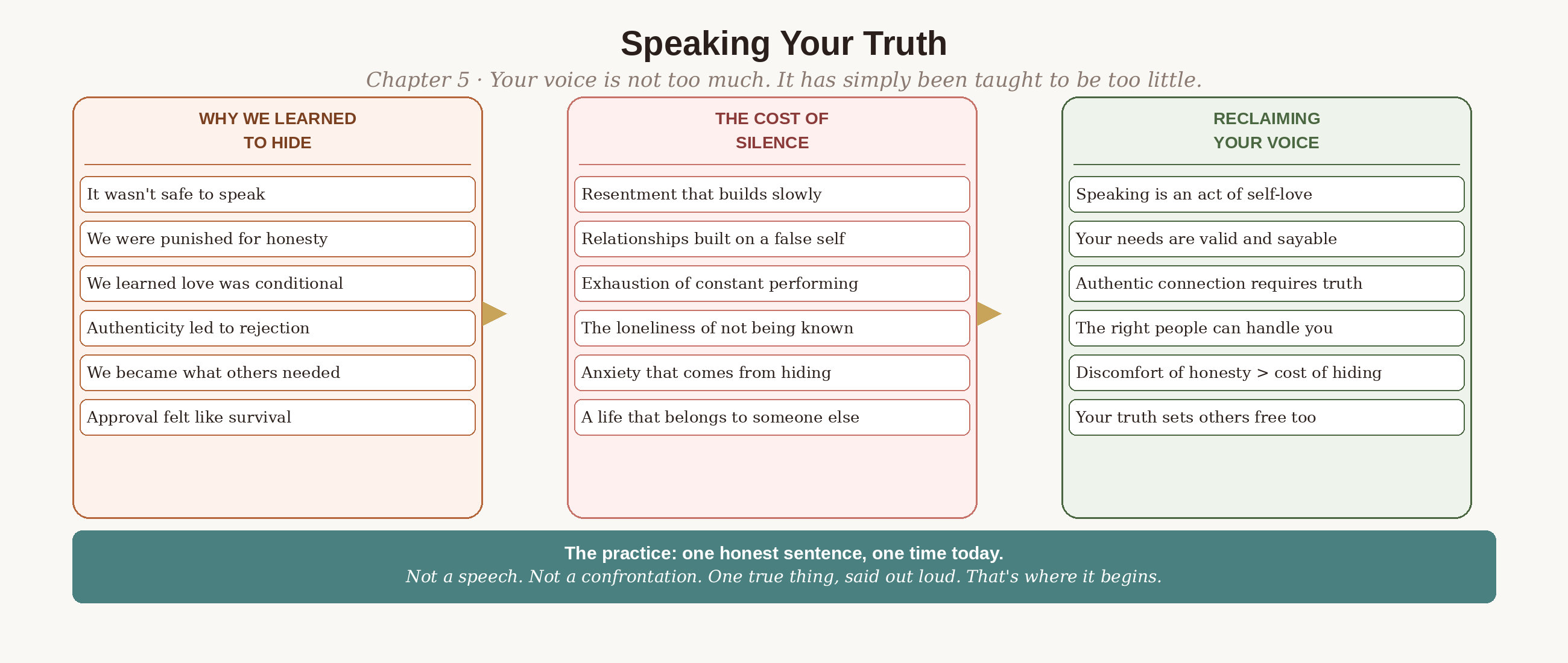
Your voice is not too much. It has simply been taught to be too little.
I spent years not knowing what I actually thought or felt about things because I was so practiced at gauging what others wanted to hear. I'd been trained since childhood to read the room, anticipate what response would be safest, and deliver that. My opinions were flexible, shaped by whoever I was talking to. My feelings were carefully curated to avoid making others uncomfortable.
When someone asked, "What do you think?" I'd pause—not to access my actual thoughts, but to figure out what they wanted me to think. When someone asked, "How are you?" I'd automatically say "fine" even when I was drowning. When someone asked what I wanted, I'd reflexively say "I don't care, whatever you want" because I'd learned that having preferences made me difficult.
I thought I was being easygoing, accommodating, kind. What I was actually being was invisible. I was performing a version of myself that was designed to never threaten, never challenge, never disrupt. And in doing so, I was betraying myself every single day.
The Price of Silence
Staying silent when you have something to say has a cost. Swallowing your truth doesn't make it disappear—it just makes it fester inside you. All those unsaid words, all those unexpressed feelings, all those swallowed truths—they don't evaporate. They take up residence in your body, in your psyche, in your sense of self.
They show up as resentment toward the people you can't be honest with. As a tightness in your throat or chest when you bite back words. As anxiety about being discovered as a fraud because you're constantly performing. As depression because you've disconnected from your authentic self so thoroughly that you don't know who you are anymore.
Silence when you want to speak creates a particular kind of pain. It's the pain of betraying yourself. Of knowing what you need to say and choosing safety over truth. Of watching yourself disappear a little more each time you swallow your words.
And here's what's insidious: we tell ourselves we're staying silent for good reasons. We're keeping the peace. We're being considerate. We're avoiding conflict. We're protecting the relationship. We're not making waves. We're being mature, evolved, enlightened.
But often, we're just being afraid. Afraid of rejection, of conflict, of being too much, of being judged, of standing out, of standing alone. And that fear keeps us trapped in a prison of our own making—a prison where we're safe from external judgment but dying from internal suffocation.
Sarah, a woman in one of my workshops, shared this: "I realized I'd spent forty years making myself easy to love by never having difficult feelings, never disagreeing, never having needs. I thought I was being a good partner, a good friend, a good daughter. But really, I was just being absent. The version of me people loved wasn't even real. It was a performance. And I was exhausted from holding up the mask."
She started crying as she continued, "The worst part is, I don't even know who I am underneath all that. I've been performing for so long, I've lost touch with what I actually think, feel, want. I'm terrified that if I stop performing, there's nothing real underneath."
This is what happens when we spend our lives swallowing our truth. We lose ourselves. And then we wonder why we feel so empty, so disconnected, so lonely even when we're surrounded by people. It's because the people around us don't actually know us. They know our performance. And we're starving for someone to see us—not realizing that we have to let ourselves be seen first.
Why We Learned to Hide
We didn't start out editing ourselves. As children, most of us were relatively unfiltered. We said what we thought, expressed what we felt, asked for what we wanted. We were authentic by default because we didn't yet know that authenticity could be dangerous.
But then we learned. Maybe we expressed anger and were punished for it, taught that our anger was bad, unacceptable, something to be ashamed of. Maybe we expressed sadness and were told to stop crying, to toughen up, that our sadness was weak or manipulative. Maybe we expressed joy and were told to calm down, to not be so loud, that our enthusiasm was too much.
Maybe we disagreed with our parents and learned that challenging authority led to consequences. Maybe we said no to something and learned that our boundaries made us difficult. Maybe we expressed a need and were made to feel like a burden.
For many boys and men, we learned that certain emotions weren't acceptable. Sadness was weakness. Fear was cowardice. Tenderness was feminine and therefore shameful. We learned that our emotional range was supposed to be narrow—anger was sometimes okay, but everything else needed to be swallowed. "Man up." "Boys don't cry." "Don't be a pussy." We learned to armor ourselves, to never let anyone see us vulnerable, to express nothing that could be used against us.
For many girls and women, you learned a different set of rules. Anger wasn't acceptable—it made you shrill, difficult, a bitch. Ambition made you selfish. Intelligence made you threatening. You learned to soften your opinions, to couch your disagreements in apologies, to make yourself smaller and sweeter and more palatable. You learned that being liked was more important than being heard.
All of us, regardless of gender, learned that authenticity came with risks. That being ourselves—fully, honestly, unapologetically—might cost us love, belonging, safety. So we adapted. We learned to perform. We learned to hide the parts of ourselves that seemed to make others uncomfortable. We learned to speak in ways that wouldn't threaten, wouldn't challenge, wouldn't disrupt.
And we became very, very good at it. So good that we forgot we were doing it. So good that the performance became indistinguishable from who we thought we were.
The Many Forms of Silence
Not speaking your truth takes many forms. It's not always dramatic silence in the face of injustice. Often it's much more subtle, much more everyday.
It's saying "I'm fine" when you're not fine. It's agreeing to plans you don't want to make because saying no feels too hard. It's laughing at jokes you don't find funny. It's letting people believe things about you that aren't true because correcting them feels awkward. It's not mentioning when someone hurts your feelings because you don't want to seem sensitive.
It's changing the subject when the conversation gets uncomfortable. It's editing your opinions to match whoever you're talking to. It's keeping secrets about who you really are because the truth feels too vulnerable. It's performing enthusiasm for things you don't care about and hiding passion for things you do because they seem weird or uncool.
It's accepting treatment you don't deserve because speaking up might make you difficult. It's staying in relationships—romantic, friendship, professional—that don't serve you because leaving would require you to say hard truths. It's living a life shaped by what you think you should want rather than what you actually want because admitting your real desires feels dangerous.
For many men, it's never admitting when you're struggling, when you're scared, when you need help. It's performing confidence you don't feel. It's pretending you have it all figured out when you're barely holding it together. It's staying silent about your mental health, your fears, your pain because admitting them would make you seem weak.
For many women, it's constantly apologizing for taking up space. It's prefacing your ideas with "This might be stupid, but..." It's shrinking your accomplishments so others don't feel threatened. It's not advocating for yourself because being assertive might make you unlikable.
All of these small silences, these daily self-betrayals, add up. They create a life where you're constantly performing, constantly editing, constantly not quite yourself. And over time, the gap between who you are and who you present yourself to be becomes a chasm you don't know how to cross.
Finding Your Voice Again
Speaking your truth—learning to be authentic after years of performing—is one of the most challenging and liberating aspects of self-love. It requires courage. It requires that you believe your truth matters more than others' comfort. It requires that you value being known over being liked.
And here's what's important to understand: finding your voice doesn't mean you have to share everything with everyone. It doesn't mean you can't have boundaries around what you share and with whom. It doesn't mean you need to process your feelings publicly or make every internal experience external.
What it means is that you stop reflexively editing yourself. You stop automatically swallowing your truth to keep the peace. You start checking in with yourself—"What do I actually think? What do I actually feel? What do I actually want?"—and you give yourself permission to honor those answers, even when they're inconvenient or uncomfortable.
It means you start speaking up when something doesn't feel right, even when it would be easier to stay quiet. You start saying no to things that don't serve you, even when saying yes would be more convenient for others. You start expressing your needs, your boundaries, your preferences—not aggressively, not demanding others accommodate you, but clearly and without apology.
It means you stop performing who you think people want you to be and start showing up as who you actually are. Messy, contradictory, evolving, imperfect—but real.
The first time I started doing this, it was terrifying. I remember being in a conversation where someone asked my opinion on something, and instead of gauging what they wanted to hear, I paused and actually checked in with myself. What did I think? And when I discovered my opinion was different from theirs, I felt that old familiar fear: If I disagree, they won't like me. If I'm honest, I'll be rejected.
But I was so tired of performing. So tired of betraying myself. So I took a breath and said what I actually thought, my heart pounding the whole time.
And you know what happened? They didn't reject me. They didn't attack me. They said, "Interesting, I hadn't thought about it that way," and we had an actual conversation. Not one where I was performing agreement, but one where two real people with different perspectives were engaging honestly.
It was such a small moment. But it cracked something open in me. I realized I'd been living in a prison of my own making, assuming that honesty would cost me everything, when really, it was silence that was costing me everything.
The Risk and Reward of Authenticity
Let me be honest: speaking your truth does carry risk. Not everyone will like it. Some people are invested in you staying small, staying quiet, staying the version of yourself that's most convenient for them. When you start showing up authentically, when you start having boundaries and opinions and needs, some people won't know what to do with that.
Some relationships might change or end. People who were comfortable with the performed version of you might be uncomfortable with the real version. And that's painful. It's scary. It's why so many of us stay silent—because the fear of loss feels overwhelming.
But here's what's also true: the relationships you lose by being yourself were never truly yours to begin with. They were relationships with your mask, with your performance, with the version of you that existed to make others comfortable. And maintaining those relationships required you to disappear.
The people who stay, the people who appreciate and even celebrate your authenticity—those are your people. Those are the relationships built on truth rather than performance. And those relationships, even if there are fewer of them, are infinitely more nourishing than a crowd of people who only know your mask.
More than that, speaking your truth creates space for others to do the same. When you show up authentically—messy, imperfect, honest—you give others permission to do the same. You create an environment where realness is possible. Where people can exhale and stop performing.
I've watched this happen again and again. Someone in a group musters the courage to be honest about their struggle, to admit they're not okay, to stop performing positivity. And it's like they've opened a door—suddenly others feel safe to be honest too. The whole dynamic shifts from performance to presence.
Your authenticity is a gift. Not just to yourself, but to everyone around you. It creates possibility. It models what's possible. It says, "You can be real here. You don't have to perform."
The Practice of Speaking Up
Learning to speak your truth is a practice. It doesn't happen all at once. You don't go from years of silence to complete authenticity overnight. It happens in small moments, in incremental choices, in gradually building the muscle of honest expression.
It starts with noticing when you're editing yourself. When you're about to say "I'm fine" when you're not fine, pause. When you're about to agree to something you don't want to do, pause. When you're about to swallow your opinion, pause. Just notice the impulse to hide, to perform, to stay silent.
You don't have to change it every time. Just notice it. Build awareness of how often you're not being authentic, how automatic the performance has become.
Then, start small. Find low-stakes situations to practice honesty. When someone asks if you want to go to a certain restaurant and you don't, say "Actually, I'm not in the mood for that. What about this other place?" When someone asks how you're doing and you're struggling, instead of automatic "fine," try "Honestly, I'm having a rough day."
Notice what happens in your body when you speak a small truth. Notice the fear that comes up. Notice that the catastrophe you imagined—rejection, abandonment, attack—often doesn't happen. Notice that most people can handle your honesty, that most people actually appreciate it.
As you build confidence, you can tackle bigger truths. You can have the hard conversations you've been avoiding. You can set boundaries you've been too afraid to set. You can express needs you've been suppressing. You can disagree with people you've been automatically agreeing with.
And yes, sometimes it will be uncomfortable. Sometimes people will be surprised or resistant or upset. But you're not responsible for managing everyone's reactions to your truth. You're responsible for honoring yourself.
Your Voice Is Not Too Much
One of the deepest fears many of us carry is that if we speak our truth, we'll be too much. Too loud, too opinionated, too demanding, too emotional, too sensitive, too intense, too difficult. We've internalized the message that we need to be less—less assertive, less honest, less visible, less ourselves.
But here's the truth: your voice is not too much. Your needs are not too much. Your feelings are not too much. You are not too much.
The people who tell you that you're too much, who need you to be smaller and quieter and more convenient—they're asking you to betray yourself for their comfort. And that's not love. That's not respect. That's not a relationship worth preserving at the cost of your authenticity.
The right people, the people who genuinely care about you, will not be threatened by your voice. They'll welcome it. They'll want to know what you really think, how you really feel, what you really need. They'll be relieved when you stop performing and start being real.
And for the people who can't handle your authenticity? That's information. That's them showing you who they are and what they can hold. And you get to decide whether that's a relationship you want to continue investing in.
Speaking your truth is not about being aggressive or disregarding others' feelings. It's about honoring yourself enough to stop disappearing. It's about showing up as a whole person rather than a fragment shaped by fear.
The Truth Will Set You Free
There's an old saying: "The truth will set you free." And it's true, but what they don't tell you is that first, it might make you uncomfortable. It might cost you some things. It might require you to have hard conversations and make difficult choices.
But the freedom on the other side is worth it.
The freedom of not having to remember what version of yourself you performed for which person. The freedom of not constantly monitoring yourself, editing yourself, second-guessing yourself. The freedom of knowing that the people in your life know the real you and choose you anyway.
The freedom of living in alignment with yourself rather than in constant conflict. The freedom of having your inner and outer worlds match. The freedom of being able to look in the mirror and recognize yourself.
When you speak your truth, when you show up authentically, you come home to yourself. And that homecoming, that integration, that wholeness—that's what self-love looks like in practice.
You cannot truly love yourself while living a lie. You cannot embrace yourself while hiding yourself. You cannot be whole while fragmenting yourself into acceptable and unacceptable pieces, showing some and hiding others.
Self-love requires that you honor your voice. That you speak your truth, even when it's scary. That you show up as yourself, even when it's uncomfortable. That you trust that being known is better than being universally liked.
Because the alternative—staying silent, staying small, staying safe—isn't actually safe at all. It's slow suffocation. It's dying while still breathing. It's the particular pain of never quite being yourself.
Speaking Your Truth Is Self-Love
Here's what I want you to understand: speaking your truth is not selfish. It's not aggressive. It's not demanding too much. It's one of the most fundamental acts of self-love there is.
Every time you speak up instead of staying silent, you're saying to yourself: "My voice matters." Every time you express a need instead of swallowing it, you're saying: "I deserve to have needs." Every time you set a boundary instead of accepting unacceptable treatment, you're saying: "I am worth protecting."
These are powerful messages to send yourself. And over time, they reshape how you see yourself. You start to believe that you matter. That your experience is valid. That you deserve to take up space.
And when you start to believe these things about yourself, everything changes. You start making different choices. You start attracting different people. You start creating a life that actually fits you rather than trying to fit yourself into a life shaped by others' expectations.
This is the work. Not fixing yourself, not improving yourself, not becoming someone more worthy of love. But honoring yourself enough to stop hiding. Trusting yourself enough to speak. Loving yourself enough to be seen.
Your voice has been there all along, underneath the performance, underneath the fear. It's been waiting for you to remember it, to reclaim it, to let it speak.
It's time.
Reclaiming Your Voice
Allow 15–20 min. Bring a journal.
This practice will help you reconnect with your authentic voice and begin the work of speaking your truth.
Part One: Voice Inventory
Take out your journal and complete these sentences as honestly as you can:
I stay silent when...
The last time I said "I'm fine" when I wasn't fine was...
I edit my opinions around...
I pretend to be okay with things that actually bother me when...
The truth I'm most afraid to speak is...
If I knew no one would judge me, I would say...
The part of myself I hide most is...
I say yes when I mean no when...
Don't censor yourself. This is just for you. Let yourself see clearly where you're performing and where you're hiding.
Part Two: What Would Your Younger Self Say?
Think back to yourself as a child, before you learned to edit yourself so carefully. What did that version of you say freely that you've learned to swallow?
Maybe you were more direct about your likes and dislikes. Maybe you asked for what you wanted without hesitation. Maybe you expressed anger or sadness or joy without self-consciousness.
Write a letter from that younger, more authentic version of yourself to your current self. What would they want you to know? What would they encourage you to say? What truth would they urge you to speak?
Part Three: The Low-Stakes Truth Practice
For the next week, commit to speaking one small truth each day in a low-stakes situation. These are truths that carry minimal risk but help you build the muscle of authenticity.
Examples:
When someone asks what you want for dinner, actually say your preference instead of "I don't care"
When someone asks how you are, give an honest answer instead of automatic "fine"
When you disagree with something minor in a conversation, say so instead of nodding along
When someone asks if you like something you don't, be honest instead of polite
When you need something, ask for it directly instead of hinting
Notice what happens in your body before, during, and after these small truths. Notice any catastrophic thinking ("If I say this, they'll hate me") and notice what actually happens (usually nothing catastrophic).
Part Four: The Unsent Letter
Think of someone you've been unable to be fully honest with. Someone you perform for. Someone you can't quite tell the truth to.
Write them a letter you'll never send. Say everything you've never said. All the ways they've hurt you that you've never mentioned. All the things you've wanted to tell them but haven't. All the truths you've swallowed to keep the peace.
Don't hold back. Be as honest, as angry, as sad, as whatever you actually feel. This letter is for you, not them.
When you're done, notice how it feels to have expressed these truths, even if only on paper. Some people choose to burn these letters as a ritual of release. Others keep them as a record of their truth. Do whatever feels right for you.
Part Five: Identifying Your Voice Triggers
Make a list of situations, people, or environments where you most lose touch with your authentic voice. Where do you find yourself most unable to speak your truth?
Maybe it's:
With family
At work
In romantic relationships
With certain friends
In groups vs. one-on-one
Around authority figures
When someone is upset with you
For each trigger, ask yourself: "What am I afraid will happen if I speak my truth here?" Write down the fear. Often just naming it helps defuse some of its power.
Part Six: The Body's Voice
Your body knows truths that your mind might deny. This week, pay attention to what your body tells you in situations where you're tempted to stay silent or perform.
When you're about to say "I'm fine" but you're not fine, what does your body feel like? Tightness in your throat? Tension in your chest? Heaviness?
When you're about to agree to something you don't want to do, what sensations arise? Contraction? A sinking feeling? Resistance?
Start trusting these physical signals as information. Your body often knows before your mind does that you're betraying yourself.
Part Seven: The Practice Statement
Create a simple statement you can use when you need to speak a truth but fear is making it hard. Something like:
Practice saying your chosen statement out loud when you're alone. Get comfortable with the words. Let your body get used to the act of beginning a hard conversation.
Then, this week, use it at least once. Have one hard conversation you've been avoiding. Say one truth you've been swallowing.
Part Eight: Celebrating Small Victories
At the end of each day this week, write down one moment when you spoke your truth, even in a small way. Acknowledge yourself for it. Notice that you survived. Notice that speaking truth, even when scary, is survivable.
Build a record of these small victories. They're evidence that you can do this. That your voice matters. That being authentic is possible.
In the next chapter, we'll explore the sacred practice of saying no—of setting boundaries that honor your needs and protect your energy. We'll discover that boundaries aren't walls that keep people out, but declarations of what you value and how you deserve to be treated.
Your voice is returning. Your truth is emerging. Trust this unfolding. Trust yourself.