The Boundary You're Afraid to Set
There's a boundary you know you need to set. You've known it for a while now—maybe weeks, maybe months, maybe years. It shows up in that tightness in your chest when your phone rings with a certain name. In the resentment that builds every time you say yes when you mean no. In the exhaustion that comes from constantly giving more than you have to give.
You know you need to set it. But you don't. Because setting boundaries feels dangerous. It feels selfish. It feels mean. You tell yourself you're being considerate, flexible, understanding. That good people don't have rigid boundaries. That love means sacrifice. That if you really cared about others, you'd be willing to stretch yourself, to accommodate, to put their needs before your own.
So you don't set the boundary. And every time you don't, you betray yourself a little more. Every time you say yes when you mean no, every time you allow treatment you don't deserve, every time you give more than you have—you're sending yourself a message: "Your needs don't matter. Your limits don't matter. You don't matter."
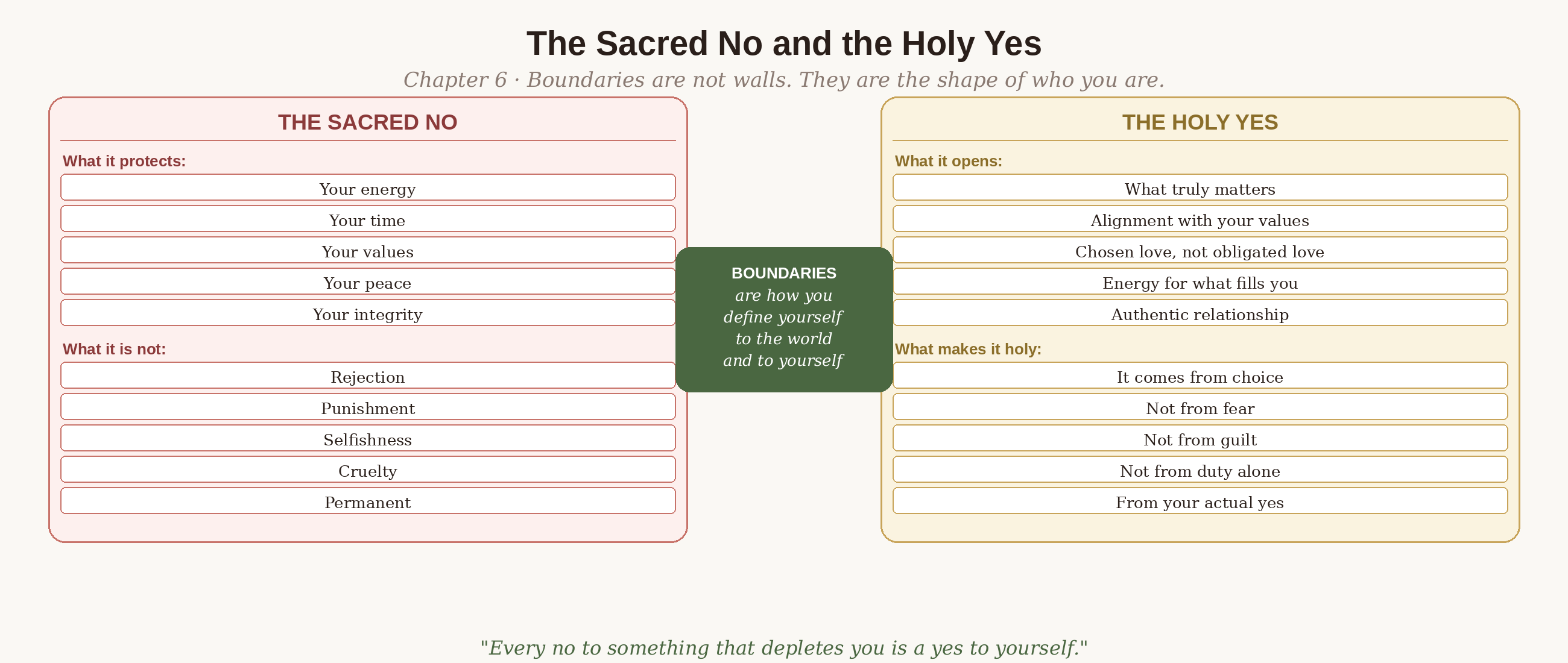
Every no to something that depletes you is a yes to yourself.
And over time, that message becomes your truth.
I spent decades without real boundaries. I said yes to everything, agreed to plans I didn't want to make, let people treat me in ways that hurt because saying something felt too confrontational. I thought I was being easygoing and kind. I thought boundaries were walls that kept people out, and I wanted to be open, available, loving.
What I didn't understand is that boundaries aren't walls. They're the architecture of self-respect. They're how you teach people how to treat you. They're how you honor your own needs, energy, and limits. And without them, you become a doormat—not out of love, but out of fear.
What Boundaries Actually Are
Let's start by clearing up what boundaries are and aren't, because there's so much confusion around this.
Boundaries are not about controlling other people's behavior. You can't make someone treat you a certain way. You can't force someone to respect you. Boundaries are about controlling your own behavior in response to others.
A boundary isn't "You have to stop calling me so much." That's a demand. A boundary is "I can't talk on the phone for more than 30 minutes" or "I'm not available to talk after 9pm." See the difference? One tries to control them. The other states your limit and what you'll do.
Boundaries are not about punishing people or pushing them away. They're about protecting your wellbeing, your energy, your peace. They're about creating the conditions under which you can actually be present and authentic rather than resentful and depleted.
Boundaries are not walls that keep everyone out. They're gates. They determine what you let in and what you keep out, what you're available for and what you're not, where you end and others begin.
A boundary is simply a statement of what is and isn't okay with you. It's information. "I'm not available to discuss this topic." "I need some alone time." "I don't lend money." "I'm not comfortable with that kind of joke." "I need advance notice before people visit." "I don't check work email after hours."
Boundaries can be physical (about your body, your space, your time), emotional (about what emotional labor you're willing to do), mental (about what topics you'll engage with), material (about your money and belongings), and spiritual (about your values and beliefs).
And here's what's crucial: boundaries are how you take care of yourself. They're not something you need when you're "healed enough" or "strong enough." They're not a luxury. They're essential. They're the foundation of any healthy relationship—including the one with yourself.
Why Boundaries Feel So Hard
If boundaries are so essential, why do so many of us struggle with them? Why does saying no feel like a personal failure? Why does protecting our needs feel selfish?
We learned early that boundaries come with consequences. Maybe when you said no as a child, you were punished, shamed, or told you were selfish. Maybe when you had needs, you were made to feel like a burden. Maybe when you expressed limits, you were told you were difficult, inflexible, not a team player.
Many of us learned that love is conditional—that to be loved, we need to be accommodating, available, endless in our capacity to give. We learned that good people don't have boundaries. Good people sacrifice. Good people put others first. Good people are flexible and understanding and willing to stretch themselves to meet others' needs.
For many men, boundaries around vulnerability and emotion feel especially dangerous. We learned that admitting we have limits makes us weak. That needing time alone means we're antisocial. That saying we can't handle something is admitting failure. We learned to push through, to be strong, to never let anyone see that we're struggling or need support.
For many women, you learned that having boundaries makes you difficult. That saying no makes you a bitch. That protecting your time and energy makes you selfish. You learned to make yourself endlessly available, to accommodate everyone's needs but your own, to feel guilty for having limits at all.
All of us learned that boundaries risk rejection. That if we're not endlessly accommodating, people might leave. That our worth lies in our usefulness, our availability, our willingness to sacrifice ourselves. That love means having no limits.
And so we became people without boundaries. We said yes when we meant no. We gave until we were empty. We allowed treatment we didn't deserve because speaking up felt too risky. We twisted ourselves into pretzels trying to meet everyone's needs while ignoring our own.
And we called this love. But it wasn't love. It was self-abandonment.
The Cost of No Boundaries
Living without boundaries has a cost. It might not be obvious at first—you might even seem to be functioning well. But over time, the cost becomes impossible to ignore.
Without boundaries, you become resentful. You say yes to things you don't want to do, and then you're angry at the person who asked, even though you're the one who agreed. You give and give and give, and then you're bitter that no one appreciates it, that everyone just takes, that you're always the one sacrificing.
But here's the truth: that resentment isn't really about them. It's about you. It's about the fact that you're betraying yourself, that you're not honoring your own needs, that you're expecting others to somehow know your limits when you haven't communicated them.
Without boundaries, you become exhausted. You're constantly overextended, constantly giving more than you have, constantly running on empty. You can't sustain it, but you keep trying because you don't know how to stop. And eventually, you burn out—physically, emotionally, spiritually.
Without boundaries, you lose yourself. When you're constantly accommodating others, when you're always flexible about your own needs, when you're perpetually available—you disappear. You become a supporting character in everyone else's life instead of the protagonist of your own.
Without boundaries, you attract people who will violate them. People who respect boundaries are drawn to other people who have boundaries. People who don't respect boundaries are drawn to people without them. When you don't have clear limits, you become a target for people who will take and take and take because you haven't shown them where your edges are.
Without boundaries, you can't have authentic relationships. Because people don't actually know you—they know the version of you that says yes to everything, that never has needs, that's always available. They're in relationship with your performance, not with you.
And perhaps most painfully, without boundaries, you can't love yourself. Because every time you violate your own limits, every time you say yes when you mean no, every time you allow treatment that hurts you—you're treating yourself with contempt. You're telling yourself that your needs don't matter, that you don't deserve protection, that you're not worth honoring.
Self-love requires boundaries. Not as something to achieve someday when you're "better," but right now. Because boundaries are how you practice loving yourself in action.
The Sacred No
Learning to say no is one of the most powerful acts of self-love there is. And I don't mean the apologetic, guilt-ridden, over-explained no that many of us have perfected. I mean the clean, clear, unapologetic no that honors your limits without needing to justify them.
No, I can't take on that project. No, I'm not available that day. No, I don't want to discuss that. No, that doesn't work for me. No, I need to leave now. No.
Just no. Not "I'm so sorry, but I can't because..." Not "I wish I could, but..." Not "Maybe another time..." Not a maybe that really means no but you're too afraid to say it clearly.
Just no.
This feels revolutionary because we've been taught that no requires justification. That we need to have a good enough reason. That we owe people explanations for our limits. But we don't.
You don't need to justify your no. You don't need to prove that your reason is valid. You don't need to convince anyone that your boundary is reasonable. Your no is complete on its own.
Now, this doesn't mean you have to be harsh or unkind. You can be warm and caring while still being clear. "I appreciate you thinking of me, but I'm not available for that." "That sounds interesting, but it's not something I can take on right now." "I hear that you need something, but I'm not the person who can provide it."
But what you don't have to do is apologize for having limits. You don't have to feel guilty for not being available for everything. You don't have to explain or justify or defend your boundaries.
Your no is sacred. It protects your energy, your time, your wellbeing. It honors your limits. It creates space for your yes to actually mean something.
Because here's the thing: when you say yes to everything, your yes becomes meaningless. If you never say no, how does anyone know when your yes is genuine? How do you know when your yes is genuine?
Saying no to what doesn't serve you creates space to say yes to what does. Your no is not withholding love—it's protecting your capacity to love, including loving yourself.
The Holy Yes
Just as important as learning to say no is learning to say yes—real, enthusiastic, wholehearted yes to what you actually want.
Many of us have spent so long saying yes to what we don't want and no to what we do that we've lost touch with our genuine desires. We've practiced self-denial so thoroughly that we don't even know what we want anymore.
We say yes to obligations and should's and have-to's. But when was the last time you said yes to something just because it brought you joy? When was the last time you said yes to rest, to play, to pleasure, to something that served no purpose except making you happy?
The holy yes is about honoring your desires, not just your duties. It's about saying yes to what lights you up, what nourishes you, what brings you alive. It's about believing that what you want matters, that your happiness matters, that you're allowed to choose joy.
This might look like:
Saying yes to the hobby you've been putting off because it seems frivolous
Saying yes to the friendship that feels nourishing even though it's not "productive"
Saying yes to rest even though you "should" be doing more
Saying yes to the creative project that calls to you even though you don't know where it will lead
Saying yes to pleasure without needing to earn it first
For many men, this means saying yes to things that don't fit the narrow box of acceptable masculine interests. Yes to tenderness, to beauty, to activities that are gentle rather than competitive. Yes to needing others, to asking for help, to admitting you can't do it all alone.
For many women, this means saying yes to your ambitions without apologizing for them. Yes to taking up space, to being seen, to pursuing what you want without making yourself small. Yes to pleasure without shame, to rest without guilt, to prioritizing yourself without needing permission.
Your yes, when it's genuine, is a declaration of what you value. It's how you build a life that actually fits you rather than trying to fit yourself into a life shaped by others' expectations.
Boundaries as Self-Definition
Here's something I wish I'd understood earlier: boundaries aren't just about saying no to others. They're about saying yes to yourself. They're about defining who you are, what you value, how you want to live.
Every boundary you set is a statement: "This is who I am. This is what matters to me. This is how I take care of myself."
When you set a boundary around your time, you're saying: "My time has value. I get to decide how I spend it."
When you set a boundary around your energy, you're saying: "I am responsible for my wellbeing. I get to protect it."
When you set a boundary around how people treat you, you're saying: "I deserve respect. I will not tolerate disrespect."
Boundaries are how you show up in the world as a person with edges, with definition, with substance. Without boundaries, you're like water—you take the shape of whatever container you're poured into. With boundaries, you're more like ice—you have form, structure, integrity.
This doesn't mean you're rigid or inflexible. It means you know who you are and what you need. It means you're clear about what serves you and what doesn't. It means you've stopped abandoning yourself in an attempt to be everything to everyone.
The Discomfort of Boundary-Setting
I'm not going to lie to you: setting boundaries, especially if you're not used to it, is uncomfortable. It brings up all kinds of feelings—guilt, fear, anxiety, shame. You'll worry you're being selfish. You'll worry you're hurting people. You'll worry you're doing it wrong.
This discomfort is normal. It doesn't mean you're doing something wrong. It means you're doing something different, something you've been taught is dangerous.
When you first start setting boundaries, people might push back. They might be surprised, confused, or even upset. This is especially true for people who have benefited from your lack of boundaries—people who are used to you saying yes, being available, accommodating their needs without question.
Their discomfort doesn't mean your boundary is wrong. It means they're adjusting to a new reality where you're no longer abandoning yourself to make their life easier. And that's okay. That's necessary. That's growth.
Some people will respect your boundaries once they understand them. Some people will test them to see if you really mean it. Some people will violate them repeatedly because they don't respect you. All of this is information.
The people who consistently violate your boundaries after you've clearly stated them are showing you who they are. They're showing you that they prioritize their comfort over your wellbeing. And you get to decide what to do with that information.
Sometimes setting boundaries means relationships change or end. This is painful. But here's what I've learned: relationships that require you to have no boundaries aren't actually healthy relationships. They're relationships that depend on your self-abandonment. And maintaining them requires you to betray yourself.
The right people—the people who genuinely care about you—will respect your boundaries. They might need some time to adjust, but they'll honor your limits because they want you to be well, not just available.
Common Boundary Myths
Let me address some common myths about boundaries that keep people from setting them:
Myth: Boundaries are mean or selfish. Truth: Boundaries are self-care. They're how you protect your wellbeing so you can actually show up for others without resentment. What's actually mean is saying yes and then being resentful, or giving until you're so depleted you snap at people.
Myth: If I have to state a boundary, the relationship is already broken. Truth: Healthy relationships require clear communication. People can't read your mind. Stating your boundaries is how you help others understand what you need. It's an act of clarity, not failure.
Myth: Boundaries will push people away. Truth: Boundaries push away people who don't respect you. They actually create more intimacy with people who do, because you can be authentic rather than resentful.
Myth: I should be able to handle more. Truth: Everyone has limits. Pretending you don't have limits doesn't make you strong—it makes you dishonest with yourself and others. Honoring your limits is strength.
Myth: Setting boundaries is confrontational. Truth: Boundaries can be stated calmly and kindly. They don't require anger or aggression. They're simply information: "This is what works for me" or "This is what I'm available for."
Myth: Good people don't need boundaries. Truth: Healthy people have boundaries. People without boundaries aren't more loving—they're more depleted, more resentful, and less able to genuinely connect.
Boundaries in Different Areas of Life
Boundaries aren't one-size-fits-all. You might need different boundaries in different areas of your life. Let's look at some examples:
Time Boundaries: "I don't schedule meetings before 9am or after 5pm." "I need 30 minutes alone when I get home from work before engaging with family." "I don't respond to work emails on weekends." "I need advance notice before people visit."
Emotional Boundaries: "I'm not available to process your relationship problems right now." "I care about you, but I can't be your therapist." "I need some time to myself when I'm feeling overwhelmed." "I can listen, but I can't fix this for you."
Physical Boundaries: "I'm not comfortable with that kind of physical contact." "Please ask before touching me or my belongings." "I need my own space/room/area." "I'm not drinking tonight."
Material Boundaries: "I don't lend money." "Please return my things when you're done with them." "I'd prefer to split the cost rather than you paying for everything." "I'm not comfortable sharing that information."
Mental Boundaries: "I'm not going to engage in gossip." "I don't want to discuss politics/religion." "Please don't give me unsolicited advice." "I need to think about this before responding."
Notice that none of these are about controlling others. They're all statements of what you're available for, what you need, what works for you.
The Practice of Boundary-Setting
Setting boundaries is a skill. Like any skill, it gets easier with practice. Here's how to start:
1. Identify where you need boundaries. Where are you consistently feeling resentful? Where are you overextended? Where are you being treated in ways that don't feel good? Those are all signs you need boundaries.
2. Get clear on what you need. What would need to change for you to feel respected, peaceful, energized? What are your actual limits? Don't think about what you should need or what seems reasonable to others. What do you actually need?
3. State the boundary clearly. Use simple, direct language. "I need..." "I'm not available for..." "What works for me is..." You don't need to over-explain or justify.
4. Prepare for discomfort. Both yours and theirs. You might feel guilty. They might be surprised or upset. That's okay. Stay with it.
5. Follow through. This is crucial. If you state a boundary and then don't maintain it, you teach people that your boundaries don't really mean anything. Following through is how you show yourself and others that you're serious.
6. Adjust as needed. Boundaries aren't set in stone. As you learn more about what you need, as circumstances change, your boundaries can evolve. That's healthy.
When People Violate Your Boundaries
Even clearly stated boundaries will sometimes be violated. This doesn't mean your boundary was unclear or that you did something wrong. It means the other person either didn't hear it, didn't respect it, or is testing to see if you'll enforce it.
When someone violates your boundary:
First time: Restate it clearly. "I mentioned I'm not available to talk after 9pm. I need you to respect that."
Second time: Restate it with a consequence. "I've asked you not to call after 9pm. If you continue to do so, I won't answer."
Third time: Enforce the consequence. Don't answer. Follow through on whatever you said would happen.
This isn't about punishing anyone. It's about showing that your boundaries are real, that they matter, that you mean what you say. It's about respecting yourself enough to not just state boundaries but to maintain them.
Some people will test your boundaries to see if you're serious. When you consistently follow through, they'll learn that you mean what you say. Others will continue to violate them no matter how clear you are. Those people are showing you that they don't respect you. And you get to decide whether that's a relationship worth maintaining.
Boundaries and Self-Love
Here's what I want you to understand: boundaries are not optional extras you add once you've "mastered" self-love. Boundaries are how you practice self-love. They're love in action.
Every time you set a boundary, you're choosing yourself. You're saying: "I matter. My needs matter. I deserve to be treated with respect." You're sending yourself a powerful message that you're worth protecting, worth honoring, worth caring for.
Without boundaries, self-love is just a nice idea. With boundaries, self-love becomes real. It becomes something you do, not just something you think about.
And here's what's beautiful: as you practice setting boundaries, as you get more comfortable honoring your limits and protecting your wellbeing, your relationship with yourself deepens. You start to trust yourself. You start to respect yourself. You start to feel safer in your own life because you know you'll take care of yourself.
You can't hate yourself into healthy boundaries. You can't shame yourself into self-respect. But you can practice setting boundaries—one small boundary at a time—and in doing so, practice loving yourself. Practice believing you matter. Practice acting as if your needs are important, until one day you realize you genuinely believe it.
The Integration of Yes and No
The most powerful state isn't one where you're all yes or all no. It's one where you're clear about both. Where you know when to say yes and when to say no. Where your yes means yes and your no means no. Where you're neither a doormat nor a wall, but a person with healthy, clear, flexible boundaries that protect your wellbeing while allowing genuine connection.
This integration—the sacred no and the holy yes working together—creates a life that actually fits you. A life where you're not constantly overextended because you say yes to what serves you and no to what doesn't. A life where your relationships are authentic because people know the real you, including your limits. A life where you're not performing endlessly availability but showing up as a whole person with edges, needs, desires, and boundaries.
This is what self-love looks like in practice. Not perfection, not being healed, not having transcended your humanity—but knowing yourself well enough to know what you need, and honoring yourself enough to protect it.
Your boundaries are not walls. They're love made visible. They're how you take care of the person you're learning to love—yourself.
Setting Healthy Boundaries
Allow 15–20 min. Bring a journal.
This practice will help you identify where you need boundaries and give you tools to set and maintain them.
Part One: Boundary Audit
Take inventory of where boundaries are missing or being violated in your life. Complete these prompts:
I feel resentful when...
I feel drained after...
I say yes but mean no when...
I allow treatment I don't like when...
I'm overextended because...
I wish I could say no to...
I give more than I have when...
I feel taken advantage of when...
Be specific. Name actual situations, people, patterns. This is your roadmap for where boundaries are needed.
Part Two: Identifying Your Limits
For each area where you've identified missing boundaries, ask yourself:
What would need to change for me to feel respected here?
What am I actually willing and not willing to do?
What are my real limits (not what I think they should be)?
What do I need to feel okay in this situation?
Write these down as clear statements. Not "I should be able to handle more" but "I can handle X but not Y." Get honest about your actual limits.
Part Three: Crafting Boundary Statements
For each boundary you've identified, write it as a clear, simple statement. Use these formats:
Practice saying these out loud. Get comfortable with the words. Notice where you want to add apologies or justifications and practice leaving them out.
Part Four: The No Practice
This week, say no to three things without over-explaining. These can be small:
An invitation you don't want to accept
A request for your time that doesn't serve you
A favor you don't have capacity for
A conversation you don't want to have
Just practice: "No, that doesn't work for me." "No, I'm not available for that." "No, thanks."
Notice the urge to justify. Practice resisting it. Your no is complete.
Part Five: The Yes Practice
Also this week, say yes to three things that bring you joy, even if they seem frivolous or unproductive:
The hobby you've been putting off
The rest you've been denying yourself
The creative pursuit that calls you
The pleasure you think you need to earn first
Practice enthusiastic yes. Not "I guess I could..." but "Yes, I want that."
Part Six: Communicating a Difficult Boundary
Think of one boundary you've been avoiding setting because it feels too hard. Write out:
Who needs to hear this boundary
What exactly the boundary is
How you'll state it clearly
What consequence you'll enforce if it's violated
What support you might need to maintain it
You don't have to communicate it yet if you're not ready. But having it clearly written prepares you for when you are.
Part Seven: Boundary Maintenance
Choose one boundary you've already set that needs better maintenance. Maybe it's been stated but not consistently enforced.
This week, commit to enforcing it every single time, no exceptions. When someone crosses it:
Restate it clearly
Follow through with the consequence you stated
Do not negotiate or explain further
Your consistency is what makes boundaries real.
Part Eight: Body Check-In
Your body knows when boundaries are violated, often before your mind does. Practice checking in with your body when making decisions:
When someone asks something of you, pause before answering. Notice:
Does your body contract or expand?
Do you feel tension or ease?
Does your energy lift or drop?
Do you feel peaceful or anxious?
Let these physical sensations inform your yes or no. Your body is giving you information about your limits.
Part Nine: The Boundary Buddy
Find one person you trust and tell them you're working on setting boundaries. Ask them to:
Hold you accountable to maintaining boundaries you've set
Celebrate with you when you successfully set a boundary
Support you when it feels hard
Remind you that your needs matter
Having someone witness your boundary-setting makes it more real and less lonely.
Part Ten: Daily Affirmation
Every morning this week, say out loud:
Say it even if you don't fully believe it yet. You're teaching yourself a new truth.
In the next chapter, we'll explore the journey from doing to being—how to separate your worth from your productivity and discover that you are valuable simply because you exist, not because of what you accomplish.
Your boundaries are forming. Your self-respect is growing. Trust this process. Trust yourself.