The Lie You've Been Living
There's a question that will reveal how deeply you've internalized the productivity trap: What would you be worth if you couldn't produce anything?
If you couldn't work, couldn't achieve, couldn't accomplish, couldn't contribute in visible, measurable ways—would you still matter? Would you still deserve love, care, respect? Would you still be valuable?
For most of us, that question brings up a visceral fear. Because somewhere deep inside, we believe our worth is tied to our productivity. We believe we have to earn our place in the world, that we have to justify our existence through achievement, that our value lies in what we do rather than who we are.
We've absorbed the message that rest is laziness, that doing nothing is wasting time, that we're only as good as our last accomplishment. We've learned to measure ourselves by our output, our efficiency, our visible contributions. We've made ourselves into human doings instead of human beings.
And the self-help industry has only made this worse. It sells us endless systems for optimization, productivity hacks, morning routines that promise we'll finally be enough if we just do more, faster, better. It tells us that if we're not constantly improving, growing, achieving, we're falling behind. That we're projects that need completion, machines that need upgrading.
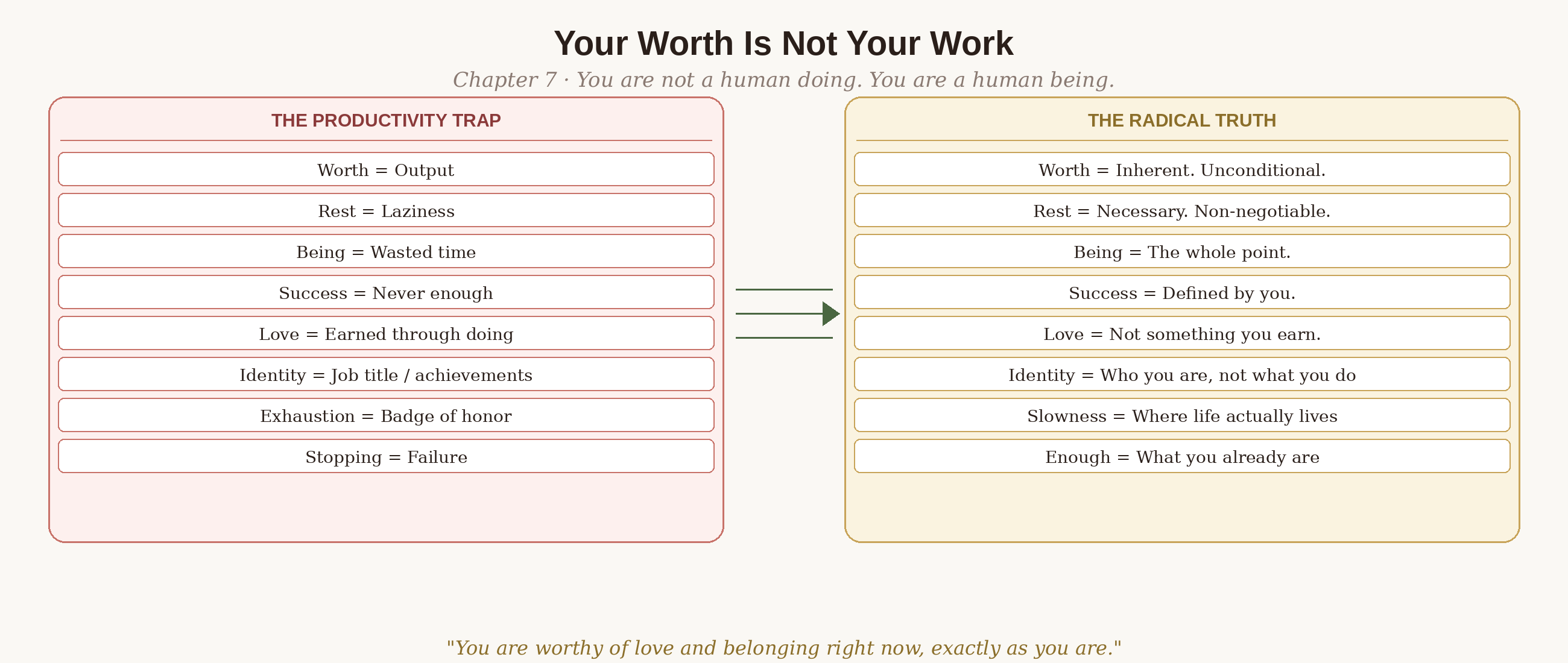
You are not a human doing. You are a human being.
But here's the truth they don't want you to know: you are not your productivity. Your worth is not determined by what you accomplish. You are valuable simply because you exist, not because of what you do.
And until you truly believe that, you'll never be free.
The Productivity Trap
The productivity trap is insidious. It convinces you that your value as a human being is directly tied to your output. That you're only worth as much as you produce. That rest must be earned through sufficient work. That you have to constantly prove your worth through achievement.
This trap shows up everywhere. In the way we introduce ourselves ("I'm a [job title]" rather than "I'm a person who..."). In the way we feel guilty for taking breaks. In the way we can't just sit without scrolling our phones because doing nothing feels intolerable. In the way we're always optimizing, always trying to get more done in less time, always feeling like we should be doing more.
It shows up in the shame we feel when we're sick or injured and can't work. In the anxiety we feel about taking vacation days we've earned. In the way we define successful days by how much we got done rather than how we felt. In the panic that arises when we imagine not working—as if without productivity, we'd cease to have meaning.
The trap is especially tight for men, who've been taught that their value lies in their ability to provide, to achieve, to succeed in the external world. We learned that we're measured by our career status, our income, our accomplishments. That our worth is determined by what we can do, what we can build, what we can earn. That if we're not productive, we're not men.
But women aren't exempt from this trap. You've been taught that you need to do it all—career, household management, caregiving, maintaining relationships, looking good while doing it. You've been taught that your worth lies in your ability to juggle everything perfectly, to never drop a ball, to be endlessly capable. That if you admit you can't handle it all, you're failing.
All of us have learned to be human doings. And we're exhausted.
The Origins of Worth Through Work
This belief—that your worth comes from what you produce—didn't come from nowhere. It has deep roots in our culture, our history, our economic system.
We live in a capitalist society that literally assigns value to humans based on their productive capacity. People are resources, human capital, assets to be optimized. If you're not producing, you're not valuable to the system. The elderly, the disabled, the sick, children—anyone who can't produce is seen as less valuable, a drain on resources rather than worthy in their own right.
We've also inherited Protestant work ethic, which taught that hard work is morally good and leisure is morally suspect. That industriousness is next to godliness. That suffering through labor is noble. This gets into our bones even if we're not religious—the sense that we should always be working, that rest is something to feel guilty about, that difficulty and suffering make us more virtuous.
Many of us also learned these lessons in our families. Maybe your parents praised you for achievements but not for simply being. Maybe love felt conditional on performance—good grades, athletic success, visible accomplishments. Maybe you watched your parents sacrifice everything for work and learned that this is what responsible adults do.
Maybe you grew up poor or working class and learned that survival depends on constant work, that there is no safety net, that rest is a luxury you can't afford. Or maybe you grew up privileged and learned that your worth lies in maintaining that status, in out-achieving your peers, in never falling behind.
Whatever the origins, the result is the same: we learned to tie our worth to our work. We learned to measure ourselves by external metrics. We learned that we have to earn the right to exist through constant productivity.
And now we're trapped in a cycle where we can never do enough. Where every achievement just raises the bar for the next one. Where we're always striving, always pushing, always trying to prove we're valuable. And we're dying inside from the exhaustion of it all.
The Impossible Standard
Here's what makes the productivity trap so cruel: there is no amount of achievement that will finally make you feel worthy. No matter how much you accomplish, the bar just moves. The goal posts shift. What felt like "enough" yesterday becomes insufficient today.
You finish one project and immediately focus on the next. You reach one milestone and your mind is already on what you haven't achieved yet. You accomplish something significant and within days—sometimes hours—you've moved on to cataloging what you still need to do, what you still haven't proven.
Because when your worth is tied to your productivity, you can never rest. There's always more to do, more to prove, more to achieve. You're in a race that has no finish line, chasing a goalpost that keeps moving, trying to earn a worthiness that you think exists somewhere just beyond the next accomplishment.
I spent years like this. Achieving felt good for maybe five minutes before the anxiety crept back in: "What's next? What do I need to do now?" I couldn't enjoy my accomplishments because I was already worried about maintaining them or exceeding them. I couldn't rest because rest felt like falling behind.
I had some external success—the markers society says should make you feel valuable. And yet I felt empty. Because no amount of external achievement can fill the hole left by believing you're not inherently worthy. No amount of productivity can satisfy the hunger for worth when you've made your value conditional on what you do rather than who you are.
This is the impossible standard: trying to earn something—worthiness—that you can't actually earn. Trying to prove something—that you matter—that you shouldn't have to prove. Trying to achieve your way into self-love when self-love requires you to stop making your worth conditional on achievement.
The Cost of the Hustle
Living in constant productivity mode has a cost. It might take years to show up, but it always does.
The cost is burnout. You push and push and push until your body and mind simply can't anymore. Until getting out of bed feels impossible. Until everything that once brought you energy now feels like an unbearable burden. Until you're so depleted there's nothing left.
The cost is missing your life. You're so focused on the next goal, the next deadline, the next achievement that you're not actually present for the life you're living. You're not noticing the small beauties, the moments of connection, the experiences that don't produce anything but matter deeply.
The cost is damaged relationships. You're always distracted, always half-present, always thinking about what you should be doing instead of being fully with the people in front of you. You've made productivity more important than presence, and your relationships suffer for it.
The cost is losing touch with yourself. When you're always in doing mode, you never have space to just be. You don't know what you actually enjoy because you've only allowed yourself activities that are productive. You don't know how you feel because you're too busy doing to check in.
The cost is anxiety and depression. When your worth is tied to your productivity, any threat to your ability to produce becomes existential. Illness, injury, job loss, aging—anything that might limit your capacity becomes terrifying. And when you inevitably can't maintain the pace, when you're human and have limitations, the depression that comes from feeling worthless is crushing.
The cost is health problems. Your body wasn't designed for constant stress, constant pushing, constant override of its signals. Eventually it breaks down. Chronic pain, autoimmune issues, cardiovascular problems, insomnia—stress-related illnesses that arise from years of treating your body like a machine that should run without rest.
The cost is spiritual emptiness. You're accomplishing things, but you feel hollow. You're checking off goals, but nothing satisfies. You're busy all the time, but you're not actually living. You've sacrificed presence, peace, joy, connection—everything that makes life worth living—on the altar of productivity.
And at the end of your life, you won't look back wishing you'd worked more. You'll wish you'd been more present, loved more deeply, rested more fully, experienced more joy. You'll wish you'd understood sooner that your worth was never tied to your work.
The Radical Truth
Here's the truth that terrifies us and simultaneously has the power to set us free: You are valuable simply because you exist. Period. Full stop. Not because of what you do, but because you are.
You don't have to earn the right to take up space. You don't have to justify your existence through achievement. You don't have to prove your worth through productivity. You are inherently valuable—not potentially valuable if you do enough, not conditionally valuable based on your output, but inherently, unconditionally valuable just by being alive.
A tree doesn't have to produce fruit to have value. It has value simply by existing—by being itself, by breathing, by being part of the ecosystem. We don't look at a tree in winter and say it's worthless because it's not producing. We understand that it's in a different season, that its value isn't determined by its visible output.
Why do we grant trees more compassion than we grant ourselves?
You are valuable in your rest as much as in your work. You are valuable when you're sick as much as when you're healthy. You are valuable when you're struggling as much as when you're succeeding. You are valuable when you're doing nothing as much as when you're doing everything.
Your worth is not something you achieve. It's something you are. It's not earned—it's inherent. It's not conditional—it's absolute.
This might be the hardest thing to believe after a lifetime of messages telling you otherwise. Your mind might be screaming right now: "But what about people who don't contribute? What about people who hurt others? Are they valuable too?"
These are complicated questions about behavior and accountability. But here's what I know: everyone's inherent worth as a human being is not up for debate. That doesn't mean all behavior is acceptable. It doesn't mean there shouldn't be consequences for harmful actions. But it means that every person has intrinsic value that exists independent of what they do or produce.
Including you.
Being vs. Doing
Learning to separate your worth from your work requires learning to be, not just do. And for most of us, being is terrifying.
Being means stopping. It means not producing, not achieving, not accomplishing. It means simply existing without justifying that existence through activity.
Being means allowing yourself to rest without earning it first. It means taking time to just sit, to just breathe, to just experience being alive without needing to make something of that time.
Being means experiencing yourself as valuable even when you're not doing anything valuable by society's standards. Even when you're not being productive, not contributing, not achieving.
For many of us, the moment we stop doing, anxiety floods in. We feel guilty, lazy, like we're wasting time. We reach for our phones to fill the space because just being feels intolerable. We create endless to-do lists to give us a sense of purpose because without tasks to complete, we don't know who we are.
This is what happens when we've made doing our identity. When we stop doing, we feel like we're disappearing. Because we've forgotten that underneath all the doing, there's a being—a person who exists independent of their productivity, who has value simply by virtue of being alive.
Learning to be requires practice. It requires sitting with the discomfort of not producing. It requires allowing space for just existing. It requires treating your existence as enough, not as something that needs to be filled or justified or optimized.
It requires asking different questions. Not "What did I get done today?" but "How did I feel today?" Not "Was I productive?" but "Was I present?" Not "What do I have to do next?" but "What do I need right now?"
It requires valuing presence over productivity, being over doing, existence over achievement.
Rest as Resistance
In a culture that profits from your exhaustion, rest is a radical act. In a system that needs you to produce constantly, rest is resistance. In a world that tells you your worth lies in your work, rest is revolutionary.
Rest doesn't have to be earned. You don't have to be sufficiently productive first to deserve rest. Rest is not a reward for good work—it's a fundamental human need, as essential as food or water or air.
But we've been taught to treat rest as a luxury, something we can only access after we've worked hard enough, produced enough, proved enough. We've been taught to feel guilty for resting, to see it as weakness or laziness rather than as necessary for human flourishing.
Real rest means rest without guilt. Rest without your mind spinning through everything you should be doing instead. Rest without justifying it, without having earned it, without making it productive.
Real rest might be sleeping. Or it might be sitting and doing nothing. Or it might be engaging in activities that bring you joy but produce nothing—reading fiction, taking a walk, playing, creating art you'll never show anyone, lying in the grass and watching clouds.
Real rest is time when you're not producing, not achieving, not optimizing yourself. Time when you're just being. Time when you exist for no reason other than you exist.
And here's what's crucial: you need this. Not as a luxury, not as a nice-to-have, but as a fundamental requirement for being human. You cannot sustain constant productivity. You will break. Your body will force the rest you won't give yourself, through illness or injury or complete burnout.
Rest now, before you break. Rest as an act of self-love. Rest as resistance against a system that wants to work you to death. Rest because you deserve to exist without justifying that existence through constant doing.
Redefining Success
If your worth isn't tied to your productivity, how do you measure success? What does a successful day look like? A successful life?
This is where we have to completely redefine success. Not based on external metrics—money, status, achievements, visible accomplishments—but based on internal experience. Based on how we feel, how present we are, how aligned we are with our values, how much we're actually living rather than just producing.
A successful day might be one where you:
Were present with the people you love
Felt your feelings instead of pushing through them
Rested when you needed rest
Said no to what didn't serve you and yes to what did
Noticed beauty—the light through a window, the taste of your coffee, the sound of laughter
Were kind to yourself when you made a mistake
Moved your body in a way that felt good
Did one thing that brought you joy even if it produced nothing
Notice that none of these are about output or achievement. They're about presence, about being alive, about treating yourself with kindness. These are the metrics that actually matter for a life well-lived.
A successful life isn't one where you achieved the most or produced the most or had the most impressive resume. It's one where you were most fully yourself, most fully present, most fully alive. It's one where you loved deeply, felt deeply, experienced deeply—regardless of what you accomplished.
This isn't to say work doesn't matter or achievements don't bring satisfaction. They can. But they're not your worth. They're not your identity. They're things you do, not who you are.
The work you do can be meaningful, can bring you joy, can be an expression of your gifts and values. But it's not your worth. Your worth exists independent of it. And when you can separate the two—when you can engage in work from a place of already knowing you're valuable rather than trying to prove your value through work—everything changes.
Letting Yourself Be Unproductive
One of the most powerful practices for breaking free from the productivity trap is deliberately allowing yourself to be unproductive. Not as a break before you get back to being productive, but as an end in itself. As practice in believing that your existence doesn't require justification.
This might look like:
Taking a day to do absolutely nothing productive and not feeling guilty about it
Engaging in hobbies that produce nothing of value to anyone but you
Lying in bed after you wake up, not immediately launching into the day
Sitting and staring out the window without your phone
Taking a walk with no destination or purpose other than walking
Spending time with people without an agenda or goal for the interaction
Allowing yourself to be bored without immediately filling the space
For most of us, this brings up intense discomfort. The voice that says "You're wasting time. You should be doing something. This is lazy. You're falling behind." The anxiety that says "If you're not constantly productive, you're losing value."
But that voice is wrong. That voice has been trained by a system that profits from your exhaustion. That voice doesn't want you free—it wants you producing.
Practice being unproductive. Practice existing without justification. Practice the radical act of believing you're valuable even when you're producing nothing.
And notice what happens. Notice that you don't actually become worthless. Notice that your relationships might actually improve because you're more present. Notice that your creativity might actually increase because you've given yourself space. Notice that your health might improve because you're finally listening to your body's need for rest.
Notice that the world doesn't end when you stop producing. In fact, your world might actually begin when you stop sacrificing your life on the altar of productivity.
The Gift of Your Being
Here's what I want you to consider: maybe your greatest gift to the world isn't what you produce. Maybe it's who you are. Maybe it's your presence, your kindness, your laughter, your listening, your love—none of which are productive in the traditional sense, all of which are invaluable.
Think about the people who have most impacted your life. Was it because of what they accomplished or achieved? Or was it because of who they were when they were with you? The way they made you feel seen, heard, valued. The way they showed up with presence and care. The way they were authentically themselves.
Your presence—not your productivity—is your gift. Your being—not your doing—is what the people who love you actually want. Your existence—not your achievements—is what makes you valuable.
You don't have to produce anything to be worthy of love. You don't have to achieve anything to deserve care. You don't have to accomplish anything to be valuable.
You already are. You always have been. You always will be.
Not because you're not productive—you might be very productive. But because productivity is irrelevant to worth. They're in completely different categories. Productivity is what you do. Worth is what you are.
And what you are is a human being. Not a human doing. Not a human producing. A human being. And that is enough. That has always been enough. That will always be enough.
Living From Worth, Not For Worth
When you finally, truly believe that your worth is inherent rather than earned, everything changes. You stop working from a place of trying to prove yourself and start working from a place of genuine desire. You stop producing to earn your worthiness and start creating from overflow.
You work because you want to, because it brings meaning or joy or satisfaction—not because you have to in order to be valuable. You rest without guilt because you understand rest is necessary, not something that needs to be earned. You engage in activities that produce nothing because you understand that living fully is more important than producing endlessly.
You set boundaries around your work because you know your worth extends beyond your productivity. You say no to opportunities that would drain you because you don't need to say yes to everything to prove your value. You take care of yourself because you're inherently worth caring for, not because self-care makes you more productive.
You stop measuring your days by what you got done and start measuring them by how you felt, how present you were, how aligned you were with your values. You stop defining success by external metrics and start defining it by internal peace.
You become less afraid. Less afraid of failure because failure doesn't make you worthless. Less afraid of rest because rest doesn't diminish your value. Less afraid of aging, illness, or limitations because your worth isn't dependent on your capacity.
You become more free. Free to actually live instead of just producing. Free to be present instead of constantly achieving. Free to exist for no reason other than you exist.
This is what self-love looks like in the realm of work and worth. Not working harder to love yourself more. Not producing more to finally feel valuable. But recognizing that your worth has nothing to do with your work, and then living from that truth.
You are not your productivity. You are not your achievements. You are not your work. You are a human being of infinite worth simply because you exist. And the moment you truly believe that—not just intellectually, but in your bones—is the moment you become free.
Separating Worth From Work
Allow 15–20 min. Bring a journal.
This practice will help you disentangle your sense of worth from your productivity and begin to value being as much as doing.
Part One: Your Productivity Story
Complete these sentences as honestly as possible:
I learned that my worth comes from my work when...
I feel most valuable when I'm...
I feel least valuable when I'm...
If I stopped being productive, I believe I would be...
The voice that says I'm only as good as my output sounds like...
I measure my worth by...
A successful day is one where I...
I feel guilty when I rest because...
Read what you've written. These beliefs have been running your life. But they're not true. They're just stories you learned.
Part Two: Inherent Worth Meditation
Find a comfortable position. Close your eyes. Take several deep breaths.
Now imagine a baby—maybe yourself as a baby, maybe a baby you know. This baby has done nothing. Achieved nothing. Produced nothing. And yet, everyone who sees this baby knows they're precious. Their worth is absolute, unquestionable, inherent.
You were that baby once. Your worth then was absolute. What changed? Not your inherent value—only what you've been taught about when and how you're valuable.
Sit with this: If your worth was inherent then, it's inherent now. Productivity didn't create it. Productivity can't destroy it. It simply is.
Say to yourself: "I am valuable simply because I exist. My worth is inherent, not earned. I don't need to prove my value through productivity. I am enough exactly as I am."
Let yourself feel whatever arises—resistance, disbelief, sadness, relief. All of it is welcome.
Part Three: The Unproductive Day
Schedule one day in the next two weeks where you deliberately do nothing productive. Clear your schedule. Tell people you're unavailable. Turn off work notifications.
Then spend the day being unproductive. Not "productive rest" like catching up on housework. Actually unproductive. Activities that produce nothing:
Reading fiction
Taking a long walk with no destination
Lying in the sun or under a tree
Drawing or creating something you'll never show anyone
Playing
Sitting and doing nothing
Napping without justification
Notice the resistance, the guilt, the anxiety. Don't try to make them go away—just notice them. They're the productivity programming fighting back.
Stay with it. Practice existing without justifying your existence through doing.
Part Four: Being Inventory
Make a list of moments when you were just being—not producing anything, but moments that mattered. For example:
Laughing with a friend
Watching a sunset
Holding someone you love
Feeling peaceful in nature
Experiencing joy for no reason
Being fully present in a moment
These produced nothing. And yet, these are often the moments that make life worth living. These are where meaning actually lives.
What does this tell you about where value really lies?
Part Five: Redefining Success
Write down how you currently measure success in your daily life. Be honest—most of us measure it by what we got done.
Now write a new definition of success based on being rather than doing. What would a truly successful day look like if success was measured by presence, peace, alignment, joy, connection?
For the next week, measure your days by this new definition. At the end of each day, instead of reviewing your to-do list, ask:
Was I present today?
Was I kind to myself?
Did I feel my feelings?
Did I rest when I needed rest?
Did I notice moments of beauty or joy?
Was I authentic?
These are the metrics that matter.
Part Six: The Rest Practice
For the next two weeks, practice rest without earning it. Not rest as a reward for productivity, but rest as a human right.
Rest when you're tired, not when you've worked long enough to justify it. Rest because you need rest. Rest because rest is necessary. Rest because you're valuable enough to care for even when you're not producing.
Notice the voice that says you haven't earned it. Thank it for sharing and rest anyway.
Part Seven: I Am Not My Work
Create a list of "I am..." statements that have nothing to do with what you do or produce. For example:
I am someone who loves deeply
I am curious
I am kind
I am resilient
I am someone who feels things strongly
I am a person who notices beauty
I am worthy of rest
I am more than my productivity
Write at least 20 statements. This is who you are—not what you do, but who you are. Your identity exists beyond your work.
Read this list daily. Remind yourself of who you are independent of what you produce.
Part Eight: The Worth-Work Separation
Each time you catch yourself tying your worth to your productivity this week—feeling worthless because you didn't accomplish enough, feeling valuable because you were productive—pause.
Say out loud: "My worth is separate from my work. I am valuable whether or not I'm productive. My worth is inherent, not earned."
You might not believe it fully yet. Say it anyway. You're interrupting the old programming and installing new truth.
Part Nine: Appreciating Your Being
Ask three people who love you: "What do you value about me that has nothing to do with what I do or achieve?"
Listen to their answers. Really let them in. You might be surprised to discover that the people who love you don't love you for your productivity. They love you for who you are when you're just being yourself.
Part Ten: The Deathbed Perspective
This is challenging but clarifying: Imagine you're at the end of your life, looking back. What will you wish you'd done differently?
Will you wish you'd worked more? Been more productive? Achieved more? Checked off more items on your to-do list?
Or will you wish you'd been more present, loved more deeply, rested more fully, enjoyed the small moments, let yourself just be alive without constantly justifying your existence?
Let that answer inform how you live now. Let it help you separate your worth from your work and start valuing what actually matters—your being, not your doing.
In the next chapter, we'll explore how all of these practices come together—how breaking the spell of self-rejection, healing your wounds, forgiving yourself and others, befriending your body, speaking your truth, setting boundaries, and claiming your inherent worth create a life of radical self-love. We'll discover what becomes possible when you finally stop trying to fix yourself and start embracing who you already are.
Your worth is emerging. Your truth is becoming clear. Trust this process. Trust yourself.