The Journey You've Traveled
When you began this course, you might have come looking for a way to fix yourself. For strategies to finally become worthy of love. For a system that would transform you into someone more acceptable, more lovable, more enough.
But that's not what happened here, is it?
Instead of giving you tools to fix what was never broken, we've been on a different journey entirely. A journey of remembering rather than becoming. Of uncovering rather than creating. Of returning home to yourself rather than striving to become someone else.
You've broken the spell of self-rejection and learned to recognize the Inner Critic as a learned voice, not truth. You've excavated your wounds and understood where you learned to believe you weren't enough. You've practiced forgiveness—both of others and, perhaps more importantly, of yourself. You've begun befriending your body, speaking your truth, setting boundaries, and separating your worth from your work.
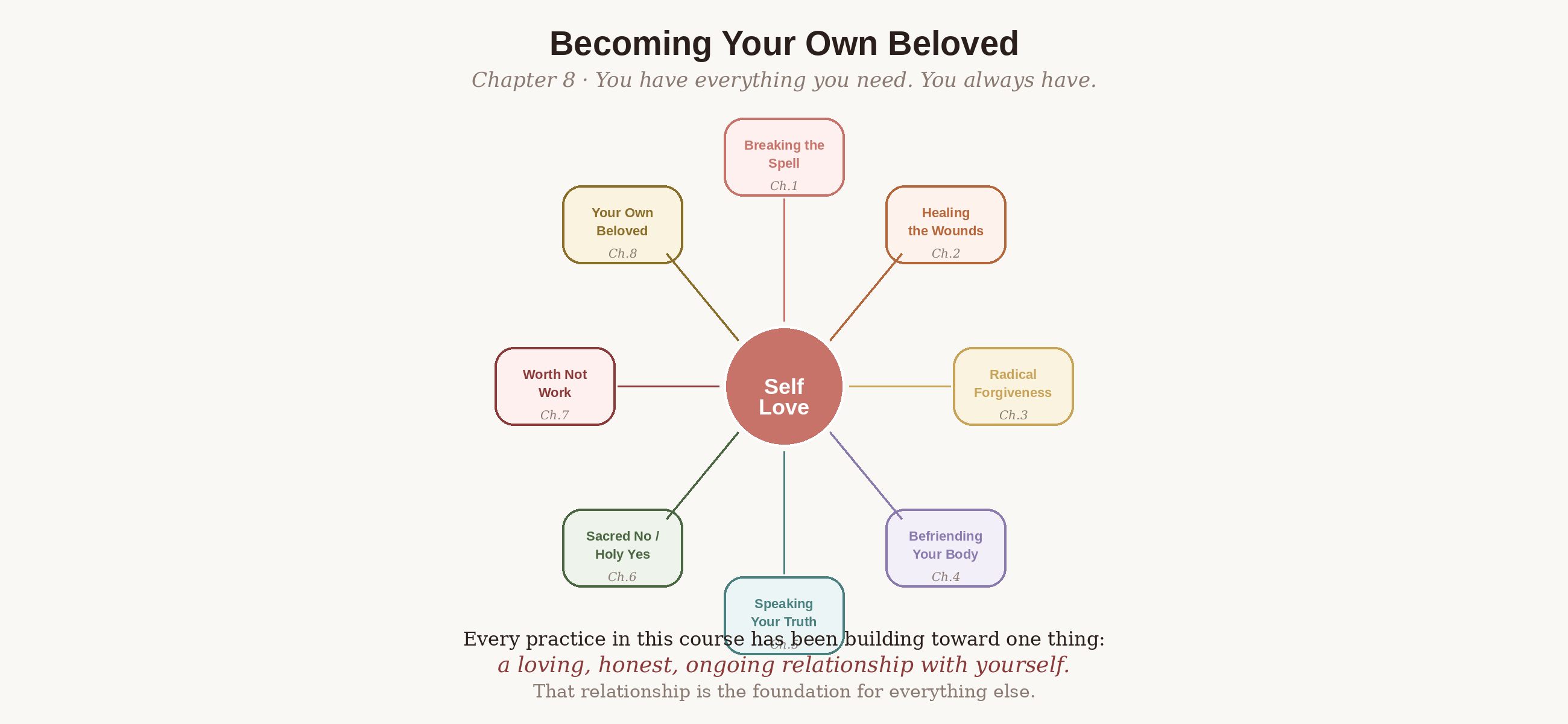
Every practice has been building toward one thing: a loving relationship with yourself.
None of this has been about fixing you. It's been about freeing you. Freeing you from the stories that kept you small, the beliefs that kept you trapped, the patterns that kept you at war with yourself.
And now, in this final chapter, we come to the heart of it all: becoming your own beloved. Not someday when you're finally healed enough or good enough. Now. Exactly as you are. With all your imperfections, your wounds, your contradictions, your messy humanity.
This is what radical self-love actually looks like. Not perfection. Not having transcended your struggles. Not having finally fixed yourself. But choosing, again and again, to love yourself through it all.
What Self-Love Actually Is
Let's be clear about what self-love is and isn't, because the term has been so diluted, so commercialized, so wrapped up in products and programs that claim to deliver it.
Self-love is not:
Buying yourself things
Spa days and face masks (though these can be nice)
Positive affirmations that you don't believe
Pretending everything is fine when it's not
Toxic positivity or spiritual bypassing
Self-improvement projects that assume you're broken
Another item on your to-do list
Something you achieve and then it's done
Self-love is:
Treating yourself with the same compassion you'd offer someone you deeply care about
Honoring your needs, limits, and boundaries
Speaking to yourself with kindness instead of cruelty
Showing up for yourself when things are hard
Believing you're worthy of care, rest, joy, and love—not because you've earned it, but because you're human
Choosing yourself even when it's uncomfortable
Being honest with yourself about what you need and feel
Forgiving yourself for being imperfect
Protecting your peace and energy
Living in alignment with your values rather than others' expectations
Self-love is a practice, not a destination. It's not something you achieve once and then maintain. It's something you choose, moment by moment, day by day. Some days it will feel natural. Other days it will feel like the hardest thing you've ever done. Both are normal. Both are part of the journey.
And here's what's crucial: self-love doesn't mean you'll always feel good about yourself. It doesn't mean you'll never have moments of self-doubt or struggle. It means you'll treat yourself with compassion through those moments instead of adding self-hatred to your pain.
Self-love means you become your own ally instead of your own enemy. Your own safe harbor instead of your own harshest critic. Your own beloved instead of your own abandoned child.
The Daily Practice of Self-Love
Self-love isn't an abstract concept or a feeling you wait to arrive. It's a series of concrete choices you make every day. It's how you treat yourself in the small moments that make up your life.
It's choosing to rest when you're tired instead of pushing through because you "should" be able to handle more. It's feeding yourself nourishing food when you're hungry instead of punishing your body with restriction or numbing yourself with excess.
It's speaking kindly to yourself when you make a mistake instead of launching into harsh self-criticism. It's setting a boundary with someone even though it's uncomfortable because you know your wellbeing matters.
It's saying no to what depletes you and yes to what nourishes you. It's being honest about how you feel instead of performing being fine. It's asking for help when you need it instead of trying to do everything alone.
It's moving your body in ways that feel good instead of punishing it with exercise designed to "fix" it. It's taking the day off when you're sick instead of powering through because productivity feels more important than health.
It's letting yourself feel your feelings—all of them, even the uncomfortable ones—instead of numbing or bypassing. It's spending time alone when you need solitude instead of forcing yourself to be social because you think you should.
It's pursuing what genuinely interests you instead of what you think you should be interested in. It's dressing for yourself instead of for others' approval. It's protecting your energy instead of making yourself available to everyone all the time.
These small choices, repeated daily, are what self-love looks like in practice. Not grand gestures or dramatic transformations. Just the daily choice to treat yourself like someone worthy of care, kindness, and respect.
Self-Love in the Hard Moments
It's relatively easy to be kind to yourself when things are going well. The real test of self-love comes in the hard moments—when you've failed, when you're struggling, when you're facing your limitations, when you're in pain.
This is when self-love matters most. This is when you most need to be on your own side. And this is when, for most of us, the old patterns want to reassert themselves. The Inner Critic gets loud. The self-rejection feels familiar. The urge to punish or abandon yourself can be overwhelming.
Self-love in the hard moments looks like:
When you fail: Instead of "I'm such a failure," self-love says, "I'm human. I tried something and it didn't work out. That's okay. What can I learn from this? What do I need right now?"
When you're struggling: Instead of "I should be able to handle this," self-love says, "This is genuinely hard. It's okay that I'm struggling. What support do I need? How can I be gentle with myself?"
When you're in pain: Instead of "I shouldn't feel this way," self-love says, "My pain is valid. I'm allowed to feel what I feel. How can I comfort myself? What would help me feel held right now?"
When you make a mistake: Instead of spiraling into shame, self-love says, "I made a mistake. I'm human. Can I make amends? Can I do better going forward? And can I forgive myself for being imperfect?"
When you're facing limitations: Instead of "I'm not enough," self-love says, "I have limits. All humans do. My worth isn't determined by my capacity. How can I honor my limits instead of fighting them?"
When others hurt you: Instead of "It must be my fault," self-love says, "I didn't deserve that treatment. I can protect myself. I can set boundaries. I can leave situations where I'm not valued."
This is advanced self-love work—loving yourself when you feel most unlovable. Staying on your own side when everything in you wants to turn against yourself. Offering yourself compassion when you feel you least deserve it.
And it's in these moments that self-love becomes truly transformative. Because when you can love yourself through the hard times, when you can be your own safe harbor in the storm, you become unshakeable. Not because nothing can hurt you, but because you know you won't abandon yourself when things get hard.
The Relationship with Yourself
Self-love is ultimately about the relationship you have with yourself. And like any relationship, it requires attention, intention, and consistent tending.
Think about how you show up in your most cherished relationships. You listen when the other person speaks. You're interested in their inner world. You show up for them when they're struggling. You celebrate their joys. You forgive their mistakes. You make time for them. You check in on how they're doing. You prioritize the relationship.
Now ask yourself: Do you do these things for yourself?
Do you listen to yourself—to your feelings, your needs, your body's signals? Or are you constantly overriding yourself, ignoring yourself, treating your inner world as less important than the external demands?
Are you interested in your own experience? Do you check in with yourself throughout the day: "How am I feeling? What do I need right now?" Or do you only notice yourself when something is urgently wrong?
Do you show up for yourself when you're struggling? Or do you abandon yourself precisely when you need yourself most, adding self-criticism to your pain?
Do you celebrate your joys, your growth, your small victories? Or do you minimize your accomplishments and immediately move on to what you still need to do?
Do you forgive yourself when you make mistakes? Or do you hold grudges against yourself, punishing yourself long after others have moved on?
Do you make time for yourself—not just for productivity, but for being, for rest, for doing things that bring you joy? Or is time with yourself always the first thing to go when life gets busy?
The relationship you have with yourself is the most important relationship you'll ever have. It's the one constant in your life. It's the foundation from which all other relationships arise. And it deserves the same care, attention, and respect that you give to the people you love.
Self-love is about becoming a good partner to yourself. It's about being someone you can rely on, someone who shows up, someone who listens, someone who cares. It's about building a relationship with yourself based on trust, compassion, and genuine care rather than criticism, control, and contempt.
Integrating All the Practices
Everything we've explored in this course works together. These aren't separate practices you master one by one—they're interwoven threads that create the fabric of self-love.
When you recognize the Inner Critic as a learned voice (Chapter 1), you can question it instead of believing it. When you understand where your wounds came from (Chapter 2), you can have compassion for yourself instead of shame. When you forgive yourself and others (Chapter 3), you release the weight you've been carrying. When you befriend your body (Chapter 4), you stop being at war with yourself. When you speak your truth (Chapter 5), you honor yourself. When you set boundaries (Chapter 6), you protect yourself. When you separate your worth from your work (Chapter 7), you give yourself permission to just be.
All of these practices support each other. Setting boundaries becomes easier when you believe you're inherently worthy. Speaking your truth becomes possible when you've forgiven yourself for being imperfect. Befriending your body becomes more natural when you've released the Inner Critic's voice. Resting without guilt becomes feasible when you've separated your worth from your productivity.
You don't have to master all of these before you can love yourself. You practice them simultaneously, imperfectly, as best you can in each moment. Some days you'll do better with one practice than another. Some days you'll struggle with all of them. And that's okay. That's human. That's the practice.
The goal isn't perfection. The goal is progress. The goal is choosing yourself more often than you abandon yourself. The goal is treating yourself with more kindness than cruelty, more compassion than criticism, more love than hate.
And over time, these choices compound. The relationship with yourself deepens. The foundation of self-love becomes stronger. And you discover that you can trust yourself to be on your own side, no matter what.
What Becomes Possible
When you truly love yourself—not someday when you're finally good enough, but now, as you are—everything changes.
You become less afraid. Not because life becomes less scary, but because you trust yourself to handle whatever comes. You know you won't abandon yourself in the hard times. You know you'll treat yourself with compassion through challenges. You know you're resilient not because nothing can hurt you, but because you can be with yourself through anything.
You become more authentic. When you're not at war with yourself, when you're not trying to fix yourself, when you believe you're worthy as you are—you stop performing. You stop contorting yourself to fit others' expectations. You show up as yourself, messy and imperfect and real.
You become more connected. When you're grounded in self-love, you can be vulnerable without being terrified of rejection. You can show up authentically in relationships. You can love others without losing yourself because you're already on solid ground. You can be rejected without it destroying you because your worth isn't dependent on others' approval.
You become more free. Free from the exhausting work of trying to earn your worthiness. Free from the constant self-improvement treadmill. Free from the belief that you need to be someone else to be valuable. Free to actually live instead of constantly trying to fix your life.
You become more present. When you're not at war with yourself, when you're not constantly monitoring and criticizing yourself, you have bandwidth to actually be present. To notice the beauty around you. To savor experiences. To be fully engaged in your life.
You become more creative. When your energy isn't going into self-criticism and self-rejection, it becomes available for creation. When you're not afraid of being imperfect, you can play, experiment, make things that might not work out. When you believe you're worthy, you give yourself permission to express yourself.
You become more joyful. Not because everything in your life is perfect, but because you're no longer adding self-hatred to your experience. You can feel joy without immediately questioning whether you deserve it. You can appreciate good moments without waiting for the other shoe to drop.
You become more resilient. When challenges come—and they will—you face them from a foundation of self-love rather than self-rejection. You're kinder to yourself through difficulties. You're more likely to ask for help. You recover more quickly because you're not compounding external challenges with internal self-attack.
This is what becomes possible when you stop trying to fix yourself and start loving yourself. Not a perfect life—life will always have challenges. But a life where you're on your own side. Where you're your own safe harbor. Where you're your own beloved.
The Ongoing Practice
I want to be honest with you: self-love is not a destination you arrive at and then you're done. It's an ongoing practice. A daily choice. A commitment you make to yourself again and again.
There will be days when it feels natural, when you're deeply connected to your worth, when treating yourself with kindness feels easy. And there will be days when the old patterns reassert themselves, when the Inner Critic is loud, when self-rejection feels familiar and self-love feels impossible.
Both are normal. Both are part of the journey.
The difference is that as you practice self-love, the difficult days become less frequent and less intense. The Inner Critic's voice becomes background noise you can choose to ignore rather than truth you must believe. The self-rejecting patterns become something you notice and course-correct rather than something that runs your life.
You'll mess up. You'll have moments—maybe days or weeks—when you abandon yourself, when you betray your boundaries, when you speak to yourself harshly, when you tie your worth to your productivity again. This doesn't mean you've failed. This doesn't mean you're not making progress. It means you're human.
And here's where the practice deepens: Can you love yourself even when you've fallen back into old patterns? Can you offer yourself compassion when you've just been harsh with yourself? Can you be gentle with the part of you that forgot to be gentle?
This is the meta-practice of self-love: loving yourself even when you're not loving yourself well. Treating the part of you that forgot to practice self-love with... self-love.
It's spiral, not linear. You'll circle back to the same issues, the same wounds, the same patterns. But each time you do, you'll be different. You'll have more awareness, more tools, more compassion. You'll be able to meet yourself with more kindness than last time. And that's growth.
You Are Your Own Beloved
Here's the truth we've been building toward through this entire course: You are the one you've been waiting for.
All the love you've been seeking from others, all the validation you've been trying to earn, all the worthiness you've been trying to achieve—it was always yours to give yourself. Not because others' love doesn't matter, but because without your own love, no amount of external love will ever feel like enough.
When you love yourself, you become your own beloved. You become the person who sees you fully, who accepts you completely, who chooses you consistently. You become the loving presence you've been craving, the safe harbor you've been seeking, the unconditional acceptance you've been longing for.
This doesn't mean you don't need others. We're wired for connection. We need community, relationship, love. But it means you can engage with others from wholeness rather than from a desperate need to be filled. You can receive love without needing it to complete you. You can give love without losing yourself.
You become unshakeable. Not because nothing can hurt you—you're human, you'll still feel pain, loss, disappointment, heartbreak. But because underneath it all, you have yourself. You're on your own side. You're your own foundation.
And from that foundation, anything becomes possible.
You can take risks because rejection won't destroy you. You can be authentic because you don't need everyone's approval. You can pursue what genuinely calls to you because you're not trying to prove your worth through external validation. You can rest because you know your worth isn't tied to your productivity. You can set boundaries because you believe you deserve to be treated well. You can speak your truth because you know your voice matters.
You become free to actually live. Not to perform or produce or prove, but to experience, to create, to love, to be. To be fully, messily, imperfectly human—and to know that's not just okay, it's beautiful.
This is what it means to become your own beloved. To show up for yourself with the devotion, patience, and unconditional love you'd offer someone you adored. To be the one who doesn't abandon yourself when things get hard. To be the one who celebrates you when things go well. To be the one who sees you, really sees you, and loves what they see.
The Invitation Forward
You've come to the end of this course, but you're standing at the beginning of something much larger—the rest of your life, lived in relationship with yourself as your own beloved.
This is not the end of the journey. It's the beginning. You're not fixed—because you were never broken. But you are different. You have tools, awareness, practices. You have a new relationship with yourself that you can continue to deepen.
The invitation now is to take what you've learned and continue practicing. To choose self-love not perfectly, but consistently. To catch yourself when you fall into old patterns and gently redirect yourself. To build a life that honors who you actually are rather than who you think you should be.
The invitation is to remember, when things get hard, that you don't need to be fixed. You need to be loved. And you can give yourself that love.
The invitation is to trust that self-love is not selfish—it's the foundation from which genuine care for others can flow. When you're grounded in love for yourself, you can love others without losing yourself. You can give from overflow rather than depletion.
The invitation is to be patient with yourself. This work takes time. You're undoing a lifetime of conditioning. You're learning a completely different way of relating to yourself. You won't get it right every time. You'll stumble. You'll forget. You'll fall back into old patterns. And you can love yourself through all of it.
The invitation is to celebrate small victories. Every time you catch the Inner Critic and choose kindness instead. Every boundary you set. Every time you rest without guilt. Every moment you're honest about your feelings. Every time you choose yourself. These are profound acts of self-love. They matter. You're changing your life one small choice at a time.
The invitation is to keep going. Even when it's hard. Even when you don't feel like it. Even when the old patterns seem easier. Keep choosing yourself. Keep showing up. Keep practicing. Because you're worth it. You always have been. You always will be.
And finally, the invitation is to know this: You are not alone on this journey. Millions of people are doing this work, unlearning the same patterns, choosing themselves, practicing self-love. You're part of a quiet revolution of people who are refusing to stay at war with themselves, who are claiming their inherent worth, who are becoming their own beloveds.
You belong here. You're exactly where you need to be. And you're already whole.
A Benediction
So let me leave you with this:
May you remember that you are not broken and never were.
May you treat yourself with the tenderness you'd offer someone you deeply love.
May you rest without guilt, knowing that your worth is not tied to your productivity.
May you speak your truth, even when your voice shakes.
May you set boundaries that honor your needs and protect your peace.
May you befriend your body and treat it as the home it is.
May you forgive yourself for being beautifully, imperfectly human.
May you know in your bones that you are worthy—not because of what you do, but because you are.
May you become your own beloved, your own safe harbor, your own source of unconditional love.
May you live from that love rather than constantly seeking it.
May you be free.
You are not a project to be completed. You are not a problem to be solved. You are not a machine to be optimized.
You are a human being. Complex, contradictory, imperfect, and infinitely worthy of love.
Not someday. Now.
Not when you're fixed. You don't need fixing.
Exactly as you are.
Welcome home to yourself.
Final Practice: Your Self-Love Commitment
Allow 15–20 min. Bring a journal.
This final practice is both an ending and a beginning—a way to honor the journey you've taken and commit to the ongoing practice of self-love.
Part One: Witnessing Your Journey
Look back at where you started this course. What brought you here? What were you seeking? What did you believe about yourself?
Now look at where you are now. What's different? What have you learned? How has your relationship with yourself shifted, even slightly?
Write a letter to yourself acknowledging this journey. Celebrate the courage it took to even begin. Honor the work you've done. Recognize the shifts, however small.
Part Two: Your Self-Love Manifesto
Write your own self-love manifesto—a declaration of how you commit to treating yourself going forward. You can use the following prompts or create your own:
I commit to treating myself with... I will no longer tolerate... I promise myself... I deserve... I am worthy of... When I'm struggling, I will... When I succeed, I will... My boundaries are... My worth is...
Make this your own. Let it be honest, specific, and meaningful to you.
Part Three: Daily Anchors
Choose 3-5 daily practices that will anchor you in self-love. These should be simple, sustainable, and meaningful. For example:
Morning: Three deep breaths and "I am worthy exactly as I am"
Throughout the day: Check in with yourself hourly—"What do I need right now?"
Evening: Name three ways you chose yourself today
Write these down. Put them somewhere visible. Let them become ritual.
Part Four: Your Support System
Self-love doesn't happen in isolation. Identify your support:
Who in your life supports your self-love journey?
What resources help you (books, podcasts, communities)?
What professional support might you need (therapy, coaching)?
How will you reach out when you're struggling?
Write down your support system. Having it identified makes it easier to access when you need it.
Part Five: When You Forget
You will have moments when you forget all of this. When the old patterns reassert themselves. When self-love feels impossible.
Write yourself a letter to read in those moments. Remind yourself:
This is temporary
You're not failing
You can start again right now
You're still worthy even when you're struggling
The practice is imperfect and that's okay
Keep this letter somewhere accessible.
Part Six: Your One-Year Vision
Imagine yourself one year from now, having practiced self-love consistently (not perfectly, but consistently). What's different?
How do you treat yourself differently? What boundaries are firmly in place? What old patterns have loosened their grip? How has your life changed? How do you feel in your body? What are you doing that you're not doing now?
Write this vision in present tense, as if it's already true: "One year from now, I..."
Let this vision guide your daily choices.
Part Seven: The Self-Love Vow
Stand in front of a mirror. Look yourself in the eyes. Place your hand on your heart.
Say these words out loud (or create your own):
Let yourself feel the weight of this commitment. You're making a vow to yourself. You're becoming your own beloved.
Part Eight: The Next Right Thing
Self-love isn't about doing everything perfectly from now on. It's about doing the next right thing.
Right now, in this moment, what is one small act of self-love you can offer yourself?
Maybe it's:
Taking a deep breath
Drinking some water
Stretching your body
Saying something kind to yourself
Resting for five minutes
Texting someone you love
Doing nothing at all
Do that one thing. Then do the next one. And the next. Self-love is built one small choice at a time.
Part Nine: Celebrating You
Take a moment to celebrate yourself. Not for being perfect or fixed or healed, but for being you. For showing up. For doing this work. For having the courage to question the stories you've been told and choose a different way.
You didn't need this course to be worthy. You were already worthy. But you chose to deepen your relationship with yourself anyway. That takes courage.
Celebrate that courage. Celebrate yourself.
Part Ten: The Ongoing Practice
Set a reminder for one month from now, three months from now, six months from now, and one year from now.
When those reminders go off, return to this course. Reread sections that speak to you. Revisit the practices. Check in on your progress. Notice how your relationship with yourself has evolved.
This is not a one-time journey. It's a lifetime practice. And you're just beginning.
Thank you for trusting me with your journey. Thank you for having the courage to question whether you really need fixing. Thank you for choosing yourself.
You are not broken. You never were. You are already whole.
Now go live like it.
With love and deep respect for your journey,
Your Brother, Eric