Microdosing is one of the most talked-about practices in psychedelic culture — and one of the most overhyped. This guide covers what the science genuinely supports, common protocols, real risks, and how to approach a practice thoughtfully rather than optimistically.
Promising but mixed — real effects beyond placebo, inconsistent results
⚖️
Legal status (US)
Federally illegal · some cities decriminalized
⚠️
Key safety concern
Long-term cardiac risk unknown · SSRIs interact
The basics
What microdosing actually is
Microdosing means taking doses of a psychedelic substance small enough to avoid any significant perceptual effect — typically 1/10th to 1/20th of a full dose. The goal is not to experience altered consciousness. A proper microdose should be sub-perceptual: you shouldn't feel high, dissociated, or visually altered. If you feel obviously different, the dose is too large.
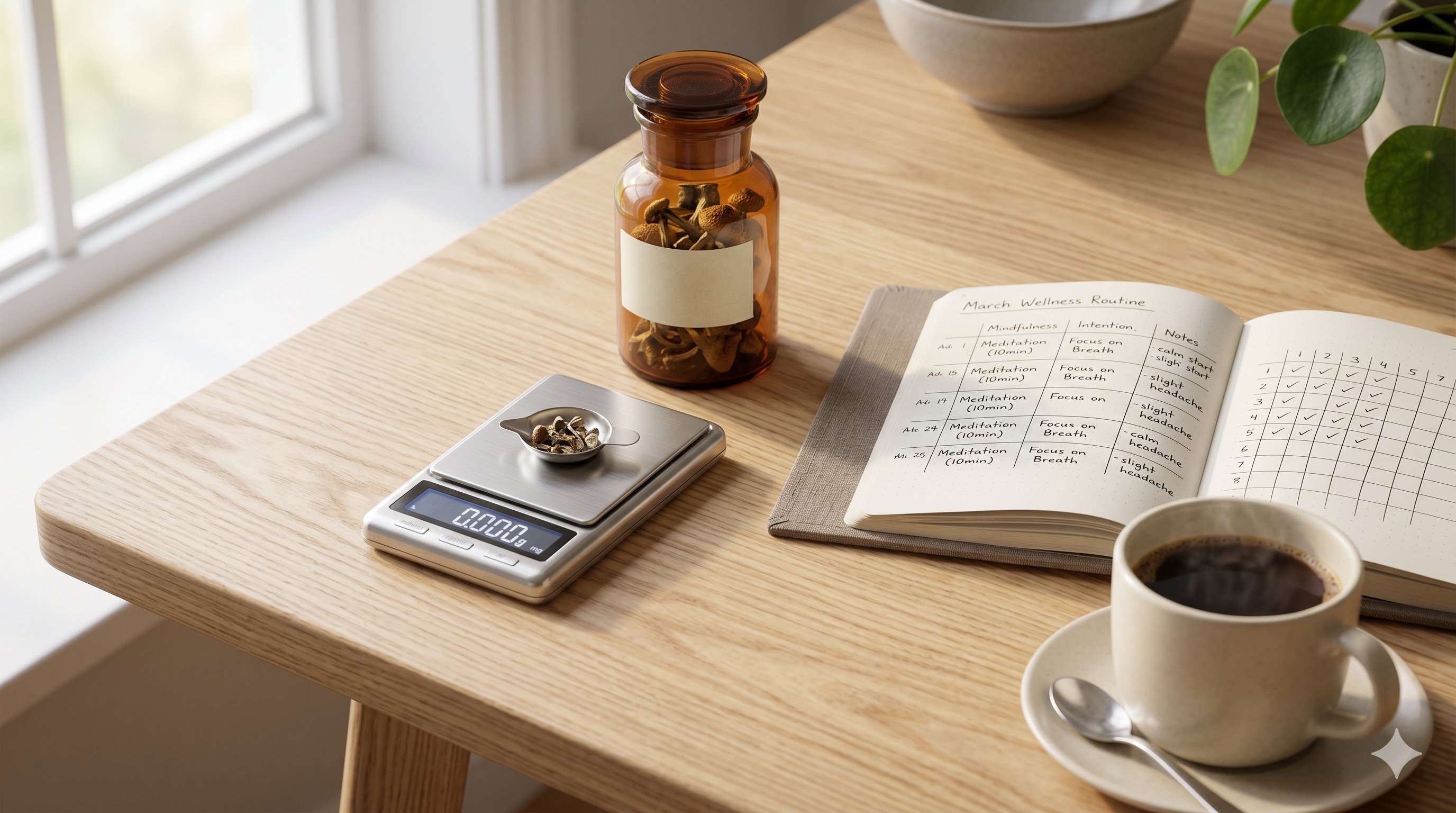
A precise, intentional practice — milligram scale, a tracking journal, and a morning routine. Microdosing done well looks like this.
The term was popularized by researcher Dr. James Fadiman starting around 2010, based on decades of anecdotal reports he collected from people around the world. The practice predates him — Albert Hofmann, who first synthesized LSD, used sub-perceptual doses himself — but Fadiman systematized the modern conversation and coined the term "microdosing" as it's now used.
The most commonly used substances are psilocybin (from mushrooms) and LSD. People report seeking improvements in mood, focus, creativity, emotional regulation, and reduced depression or anxiety symptoms — without the disruption of a full psychedelic experience. Whether the research supports these claims is more complicated than enthusiasts often suggest.
ℹ
Microdosing is not a treatment. No regulatory agency has approved microdosing for any condition. It is a practice — unregulated, illegal in most jurisdictions, and with a research base that is growing but still limited. The information on this page is educational, not medical advice.
The science
What the research actually shows
The honest picture is more nuanced than either camp claims. The "it's just placebo" critics and the "it changed my life" advocates are both overstating their cases. Here's what the controlled studies as of 2024 genuinely support.
🔬
The state of the evidence as of 2024
A 2024 rapid review in the Journal of Psychopharmacology examined all controlled microdosing studies and concluded the claim that microdosing is "predominantly placebo" is premature — studies show real physiological and neurobiological changes beyond expectancy effects. However, the same review noted small sample sizes, methodological inconsistency, and that most trials have only studied single or few doses in healthy volunteers. Clinical evidence for specific conditions remains thin. The overall picture: something real is happening, but exactly what it's good for and who it helps isn't settled.
Better supported
Mood and emotional wellbeing
Multiple observational and some controlled studies find improvements in mood, reduced emotional reactivity, and increased sense of wellbeing. Several RCTs found modest but significant acute positive mood changes above placebo. The strongest self-report evidence is for mood, though effect sizes in trials are smaller than observational reports suggest.
Better supported
Real neurobiological effects
Controlled studies confirm microdosing produces measurable physiological changes — changes in EEG, serotonin receptor activity, subjective perception, and some blood pressure and heart rate effects. This means effects are not purely expectancy-driven. The direction and clinical significance of these changes is still being worked out.
Mixed evidence
Depression and anxiety symptoms
Observational studies consistently show people report improvements. But most placebo-controlled trials have failed to find significant benefits beyond expectancy effects, possibly due to small samples, short durations, or doses that were too low. A 2024 RCT for depression found no significant benefit in the placebo-controlled phase. More and larger trials are needed before confident claims can be made.
Mixed evidence
Focus, creativity, and cognition
The "Silicon Valley productivity hack" claim has not held up well under controlled conditions. Most trials using objective cognitive assessments (not self-report) find no significant improvements in focus, memory, or problem-solving. Some participants show increased social cognition and flexible thinking, but these effects weren't consistent. Creativity benefits remain largely anecdotal.
Weak evidence so far
ADHD
Despite widespread anecdotal reports, a 2024 placebo-controlled trial of LSD microdosing for ADHD found no significant reduction in symptoms vs. placebo. The trial was well tolerated but efficacy was not demonstrated. Research continues, but the evidence base is currently too thin to support microdosing as an ADHD intervention.
Weak / unclear
Addiction and substance use
Some observational data suggest people who microdose report reduced problematic substance use. Whether microdosing causes this or whether motivated individuals simply make other lifestyle changes simultaneously is unclear. No controlled trials have specifically examined microdosing for addiction treatment. Full-dose psilocybin therapy has stronger evidence here.
💡
The research gap to watch: Most controlled studies have tested small numbers of single doses in healthy volunteers. The real-world practice is repeated doses over weeks or months. The long-term effects — both benefits and risks — of sustained microdosing have not been studied in rigorous trials. This is one of the most important unanswered questions in the field.
What people use
Research Review · October 2025
Microdosing Psilocybin Explained: Truth vs Hype
Dr. Rotem Petranker, PhD — Psychedelic Medicine Podcast
One of the most rigorous researchers on microdosing separates what the clinical studies actually show from what the community believes. If the hype is running ahead of the evidence, this is where you find out — and by how much.
The three main substances
Psilocybin mushrooms are by far the most commonly used, followed by LSD. Each has a different duration, character, and practical profile.
🍄
Psilocybin mushrooms
Psilocybe cubensis and relatives
The most popular by far. Typical microdose: 0.05–0.3g of dried mushroom. Effects last 4–6 hours. Potency varies significantly between batches and strains — this inconsistency is a real practical challenge. Many people powder and capsulate to standardize dosing. Generally described as warmer and more introspective than LSD.
Most commonPotency varies
🔬
LSD
Lysergic acid diethylamide
Typical microdose: 5–20 µg (most tabs are ~100 µg). Requires careful volumetric dosing to divide accurately. Duration 8–12 hours — longer than psilocybin, which can disrupt sleep if taken too late. More consistent potency than mushrooms. The most studied substance in controlled microdosing trials. Generally described as more energizing and analytic.
Most studiedLonger duration
🌿
1P-LSD / AL-LAD and analogues
LSD research chemical analogues
Legal in some jurisdictions as "research chemicals." Pharmacologically similar to LSD, shorter-acting in some cases. Used as legal alternatives where LSD is illegal. Less studied. The legal landscape shifts frequently — what is legal today may not be tomorrow. Approach with extra caution given even less research.
Least researchLegal grey area
How people structure it
Common protocols
A protocol is simply a dosing schedule. The goal of any schedule is to get benefit while avoiding tolerance buildup — psychedelics produce rapid tolerance, so dosing every day quickly reduces effectiveness. All protocols include regular rest days for this reason.
Most widely used · Best starting point
The Fadiman Protocol
Dr. James Fadiman · "The Psychedelic Explorer's Guide"
One day on, two days off — repeated for 4–8 weeks, then a 2–4 week break. The most research-referenced protocol and the best starting point for anyone new to microdosing. The two rest days let you observe the contrast between dose days and normal days, and prevent tolerance.
Day 1 ✓Day 2 –Day 3 –Day 4 ✓Day 5 –Day 6 –Day 7 ✓
Dose days per week~2–3
Cycle length4–8 weeks
Break after cycle2–4 weeks
Best forBeginners · Research
More intensive · Neuroplasticity focus
The Stamets Stack
Paul Stamets · mycologist and psychedelic advocate
Five days on, two days off. Combines psilocybin with Lion's Mane mushroom (claimed to promote neurogenesis) and niacin (vitamin B3, claimed to help distribute compounds across the blood-brain barrier). The "stack" component is speculative — the neuroplasticity theory is plausible but unproven in controlled human trials.
Mon ✓Tue ✓Wed ✓Thu ✓Fri ✓Sat –Sun –
Dose days per week5
Stack additionsLion's Mane + Niacin
Evidence for stackTheoretical · Unproven
Best forExperienced microdosers
Simpler scheduling
Two Fixed Days Per Week
Adaptation of Fadiman · e.g. Monday and Thursday
Because the Fadiman protocol shifts which days you dose (the cycle doesn't align with weeks), many people find two fixed days easier to maintain. Always separated by at least one rest day. More practical for people with structured work or family schedules. Very similar outcomes to Fadiman in anecdotal reports.
Mon ✓Tue –Wed –Thu ✓Fri –Sat –Sun –
Dose days per week2 · Fixed
AdvantagePredictable scheduling
Best forStructured schedules
Min gap between doses1 full rest day
Advanced · Intuitive
Intuitive / As-Needed
No formal originator
Microdosing only when circumstances seem to call for it — a creative project, a difficult week, a social event. No fixed schedule. Requires at least one rest day between doses. Better suited to experienced microdosers who know their response well. Not recommended while still calibrating dose or learning the effects. Risk of drifting into unconscious over-reliance.
StructureNone · As needed
Min gap between doses1 rest day always
Journaling neededMore important than ever
Best forExperienced only
💡
Start with Fadiman. The two-day gap makes it easy to observe the contrast between dose and non-dose days — which is essential for calibrating whether and how it's working for you. Take your dose before 10am on dose days (Fadiman's recommendation) to avoid any stimulant effect interfering with sleep.
Getting the dose right
How much — and why it's tricky
Getting the dose right is the most practically difficult part of microdosing. Too much and you feel intoxicated; too little and nothing happens. Individual sensitivity varies enormously — someone else's dose may be completely wrong for you.
Substance
Typical microdose range
Starting point
Preparation notes
Psilocybin mushrooms
0.05 – 0.3g dried
0.1g dried
Grind to powder and capsulate for consistency. Potency varies by strain and batch — expect calibration needed.
LSD
5 – 20 µg
10 µg
Volumetric dosing: dissolve 1 tab (~100 µg) in 10ml alcohol/water. 1ml = ~10 µg. Cutting blotter is inaccurate — avoid.
Psilocybin (pure)
0.5 – 3 mg
1 mg
Only available in clinical trial contexts or from synthetic sources. Milligrams require precise measurement; mg and µg are easily confused.
The "calibration" approach: start at the low end of the range. On your first few dose days, observe carefully — can you feel anything? If you feel noticeably altered, perceptually different, or impaired in any way, the dose is too high. Reduce by 0.05g next time. If you feel nothing at all after 3–4 doses, increase slightly. The target is subtle: some people describe it as feeling "10% more alive" rather than high.
Take it on a day when you have no critical obligations the first time, so any unexpected effects don't cause problems. Some people have an unexpectedly strong reaction even to sub-threshold doses — this is less common but real.
Honest risk assessment
Real risks — not hype, not dismissal
The psychedelic community tends to understate microdosing risks, while critics overstate them. Here's what the evidence actually supports as genuine concerns.
⚠️ Do not microdose if any of the following apply to you
✗
You have a personal or family history of psychosis, schizophrenia, or bipolar disorder type 1 — psychedelics, even at sub-perceptual doses, may destabilize these conditions
✗
You are currently taking SSRIs, SNRIs, or MAOIs — interactions are significant. SSRIs may blunt or block effects entirely; MAOIs combined with psilocybin carry serious risks
✗
You are taking lithium — combining lithium with psychedelics carries risk of seizure
✗
You are pregnant or breastfeeding — no safety data exists
✗
You have a known heart condition or valvular disease — see cardiac risk below
Unknown — critical gap
Long-term cardiac risk
This is the most serious unanswered safety question. Psychedelics activate 5-HT2B serotonin receptors, which in chronic use have been associated with cardiac valvulopathy (damage to heart valves) — similar to the mechanism behind the withdrawn drug fen-phen. No long-term human studies on microdosing and cardiac health exist. Current researchers flag this as an urgent priority. The risk for short-term microdosing (weeks) is considered low, but sustained multi-month or multi-year practice carries theoretical risk that cannot yet be quantified.
Real risk
Anxiety and emotional disruption
Increased anxiety is among the most commonly reported adverse effects in both observational and controlled studies. Some people find microdosing makes difficult emotions more present rather than muted — which can be therapeutic or destabilizing depending on context and support. If anxiety increases significantly, reduce dose or stop. Not everyone benefits.
Real risk
Functional unblinding — placebo amplification
Even at true sub-perceptual doses, many people can tell when they've taken psilocybin — making truly blinded trials difficult and inflating self-reported benefits through expectancy. This doesn't mean effects aren't real, but it means personal reports should be weighed cautiously. Journaling blind (not knowing which day you'll dose) where possible helps reduce this bias.
Lower risk but real
Tolerance and habituation
Psychedelic tolerance builds rapidly with daily use. This is why all protocols include rest days. But there's also a psychological risk: some people find themselves relying on dose days to feel motivated or positive, then feeling flat on off-days. This reliance pattern — while not physiological addiction — deserves attention. Tracking mood on both dose and rest days helps identify this.
Lower risk but worth knowing
Physical side effects
Reported across studies: mild headache, nausea, energy fluctuation, and in some LSD studies, increased blood pressure. These are generally mild and transient. Nausea is reduced by taking on an empty stomach or consuming mushrooms as tea (which removes chitin from the mushroom cell walls). Most people tolerate microdoses physically without significant issues.
Practical risk
Legal exposure
Psilocybin is Schedule I federally in the US. Possession of any amount is a federal offense, regardless of intent. Some cities have decriminalized (Portland, Denver, Oakland, others) but this affects prosecution priority, not legality. Being found with mushrooms on a dose day at work, or in a state without decriminalization, carries serious legal risk. This is the most concrete risk for most people.
Making it useful
Clinical Explainer · November 2024
Doctor Explains the Science Behind Microdosing
Dr. Tracy Kim Townsend, MD
A physician breaks down exactly how microdosing works at the neurological level, what the current research shows about benefits and risks, and what anyone considering it should know before starting. Clear, clinical, and free of the enthusiasm bias that surrounds most microdosing content.
Tracking your experience
Journaling is not optional — it's the mechanism by which microdosing becomes useful rather than just something you do. Without systematic tracking, it's very difficult to distinguish genuine effects from placebo, bad days, life circumstances, and wishful thinking.
What to track on every day (dose and rest days)
Morning (before or at dose time)
→
Overall mood: 1–10 rating
→
Sleep quality last night: 1–10
→
Energy level: 1–10
→
Any notable emotions or thoughts on waking
→
Dose day or rest day — note clearly
Evening (end of day)
→
Mood across the day: any notable shifts
→
Focus and productivity: how did work feel?
→
Social interactions: any different quality?
→
Any physical effects: headache, nausea, fatigue
→
One sentence summary of the day
The key comparison is not "how do I feel today?" but "how do dose days compare to rest days over several weeks?" Look for patterns, not individual data points. Some benefits show up gradually rather than acutely — people sometimes don't notice until week 3 or 4 that their general baseline has shifted.
If after 4 weeks of tracking you cannot identify any meaningful difference between dose and rest days — or if rest days are consistently worse — that's important data. Not everyone responds. Continuing a practice that isn't working, or that makes rest days feel worse, is not useful.
📓
The Inner Compass Integration Toolkit includes a guided journal with phase-aware prompts and an emotion tracking tool that work well for a microdosing practice log — no account needed, all stored locally.
Legal context
Where things stand legally
The legal landscape for psilocybin is shifting faster than almost any other drug policy area — but the baseline is still federally illegal in the US, and legal in very few places worldwide.
Federally illegal
United States (federal)
Psilocybin is Schedule I — no accepted medical use, high potential for abuse. Possession of any amount for any purpose is a federal offense. State and local laws vary but don't override federal law.
Decriminalized
Several US cities & Oregon
Denver (CO), Oakland and Santa Cruz (CA), Ann Arbor (MI), Somerville and Northampton (MA), and others have deprioritized enforcement of personal possession. Oregon decriminalized all drugs statewide. Decriminalization ≠ legal — it means low enforcement priority.
Legal access
Oregon licensed services
Oregon's licensed psilocybin service centers offer supervised psilocybin sessions — not take-home microdosing. These are full-dose therapeutic experiences, not a microdosing supply source. Colorado is implementing similar supervised access.
Illegal
Most countries
Psilocybin is controlled in most countries including the UK, Australia (except TGA-approved clinical use), Canada (except special access), and most of Europe. Jamaica and the Netherlands (truffles) are notable legal exceptions.
Grey area
Netherlands (truffles)
Psilocybin mushrooms are banned but psilocybin truffles (sclerotia) are sold legally. This is one of the few places where psilocybin-containing material can be legally purchased — though it cannot be legally imported to other countries.
Legal & licensed
Jamaica
Psilocybin mushrooms are not scheduled in Jamaica — fully legal. This is why Jamaica is the most common destination for psilocybin retreat centers serving North American clients.
⚖️
For a full interactive US state-by-state legal map, see the Inner Compass Legal Status Map. The landscape is changing rapidly — particularly in 2024–2025 as more states consider legislation.
Common questions
Frequently asked
Is microdosing the same as taking a full psychedelic dose?+
No — they are meaningfully different experiences with different mechanisms and different evidence bases. A microdose is intentionally sub-perceptual: you should not feel altered, dissociated, or see any visual changes. A full therapeutic dose produces a profound altered state lasting 4–8 hours that is the basis of psilocybin-assisted therapy research. The benefits studied in clinical trials — for depression, PTSD, addiction — come from full doses, not microdoses. Don't conflate the two when evaluating evidence.
Can I microdose while on antidepressants (SSRIs)?+
This requires a conversation with a knowledgeable physician before proceeding. SSRIs work partly by downregulating serotonin receptors — the same receptors that psilocybin acts on. For many people on SSRIs, microdosing produces little or no effect as a result. Some people taper off SSRIs before microdosing, but this carries its own risks and should only be done under medical supervision. Never stop SSRIs abruptly. MAOIs combined with psilocybin at any dose carry serious risk of serotonin syndrome — do not combine.
How do I know if my dose is correct?+
A correct microdose should not be perceptible as intoxication. You might feel slightly more energized, present, or emotionally accessible — or you might feel very little on the day of dosing and notice effects more in your overall patterns over weeks. If you feel obviously high, see visual distortions, feel dissociated from your body, or have difficulty concentrating on normal tasks, the dose is too high. Reduce by half and try again. If you feel absolutely nothing after several calibration doses, try a very modest increase. The target is subtle enough that some people aren't sure if "anything is happening" — which is often appropriate.
Can I drive or work normally on a microdose day?+
For the first 2–3 dose days during calibration, do not drive or operate machinery — you're still learning your response. Once you're confident your dose is genuinely sub-perceptual and you have several data points confirming no impairment, most people report being able to work normally. That said, if you feel any impairment, the dose is too high. Err on the side of caution, especially when safety matters. Being found intoxicated at work carries obvious legal and professional risks.
How do I get psilocybin for microdosing?+
We can't guide you here — psilocybin is federally illegal in the US and most other countries. Some people grow their own (also illegal in most places), some obtain from underground networks (carries legal risk), and a small number travel to legal jurisdictions. In the Netherlands, psilocybin truffles can be purchased legally. In Oregon, licensed service centers provide psilocybin for supervised sessions — not for home microdosing. The legal landscape is shifting, but right now, obtaining psilocybin for personal microdosing carries legal risk in most of the world.
How long should a microdosing practice last?+
Most protocols suggest a cycle of 4–8 weeks followed by a 2–4 week break. This allows tolerance to fully reset and gives you clear comparison data. Indefinite, uninterrupted microdosing is not recommended — partly for the theoretical cardiac risk from chronic 5-HT2B activation, and partly because breaks help you evaluate whether the practice is genuinely helping. If you're not sure whether it's working, that's a strong signal to take a break and see how you feel. Many people do several discrete cycles over a year rather than continuous use.
Is microdosing right for me if I'm struggling with serious depression or PTSD?+
If you have serious depression or PTSD, microdosing is not the most evidence-backed path. Full-dose psilocybin therapy (for depression) and MDMA-assisted therapy (for PTSD) have significantly stronger clinical evidence. The controlled trial evidence for microdosing as a treatment for depression has been inconsistent. If you're struggling seriously, exploring clinical trials, ketamine therapy, or therapy-supported full-dose sessions is likely more appropriate than microdosing. Microdosing is not a substitute for professional mental health care.