The Long Arc — Months 1 through 12
- Understand what integration actually looks like at 30, 90, 180, and 365 days — including the specific markers that distinguish genuine consolidation from fading.
- Know the research on when psychedelic-initiated change tends to hold versus when it fades — and what makes the difference.
- Understand spiritual bypass specifically and be able to recognize it in your own integration process.
- Have a clear framework for working with regression when old patterns return — without catastrophizing or abandoning the work.
- Have completed the 12-month integration map and the monthly review template.
Opening
Most courses on psychedelic integration stop at the first two weeks. The acute window closes, the daily journaling guidance ends, and the assumption is that the person will carry whatever was built during that period forward into ordinary life. Some do. Many don't. The practices fall away. The insights become a story that gets more polished and less actionable over time. Six months later, someone who had a genuinely significant experience finds themselves wondering why their life doesn't look meaningfully different.
This module exists because that pattern is preventable, and because the long arc of integration — the months and year following a session — is both less supported and more important than most integration guidance acknowledges. The first two weeks are high-leverage. But the year that follows is when the change either roots itself in how you actually live or returns to the level of a meaningful memory.
The research is helpful here. The follow-up data from psychedelic therapy trials — typically collected at one month, three months, and six months — consistently shows that the people who maintain gains are not necessarily the ones who had the most profound sessions. They are the ones who did the most consistent integration work. The variable is not the experience; it is what is built on the experience.
This module covers the year after a session with the same specificity that earlier modules covered the preparation and acute integration periods. What to expect at each milestone. What makes the difference between insights that consolidate and insights that fade. How to recognize and work with regression. How to build the lifestyle structures that sustain change across the long arc. And — an important framing — what this whole process is actually for, beyond the immediate experience of the session itself.
The 12-Month Arc — What to Expect at Each Milestone
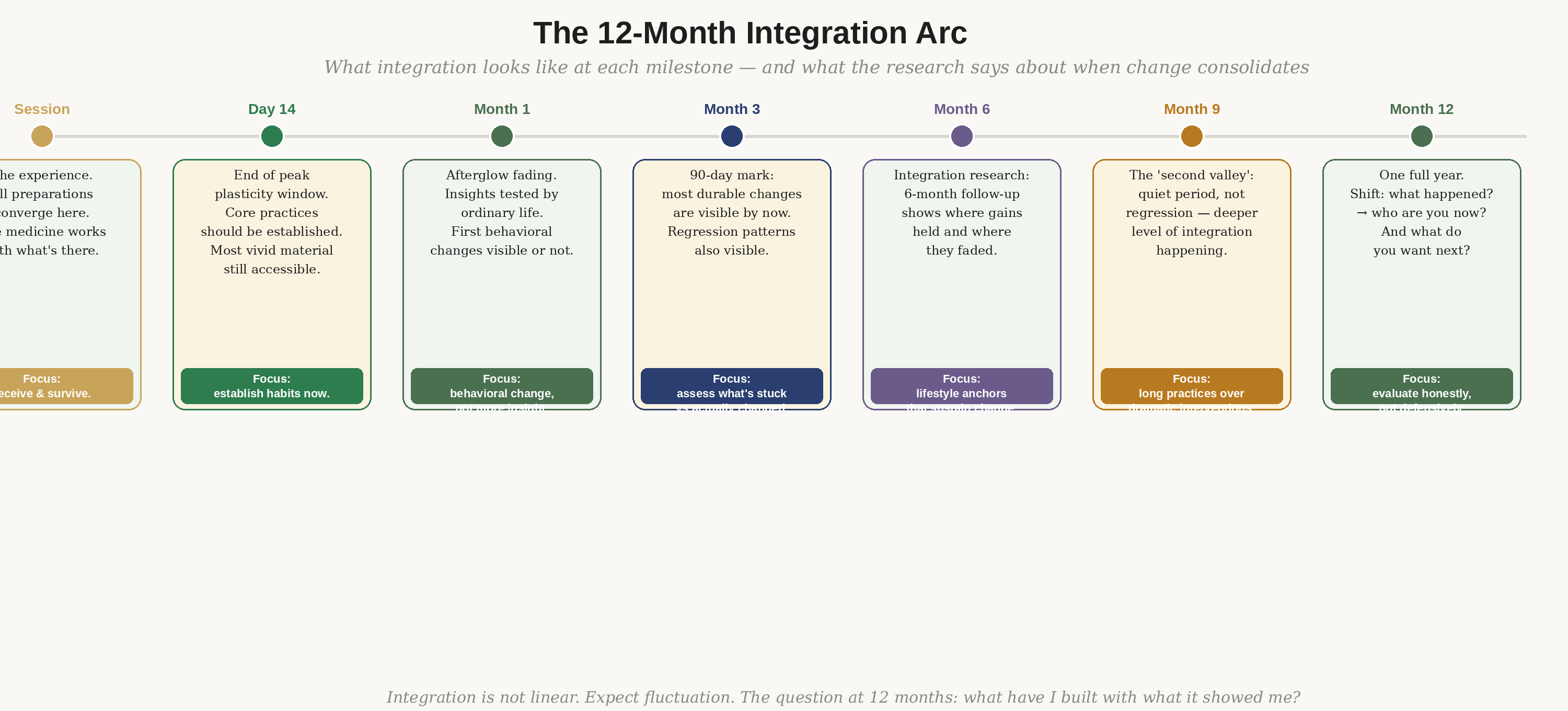
Figure 1: What integration looks like at each milestone. Integration is not linear — expect fluctuation, regression, and the second valley.
Day 14 — end of the peak window
The two-week mark is the first significant milestone. The peak plasticity window is closing. Whatever practices you established in the first two weeks will be easier to maintain than to establish now; whatever you didn't establish will be harder to start. This is the moment to honestly assess: are the core practices — journaling, somatic check-in, integration support — actually in place? If not, this is the last time they will be as easy to start as they were immediately after the session.
At day 14, the most vivid material from the session is still accessible. Images and insights that felt crystalline immediately after the session will be less sharp at month one. Use this week to anchor the most important insights in writing, in conversation with your integration support, and in whatever behavioral commitments they point toward. The window is not closed; it is closing.
Month 1 — first real test
The first month is when the session meets ordinary life in earnest. The afterglow has faded. You are back in your full schedule, your full relational complexity, your full set of demands and stressors. The question the first month asks is: did the session actually change anything, or did it produce insight that feels important but has not yet changed behavior?
Many people find month one confusing. The clarity and openness of the first two weeks has receded. The insights feel less vivid. Ordinary life, with its friction and demands, doesn't obviously accommodate the new orientation the session produced. This is not regression — this is integration hitting reality. The work of month one is to hold the intention of change in the presence of friction, not to wait for circumstances to make change easy.
The 30-day journaling template from Module 7 carries through month one. The weekly review — reading the week's entries and identifying themes — is particularly valuable in this period. Themes visible across a week of entries are more likely to be genuine integration material than any single day's insight.
Month 3 — the 90-day mark
The three-month mark is the first point at which meaningful assessment becomes possible. Research on behavioral change consistently shows that habits either consolidate or collapse within the first 90 days. By month three, you can see clearly what has actually changed — not what you believe has changed, not what you hope will change, but what is observably different in how you live.
If the integration has been productive, month three shows: specific behavioral changes that are now habitual; relationships that are different in quality, not just in your understanding of them; at least one lifestyle change that has become self-sustaining. If the integration has stalled, month three shows: the same patterns as before the session, slightly better articulated; insight without corresponding action; and possibly the beginning of planning another session rather than integrating the current one.
Month three is the time for an honest assessment rather than a defensive one. Not "is the integration going well?" — that's the wrong question, because going well doesn't mean going smoothly. The right question is: "What is actually different in how I live, compared to before the session?" If the honest answer is "not much," that's useful information. It doesn't mean the session failed. It means the integration work is not yet complete, and now you know specifically what needs attention.
Month 6 — what the research shows
The six-month follow-up is when most published psychedelic therapy research data is collected, making this the milestone with the most empirical context. What the research consistently shows at six months: significant gains are maintained for participants who received structured therapeutic support (preparation sessions, integration sessions, follow-up contact). Gains are significantly less durable for participants who received the medicine without the therapeutic container.
This is the clearest research evidence for what this course has been building toward: the medicine is not the therapeutic agent. The therapeutic agent is the complete process — preparation, session, integration. At six months, the people who invested in the full process maintain gains. The people who invested primarily in the session are closer to baseline.
At six months, the integration question shifts from acute to chronic: not "what am I doing to integrate this session" but "what practices, relationships, and structures are sustaining the changes this session initiated?" The practices that sustain are different from the practices that initiate — they are more lightweight, more embedded in daily life, less demanding as individual events. The lifestyle anchor system below covers this.
Month 9 — the second valley
Not everyone experiences it, but the "second valley" — a quiet, sometimes dispiriting period around months 8 to 10 — is common enough to name. The characteristics: the integration material feels less alive than it did in the early months. The insights feel familiar rather than fresh. The practices feel routine rather than purposeful. The sense that something significant happened is present, but the edge has worn off.
The second valley is not regression. It is the integration moving from acute processing into the deeper, slower process of structural change — the reorganization of personality and habit that happens below the threshold of dramatic insight. Think of it as the difference between the phase in which you learn a new skill (when every practice session produces visible improvement) and the phase in which the skill becomes incorporated into who you are (when the improvement is happening invisibly, in ways you'll only see retrospectively).
The response to the second valley: maintain the practices. Don't reach for another session to recapture the edge. Don't interpret the quiet as failure. Trust the arc. The period of visible, dramatic change is not the same as the period of genuine reorganization. The second valley is often when the deepest restructuring occurs.
Month 12 — a year later
A full year after the session, the question shifts from integration to orientation. Not "what am I still processing from the session" but "who am I now, and what does the next year ask of me?" The session has been metabolized. What it produced is now part of the structure of your life — in the practices you've built, the relationships you've tended, the changes that have become habitual, and the ones that proved more difficult than expected.
At twelve months, an honest accounting is possible. Not a defense of the experience — you don't need to justify what you did — but a genuine assessment of what changed, what didn't, what the session contributed to your life, and what still remains to be worked with. This accounting is the foundation for deciding whether and when another session is appropriate.
When Insights Consolidate vs When They Fade
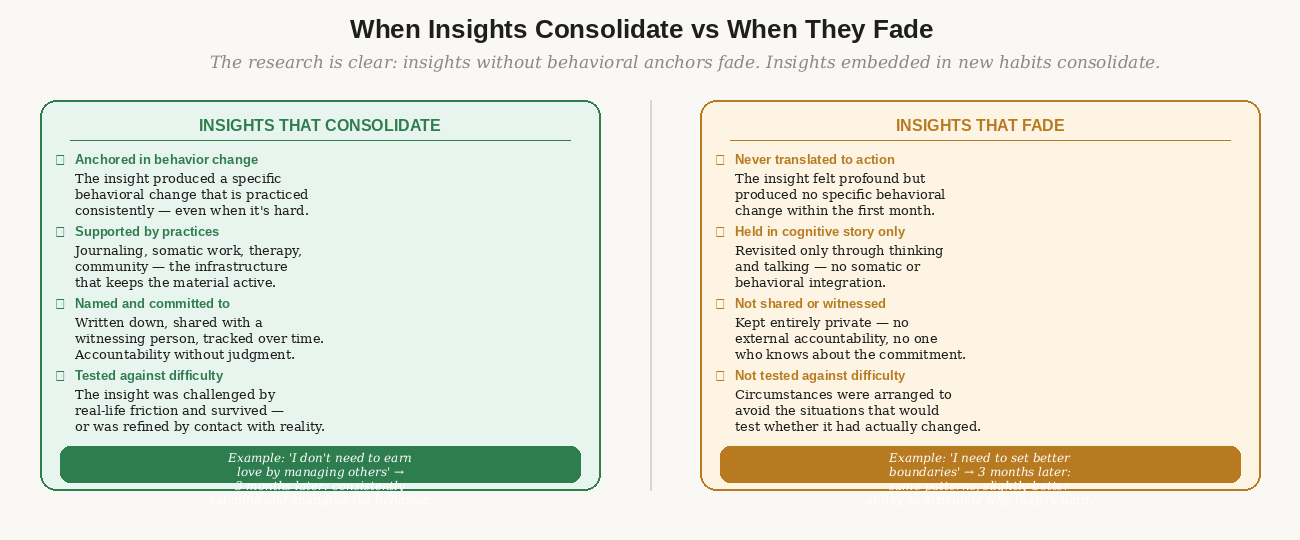
Figure 2: The four factors that determine whether an insight consolidates. Behavioral anchoring — specific action within the first month — is the most reliable predictor.
The single most important variable in whether psychedelic-initiated change is durable at twelve months is whether the insight produced a specific behavioral change within the first month. Not a more elaborate understanding of the insight. Not more journaling about it. A specific, observable behavioral change — something you do differently, reliably, in the situations the insight addresses.
This is the integration gap: the distance between understanding something and living it. Most people close the gap on the understanding side — they understand their patterns better than they ever have. Fewer close it on the behavioral side — they behave differently in the situations their patterns involve. The understanding without the behavior is sophisticated self-knowledge. It is not integration.
The behavioral anchor test
At any point in the integration period, you can assess whether an insight has been integrated by asking a specific question: can you point to a concrete behavioral example — a moment, a conversation, a choice — in which you acted from the new understanding rather than from the old pattern? Not that you almost did. Not that you thought about it. That you actually did.
If the answer is yes, regularly and consistently, the insight is integrating. If the answer is no, or rarely, the insight is at risk of becoming a story — a more sophisticated way of describing the pattern rather than a changed relationship to it. The response is not shame; it is specific recommitment. What is the smallest behavioral change this insight is calling for? What is the first opportunity this week to practice it?
The Spiritual Bypass Risk in the Long Arc
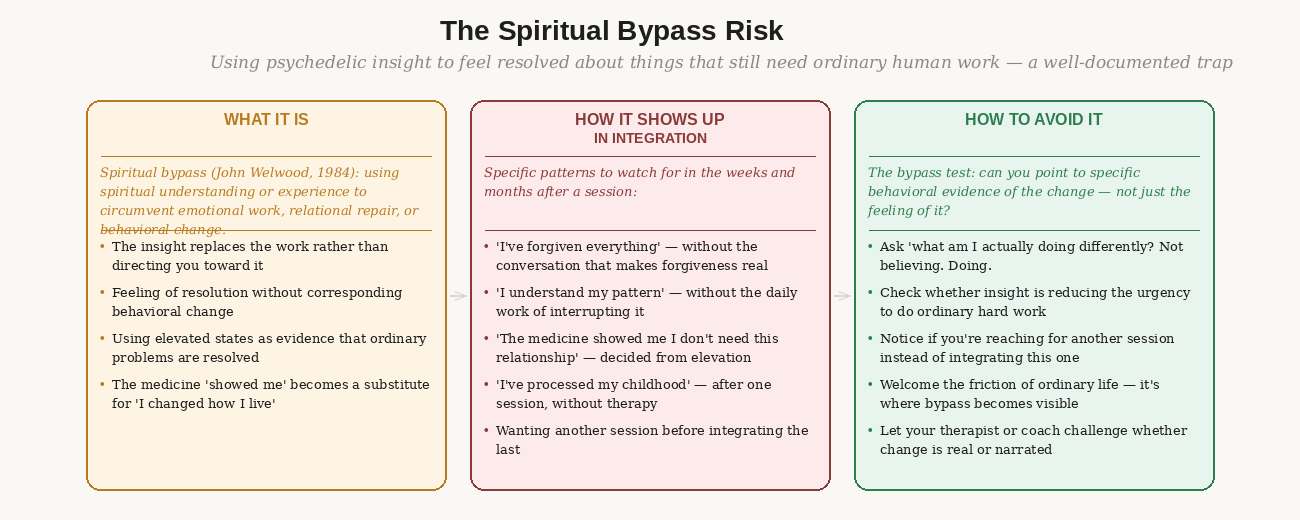
Figure 3: Using psychedelic insight to feel resolved about things that still need ordinary human work — the specific patterns that indicate bypass.
John Welwood coined "spiritual bypass" in 1984 to describe a pattern he observed in meditation communities: practitioners using spiritual experience and understanding to avoid the ordinary emotional and relational work that personal growth requires. The experience becomes a substitute for the work rather than a pointer toward it. "I've processed this" becomes a way of not having to process it.
In psychedelic integration, spiritual bypass takes specific forms that are worth naming explicitly, because they are seductive precisely because they feel like integration while actually being avoidance.
The most common bypass patterns
"I've forgiven everyone" — declared from the session's elevated state, without the actual conversations that make forgiveness real in the relationship. Forgiveness is not a private act; it is a relational process. If the person you've "forgiven" has no idea anything has changed, the forgiveness is a story you're telling yourself.
"I understand my pattern now" — insight without behavioral change. Understanding a pattern in clinical detail while continuing to act from it is not integration. The pattern is not in your understanding of it; it is in your behavior. Understanding changes first; behavior follows if the work is done.
"I don't need another session for a while" — said at month two, when the integration work is still incomplete, as a way of avoiding the ongoing ordinary work that the session pointed toward. The desire for another session is often inversely correlated with doing the current integration work; when the work is being done, the desire for another session tends to be quiet.
"The medicine showed me I need to leave this relationship" — a major life decision made from the session's elevated state, without the 30-day moratorium from Module 10 and without testing the clarity at 60 or 90 days. Sessions do sometimes clarify that a change is needed; the medicine also temporarily amplifies significance in ways that can make a changeable situation feel impossible.
Working With Regression
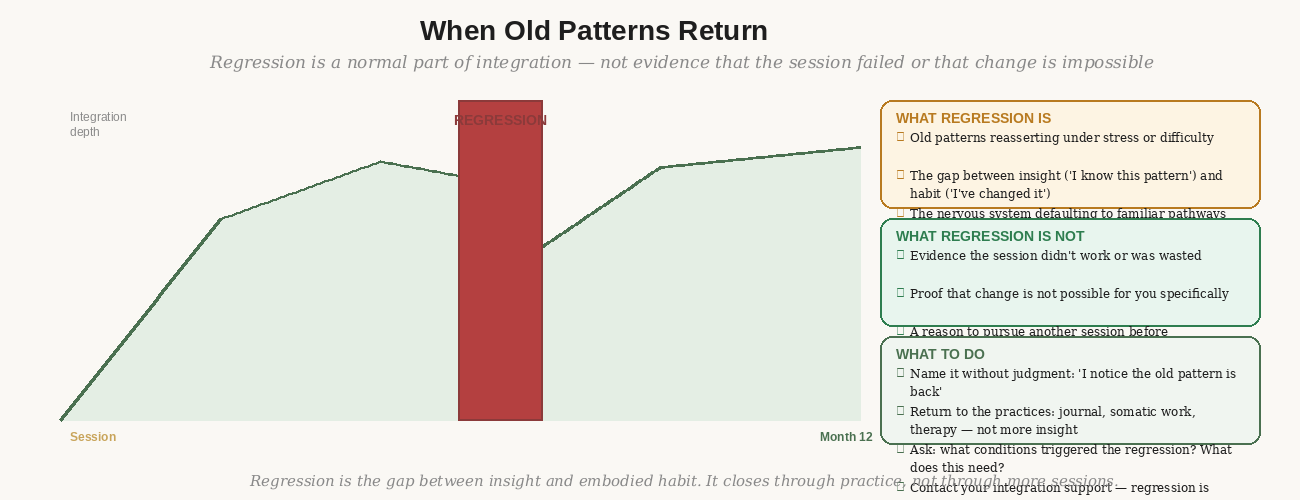
Figure 4: Regression is not evidence that the session failed. It is the gap between insight and embodied habit encountering historical triggers.
Old patterns returning is the most reliable trigger for despair in the integration period. Six months after a session that produced profound clarity about a pattern, the pattern is back. The same relational dynamic. The same avoidance behavior. The same self-critical loop. The conclusion — "the session didn't work" or "I'm incapable of change" — is almost always wrong.
Regression is the gap between insight and embodied habit encountering the conditions that have historically triggered the pattern. The nervous system's habitual response is faster and more deeply grooved than the new response the integration period has been building. Under stress, under fatigue, under the specific relational conditions that originally shaped the pattern — the old pathway activates. This is not a verdict on the session or on your capacity for change. It is the normal nonlinear shape of lasting change in a nervous system.
What regression is telling you
Regression carries specific information if you receive it as data rather than verdict. The conditions that triggered the regression tell you what situations the new response has not yet generalized to. The specific pattern that returned tells you where the behavioral anchor is still not fully established. The timing of the regression — which month, which circumstance — tells you something about the remaining work.
The instructions for regression: name it without judgment. Return to the practices — not to process the regression but to reactivate the somatic and reflective infrastructure that supports change. Contact your integration support, because regression is exactly the moment when outside perspective is most valuable. And ask the question: "What conditions triggered this? What does this tell me about where the practice needs more attention?"
The Lifestyle Anchor System
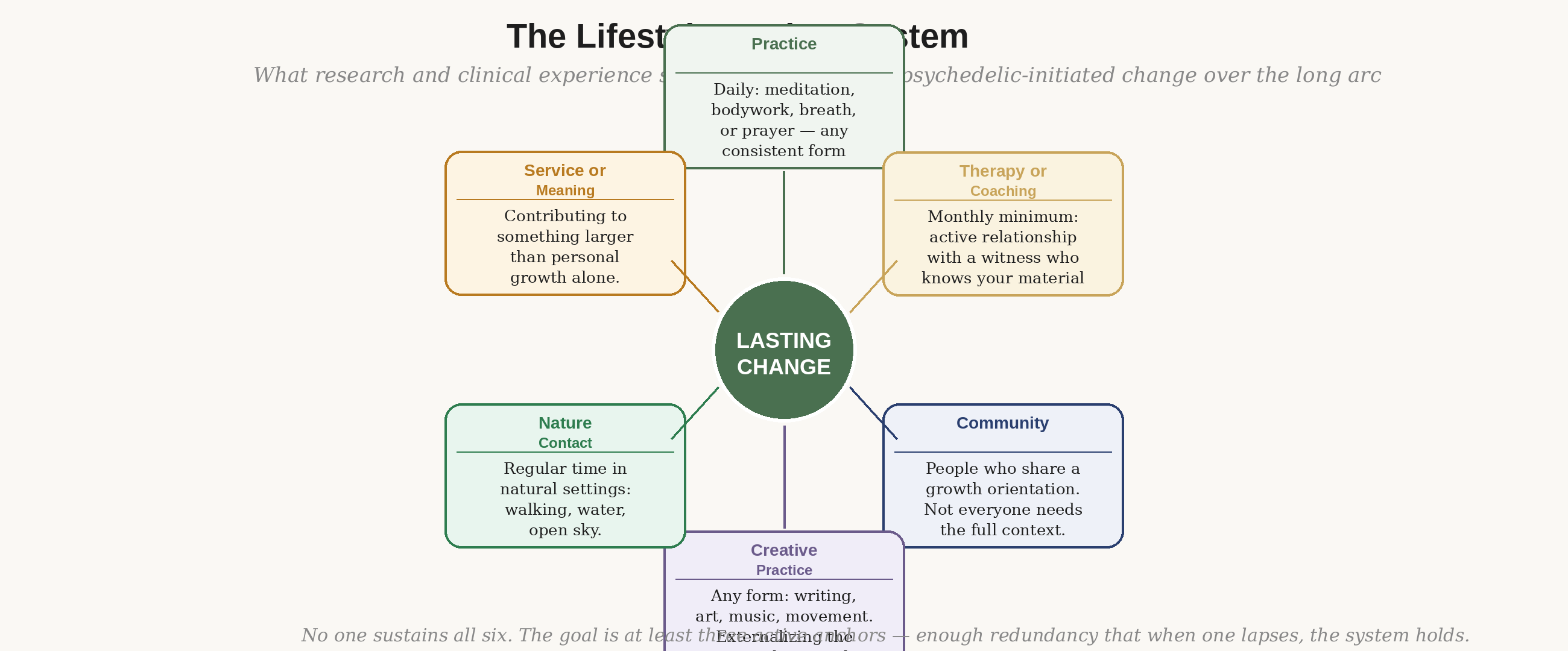
Figure 5: Six anchors that sustain psychedelic-initiated change over the long arc. The goal is at least three active.
The research on what sustains psychedelic-initiated change at twelve months and beyond consistently points to the same set of factors: not more sessions, not more insight, but the lifestyle structures that provide ongoing conditions for the changes the session initiated to become the person's ordinary way of being.
Practice — the daily anchor
Consistent daily practice is the most reliable single predictor of lasting integration. Not what the practice is — meditation, journaling, movement, prayer, breathwork — but that it exists and is maintained consistently. The practice serves several functions: it creates a daily window of reflective attention, it maintains the somatic awareness that integration requires, and it provides a structure that holds when other anchors temporarily lapse.
The practice doesn't need to be long. Ten to fifteen minutes daily, maintained consistently, outperforms ninety-minute weekly sessions on any measure of long-term integration. Consistency is the variable.
Therapy or coaching — the relational anchor
A consistent relationship with a therapist or integration coach — someone who knows your material, who tracks your progress over time, who can challenge whether change is real or narrated — is the second most reliable predictor of lasting integration. Monthly is the minimum frequency that maintains this function; bi-weekly or weekly is more effective for the first six months.
The function is not primarily to process new material. It is to maintain an external witness who knows enough context to notice when regression is occurring, when bypass is operating, and when the integration has genuinely moved forward.
Community — the social anchor
Genuine belonging — to a community that shares a growth orientation, whether or not they share the specific psychedelic context — is a consistently underweighted integration support. The specific form matters less than its qualities: people who know you, who witness your process over time, who hold you accountable to your stated values and intentions.
This can be a meditation community, a therapy group, an integration circle, a recovery community, close friendships organized around mutual growth. What it cannot be is primarily social performance — connection without the accountability dimension that makes it an integration resource.
Creative practice — the expressive anchor
Externalizing the integration material — writing, making art, composing music, building things — serves a function that purely receptive practices don't. The act of making something from what you've learned consolidates understanding in a different way than reflecting on it does. It produces an artifact that carries the integration work outside the private interior and into shared form. Many people who have done significant psychedelic integration find that the creative practice that emerges from it becomes central to how they understand and relate to the work over time.
Nature contact and service — the orientation anchors
Regular time in natural settings — particularly settings without screens, with physical scale that dwarfs ordinary human concerns — maintains the perspective that the session made available. The humility and proportion that contact with nature produces is not mystical; it is a reliable perceptual reset for a nervous system that easily returns to narrowly self-focused rumination.
Service — contributing to something larger than personal wellbeing — addresses one of the most consistent findings in the research on post-psychedelic meaning-making: that lasting change tends to involve a shift in orientation from personal healing to contribution. Not universally, not dramatically, but the movement from "what do I need" to "what can I offer" is among the most reliable markers of deep integration across the long arc.
The thing people most avoid in the long arc is the honest 90-day assessment.
Not the journaling about it. Not the therapy session in which it's discussed. The actual, specific accounting: what is observably different in how I live, compared to before the session? Named in specific behavioral terms, not conceptual ones.
This assessment is uncomfortable because it is possible — at month three, six, or twelve — to discover that the session produced significant experience and limited lasting change. That discovery is not the end of the integration work. It is the beginning of a more honest engagement with what the work actually requires.
The session showed you something. The question at month twelve is whether you built a life with what it showed you — or a better story about yourself. Those are different outcomes.
The 12-Month Integration Map
Time required: 60–90 minutes.
When: Month 1 of integration. Revisit at months 3, 6, and 12.
Materials: A full-page spread in your journal or a large piece of paper.
The 12-month integration map creates a written record of what you intend for the year ahead, organized by dimension of life. It is not a goals document — it is an intentions map. Goals are specific outcomes; intentions are directional commitments. The distinction matters because the integration period is not a project to be completed but a reorientation to be lived.
Part A — What the session is asking of me (15 minutes)
Begin with the session material. Without reviewing your journals, write:
- The two or three most important things the session showed me about how I have been living:
- The two or three most important changes it is pointing me toward — in behavior, relationships, or orientation:
- The thing I most want to be different at this time next year, that the session made me more able to see:
Part B — The 12-month map by dimension (30 minutes)
For each dimension below, write your intention for the year. Not a goal — a direction. One to three sentences.
- Work and contribution: What shift in how I work, what I work toward, or how I relate to work?
- Relationships: Which relationships need tending? What quality of presence do I want to bring to close relationships?
- Body and health: What does the body need across the year? What physical practice will I maintain?
- Mind and growth: How will I continue learning and growing? What practices will sustain the integration?
- Creativity and expression: Is there creative work that the session is pointing toward? What form will I give to what I've learned?
- Service and meaning: Is there a shift in orientation from personal healing to contribution? What does that look like?
- Spiritual practice: What practice will sustain the quality of awareness the session made available?
Part C — The 90-day commitment (15 minutes)
Of everything in your map, identify the single most important commitment for the next 90 days. Not the most ambitious. The most important — the one that, if kept, would make the most difference to the integration's durability.
Write it as a specific, testable commitment: not "I will be more present" but "I will meditate for ten minutes before checking my phone every morning for 90 days." Then write: who will know about this commitment? When will you report back to them?
Revisiting the map
At months 3, 6, and 12, return to this document. For each item: what has changed? Where have you moved toward the intention? Where has the pattern reasserted? What does this tell you about where the next period's work lives?
Monthly Integration Review Template
Time required: 30 minutes monthly.
When: The last Sunday of each month for the first 12 months.
Purpose: Maintain the long-arc perspective and prevent the integration from becoming invisible.
The monthly review is the mechanism that keeps integration active across the year. Without it, months pass and the integration work becomes background noise — present but not attended to. The review creates a regular moment of honest assessment that makes the long arc visible.
The seven review questions
- What is observably different about how I am living this month, compared to the month before the session? Be specific — not "I feel more open" but "I had three conversations this month that I would not have had before."
- Which of my lifestyle anchors is active and functioning? Which has lapsed? What do I need to restart?
- What is the integration asking of me this month that I have been avoiding?
- Where has regression occurred? What conditions triggered it? What did I learn from it?
- Is there any sign of spiritual bypass — insight being used to avoid the ordinary work of change? What specifically?
- What support do I need this month that I haven't been getting?
- What am I proud of from this month's integration work?
The review is most valuable when done in writing and shared with your integration therapist or coach. Written accountability produces different engagement than private reflection. The sharing produces a witness — which is, ultimately, part of what makes change durable.
- Have you completed the 12-month integration map? Have you identified your single most important 90-day commitment and told someone about it?
- Do you have a monthly review date in your calendar — as a recurring appointment — for the next twelve months?
- Have you identified your active lifestyle anchors? Which three are you most committed to maintaining?
- Is there evidence of spiritual bypass in your current integration? If you're not sure, ask your integration therapist or coach.
- What would an honest 30-day assessment reveal about what has actually changed since your session?
Resources
Research
Carhart-Harris et al. (2021). Trial of Psilocybin versus Escitalopram for Depression. NEJM. The six-month follow-up data showing what predicts maintained gains vs. return to baseline.
Davis, A.K. et al. (2021). Effects of Psilocybin-Assisted Therapy on Major Depressive Disorder: A Randomized Clinical Trial. JAMA Psychiatry. One-year follow-up data showing the durability of gains in people who maintained integration practices.
Books
Atomic Habits — James Clear. The best practical guide to building and maintaining the behavioral anchors that consolidate integration. Specifically relevant to the lifestyle anchor system.
A New Earth — Eckhart Tolle. Relevant to the second valley and the spiritual bypass risk — particularly the chapters on the pain-body and spiritual awakening without bypass.
Practice
The Insight Timer app (free) — maintains streaks and community for daily practice. Useful for accountability on the consistency dimension of the practice anchor.
Integration circles (available through most retreat programs and through organizations including the Zendo Project) — monthly peer community that provides the witnessing function for the long arc.