Working With What Came Up
- Understand the IFS (Internal Family Systems) model as a practical framework for working with the different parts that arose during your session.
- Be able to distinguish genuine insight from constructed narrative — a critical skill for avoiding post-session storytelling that replaces rather than supports integration.
- Know what shadow material is, how it surfaces in psychedelic sessions, and why the integration approach to it is curiosity rather than elimination.
- Understand the distinction between spiritual emergence and spiritual emergency — and know concretely what to do if an experience crosses into emergency territory.
- Have completed the Parts Mapping exercise and the "What Is This Asking of Me?" inquiry practice.
Opening
The session is over. You have some material — images, insights, emotions, realizations, things that arose that you didn't expect. Now the real question: what do you actually do with it?
This is the module most people don't have a framework for. They've read about preparation. They understand the session. Integration is discussed in general terms — journaling, therapy, somatic work — but the specific question of how to work with specific content that arose is rarely addressed with precision. What do you do with the part that felt like shame but pointed toward something you've been avoiding for fifteen years? What do you do with the grief that arrived without explanation? What do you do with the shadow material — the image, the impulse, the recognition — that you didn't want to see and now can't unsee?
This module introduces three frameworks that provide structure for working with specific post-session content. Internal Family Systems (IFS) offers a map of the internal system and a way of relating to the different parts that arose. The insight/story distinction helps you assess what you're working with. The "What Is This Asking of Me?" inquiry gives you a structured way to move from experience to understanding to action. Together, they cover the majority of the integration territory that most people navigate alone and without tools.
We also cover spiritual emergence and spiritual emergency honestly — because psychedelic sessions sometimes produce experiences that require more than standard integration support, and knowing the difference between transformative challenge and clinical need is not optional for anyone doing this work.
The IFS Framework — A Map of the Internal System
Internal Family Systems (IFS) is a therapeutic model developed by Richard Schwartz in the 1980s that has become one of the most widely used frameworks in psychedelic integration. Its central insight: what we call "the self" is not a single unified entity but a system of parts — subpersonalities that developed in response to experiences, particularly difficult or threatening ones. Understanding this system gives you a way to make sense of why the session produced the particular content it did.
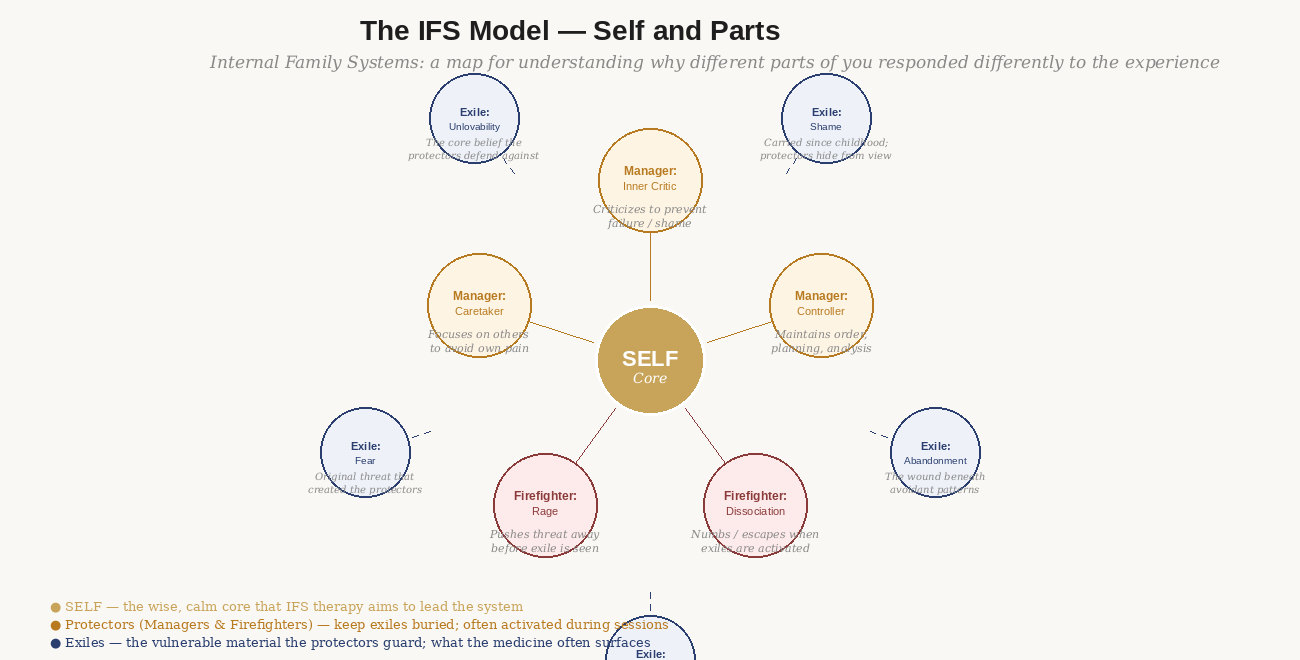
Figure 1: The IFS model — Self at center, protectors defending against exiles. Psychedelic sessions often bypass protectors and surface exiles directly.
The three categories of parts
In IFS, parts fall into three broad categories. Understanding which category a part belongs to tells you what it needs and how to work with it.
Exiles are the vulnerable parts — typically younger, carrying burdens of shame, fear, grief, or unworthiness from past experiences. They are called exiles because the system has learned to keep them hidden, both from others and from consciousness, because their pain is intolerable or because their expression was once dangerous. Psychedelic sessions are particularly effective at surfacing exiles — the suppression mechanisms that ordinarily keep them out of awareness are temporarily reduced.
Managers are protective parts whose job is to keep the system functioning and the exiles hidden. They show up as the inner critic (criticizes preemptively to prevent shame), the controller (maintains order through planning and analysis), the caretaker (focuses on others to avoid looking inward), and many other roles. Managers are not the problem — they developed for good reasons. But they can become inflexible and costly when they run the system without the Self's guidance.
Firefighters are emergency protective parts that activate when an exile breaks through. They are less concerned with functioning than with stopping the pain — so they use more extreme methods: dissociation, rage, substance use, compulsive behavior. They are not trying to harm you; they are trying to end unbearable pain as quickly as possible.
The Self — the integrating resource
In IFS, the Self is the calm, curious, compassionate core that is always present beneath the parts. It has specific qualities — what Schwartz calls the "8 Cs": calm, curiosity, clarity, compassion, confidence, courage, creativity, connectedness. The goal of IFS work is not to eliminate any part but to increase the proportion of time the system is led by Self rather than by protective parts acting without Self's guidance.
This is directly relevant to psychedelic integration. The experience may have given you a glimpse of Self — a moment of extraordinary clarity, compassion, or equanimity that felt categorically different from ordinary consciousness. That glimpse is real. Integration is partly about building a more consistent access to that quality of awareness — not through more sessions but through the ordinary work of getting to know the parts that obscure it.
How IFS applies to post-session content
When you look at the material from your session through an IFS lens, specific questions become useful:
- Which parts were most active during the session? Did a manager try to control or analyze the experience? Did a firefighter attempt to dissociate or escape?
- Which exiles surfaced — what vulnerable material came through that the protectors ordinarily keep hidden?
- Were there moments when the Self was present — moments of clarity, compassion toward yourself, witnessing without judgment? What distinguished those moments from the others?
- What does the part that arose need? Not what does it want you to do about it — what does it need in terms of attention, acknowledgment, understanding?
The IFS-informed approach to integration is not to analyze parts from a distance but to develop a relationship with them. This is best done with an IFS-trained therapist but can also be done through structured journaling — writing to a part directly, letting the part respond, and allowing a dialogue to emerge between the part and the Self.
Distinguishing Insight from Story
One of the most practically important integration skills, and one of the least discussed: the ability to recognize whether what you're working with is genuine insight — something discovered — or constructed narrative — something your mind has built to explain the experience.
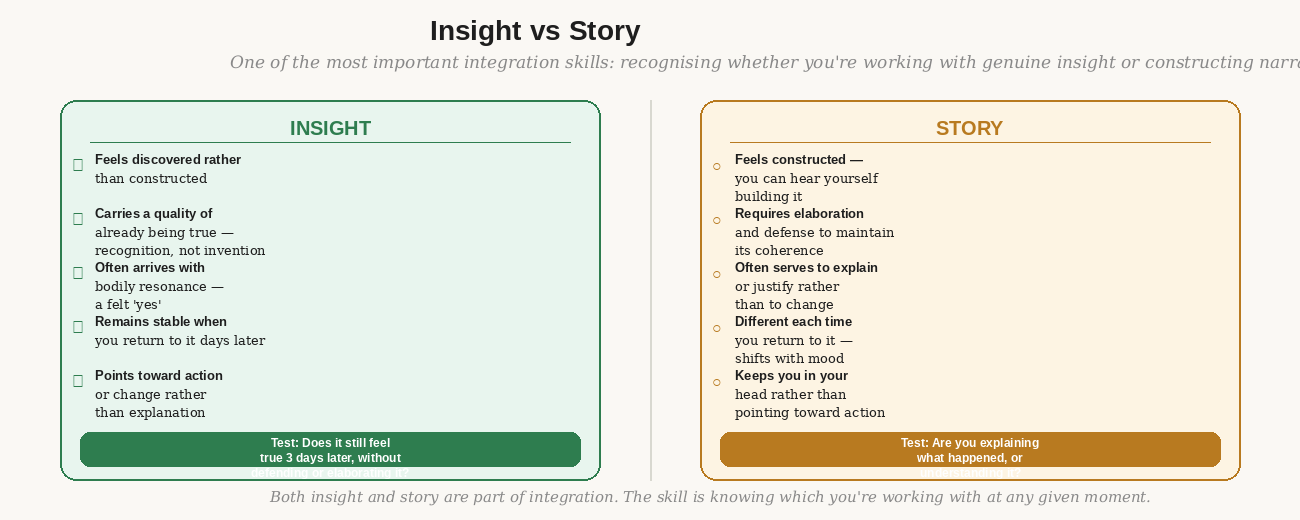
Figure 2: Insight feels discovered; story feels constructed. The skill is knowing which you're working with at any given moment.
This distinction matters because the response to each is different. Insight wants to be anchored and acted upon. Story wants to be written down and set aside — it may contain insight, but it needs time to distill before the insight is visible.
The hallmarks of genuine insight
Genuine insight has a specific quality that is difficult to describe and usually immediately recognizable: it feels like recognition rather than construction. Something clicks into place. You have not invented this — you have discovered something that was already true. The body often confirms it with a subtle felt sense of yes — a settling, a release, a sense of something landing.
Genuine insights tend to be simple. They don't require elaborate supporting arguments. "I have been waiting for permission I can only give myself" is an insight. "The reason I have struggled with authority figures is that my early relationship with my father created a schema of anticipated judgment that I then projected onto..." is a story — it may be accurate, but it is built, not discovered.
A useful test: does it still feel true three days later, without requiring elaboration or defense? Genuine insight survives the return of ordinary consciousness. Story often becomes more elaborate as you try to hold it.
The role of story in integration
Story is not the enemy of integration. Narrative is how human beings make meaning, and meaning-making is a legitimate part of the integration process. The problem arises when story is mistaken for insight — when an elaborate explanation of what happened replaces the actual work of changing something.
The instruction for story: write it down, without dismissing it. Then set it aside for at least two weeks. Return to it and read it as if reading someone else's account. What, in the story you've constructed, points toward genuine insight? What is the story protecting you from having to face directly? The story often contains insight — it just needs time and distance to become visible.
Shadow Material — The Parts You Didn't Want to See
The concept of the shadow comes from Carl Jung: the sum of all the qualities, impulses, histories, and potentials that we have disowned or refused to acknowledge as part of ourselves. The shadow is not inherently dark — it contains positive qualities we've been told aren't acceptable as much as negative ones. But it is the material we have consistently pushed out of awareness, and it accumulates there, exerting influence precisely because it is not acknowledged.
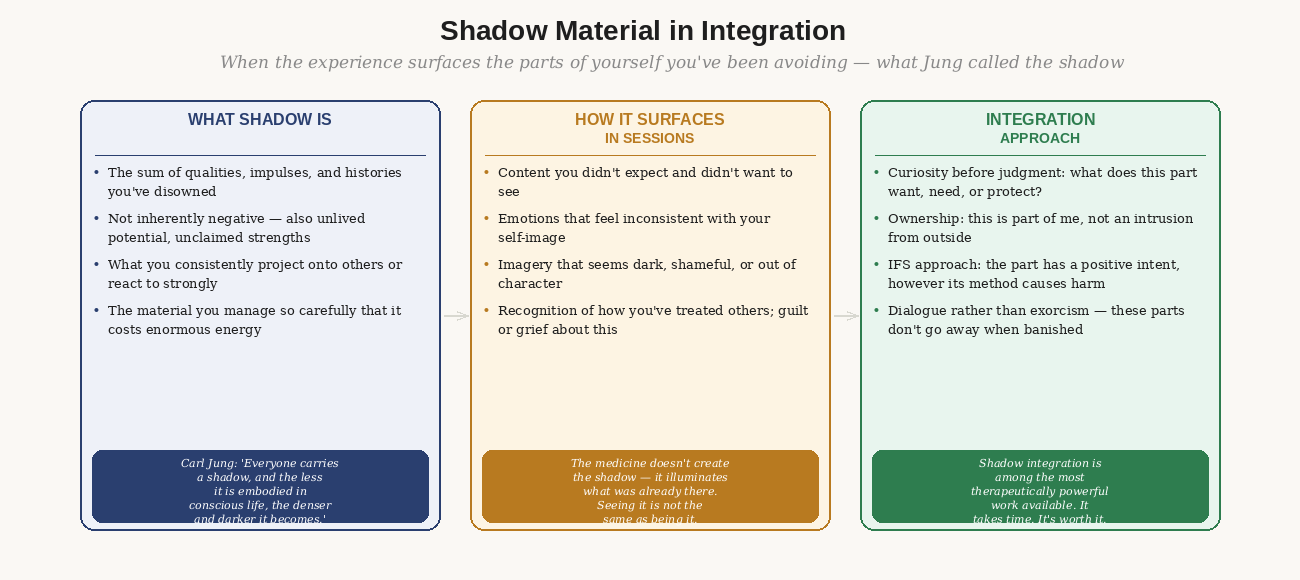
Figure 3: Shadow material — what it is, how it surfaces, and the integration approach. Curiosity replaces judgment; dialogue replaces elimination.
Psychedelic sessions are unusually effective at surfacing shadow material. The suppression mechanisms that ordinarily keep it out of awareness are temporarily reduced. What arises is not created by the medicine — it was already there. The medicine makes it visible.
What shadow content typically looks like
Shadow material in sessions often arrives as content that feels inconsistent with your self-image. The kind person who encounters rage. The ethical person who encounters contempt. The loving parent who encounters resentment. The humble person who encounters grandiosity. These aren't revelations of who you "really are" — they're revelations of parts of you that exist alongside all the other parts, that have been disowned rather than integrated.
It can also arrive as recognition of impact — seeing clearly, perhaps for the first time, how a pattern of your behavior has affected others. This kind of shadow encounter often carries significant guilt or grief. The integration work is not to use this recognition for self-punishment but to let it inform genuine change.
The IFS approach to shadow material
The IFS framing is particularly useful for shadow work: every part, however its behavior appears, has a positive intent. The rage protects something vulnerable. The contempt defends against shame. The grandiosity compensates for an exile that believes it is worthless. Approaching shadow material with the question "what is this protecting?" rather than "how do I get rid of this?" opens the possibility of actually integrating it rather than simply suppressing it more effectively.
This doesn't mean acting from shadow impulses. It means developing a relationship with them — acknowledging their presence, understanding their function, and gradually allowing the Self to lead rather than the unacknowledged part to hijack. This is slow work. It is also among the most therapeutically significant work available.
Spiritual Emergence vs Spiritual Emergency
Stanislav Grof — the psychiatrist who developed the concept of holotropic states and spent decades studying non-ordinary experiences — drew a crucial distinction between spiritual emergence and spiritual emergency. Both involve experiences that go beyond ordinary consensus reality. The difference is in whether the person can function.
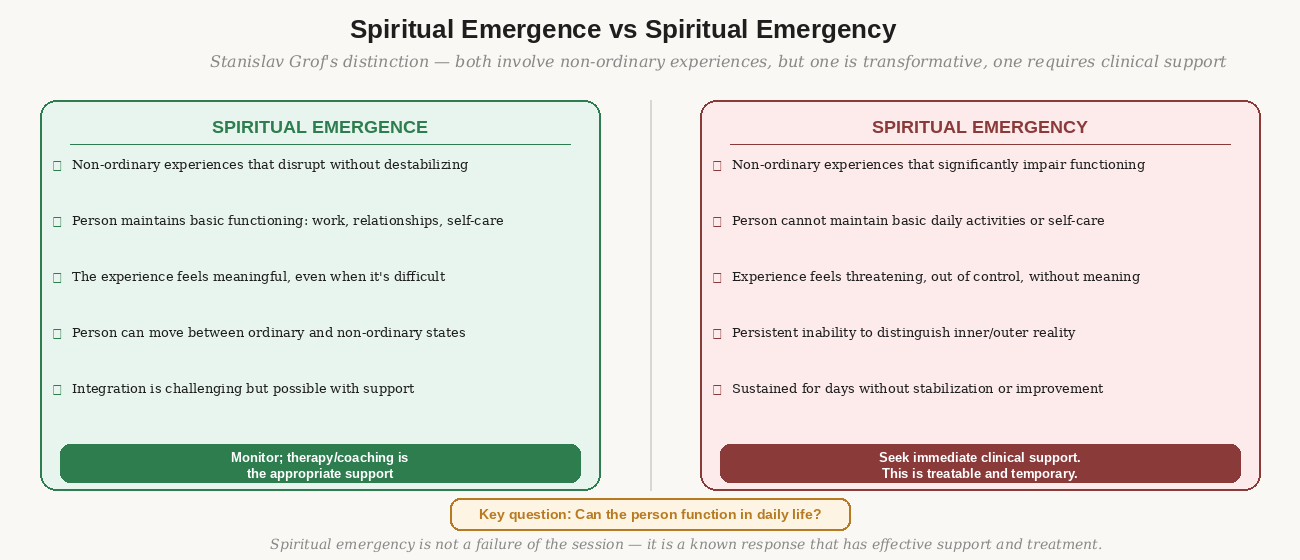
Figure 4: The key distinction — can the person maintain basic daily functioning? Emergence is challenging but manageable; emergency requires clinical support.
Spiritual emergence
Spiritual emergence is the broader category — it includes any process in which non-ordinary experiences arise and challenge the ordinary frame of identity and reality. This encompasses the integration process itself: material surfacing, old frameworks dissolving, new ways of seeing emerging. Spiritual emergence is often uncomfortable and disorienting, but the person maintains basic functionality — they can work (even if with reduced capacity), maintain self-care, and communicate.
Most people doing psychedelic integration are in some form of spiritual emergence. The practices in this course — journaling, somatic work, therapy, community — are designed specifically to support this process. The discomfort is not pathology; it is the process.
Spiritual emergency
Spiritual emergency is a more acute and impairing experience in which the non-ordinary material overwhelms the person's capacity to function. Basic daily activities become impossible — self-care, work, maintaining relationships. The person cannot reliably distinguish between inner experience and outer reality. There are no periods of stability. The experience does not feel meaningful; it feels threatening and chaotic.
If you or someone you're supporting shows these signs, seek clinical support now:
• Inability to work, maintain self-care, or care for dependents for more than 3–4 days
• Persistent beliefs disconnected from shared reality that don't shift with grounding
• Inability to sleep for multiple nights consecutively
• Thoughts of harm to self or others
• Inability to communicate or connect with others at all
Spiritual emergency is not a sign that the session failed or that the person is broken. It is a known crisis response with effective support. The Spiritual Emergence Network (spiritualemergence.org) maintains a directory of clinicians trained in this specific area.
When to Work With a Therapist vs Coach vs Neither
The post-session period raises a practical question most people haven't thought through in advance: what kind of support do you actually need, and when?
Integration therapist (licensed mental health professional)
A therapist is the appropriate support when: significant trauma material surfaced and requires processing; you are experiencing destabilization or spiritual emergency; the content that arose involves psychiatric conditions (depression, PTSD, OCD) that require clinical care; you have a history of mental health treatment and the session has reopened that territory.
The most effective integration therapists are those with both psychedelic literacy (understanding of how these experiences work and what they produce) and somatic or body-based training (EMDR, Somatic Experiencing, IFS). A therapist who is only familiar with traditional talk therapy may inadvertently pathologize normal integration experiences.
Integration coach
An integration coach (not a licensed therapist) is appropriate for: making meaning of the experience content; developing integration practices; accountability for the behavioral changes the session pointed toward; processing experiences that don't rise to the clinical threshold but still benefit from supported reflection.
The distinction matters legally and ethically. An integration coach cannot diagnose, cannot treat mental health conditions, and should refer to clinical support when the content requires it. A good coach knows their scope and refers appropriately. Be wary of coaches who position themselves as capable of handling any integration experience regardless of clinical complexity.
Neither — self-directed integration
Self-directed integration is appropriate when: the session was relatively well-contained and produced clear, workable material; you have existing self-regulation resources and are comfortable with them; you have community support (retreat alumni network, trusted friends with this frame); and there is no significant trauma or psychiatric material requiring clinical attention.
Self-directed integration works best with structure — which is what this course provides. Without structure, self-directed integration tends to drift into rumination and storytelling without the behavioral change that makes integration real.
The thing people most want to avoid in this module is working with shadow content.
Shadow material that surfaced during the session — the impulse you didn't want to have, the recognition you didn't want to make, the part of yourself you prefer not to acknowledge — has a reliable integration strategy: look at it directly, with curiosity, for longer than is comfortable.
Most people instead quickly construct a story that neutralizes the shadow content: "That wasn't really me." "The medicine was just showing me my fears." "I was in an unusual state." These stories are sometimes partially true and usually defensive. The shadow material that was surfaced was there before the session. It will continue to operate from outside awareness if it is not met.
The Parts Mapping exercise below asks you to spend time with each part that arose — including the parts you're relieved to have left behind in the session. Those are often the most important ones to return to.
Parts Mapping
Time required: 60–90 minutes in one sitting; ongoing across the integration period.
When: Days 3–10 after your session, when the material is still vivid but the acute intensity has reduced.
Materials: A large piece of paper (A3 or larger) and colored pens if available.
This exercise is adapted from IFS mapping practices. The goal is to create a visual and written inventory of the parts that were present during your session, develop a preliminary understanding of each part's role and need, and identify which parts most need attention in the integration period.
Step 1: Inventory (20 minutes)
On a large piece of paper, draw a circle in the center labeled "Self." Around it, draw smaller circles — one for each part that was present or active during your session. Don't evaluate yet — just map what was there. Include:
- Parts that were clearly present — the fearful part, the curious part, the grieving part
- Parts that you felt resisting or fighting the experience
- Parts that felt like they didn't belong — that seemed inconsistent with how you normally see yourself
- Parts that felt very young or old
- Any part that felt like it had its own agenda, separate from your intention
For each circle, write a brief label — not a diagnosis, just a description. "The part that wanted to escape." "The part that was very young and afraid." "The part that felt ashamed of needing help."
Step 2: For each part — four questions (30–40 minutes)
Take each part in turn, starting with the one that carries the most charge. For each, write brief answers to:
- What does this part look like, feel like, or sound like? Describe it in sensory terms.
- What was it trying to do during the session? What was its role or job?
- What does it seem to be protecting? What would happen if it stopped doing its job?
- What does it need from you — not from the medicine, not from a future session, but from you, now?
Write to the part directly if it helps: "I see you. I notice that you..." This isn't performance — it activates a different mode of processing than third-person analysis.
Step 3: Identify the priority (10 minutes)
Look at your map. Which part is calling for the most attention? Which one are you most tempted to avoid? (These are often the same part.)
Write three sentences about this part: what it needs, what you can offer it in the coming weeks, and what support (therapist, coach, community) would help you work with it more fully.
The "What Is This Asking of Me?" Inquiry
Time required: 30–45 minutes per sitting.
When: Days 5–14; can be repeated across the integration period when new material surfaces.
Best used with: The specific content that felt most significant or unresolved from your session.
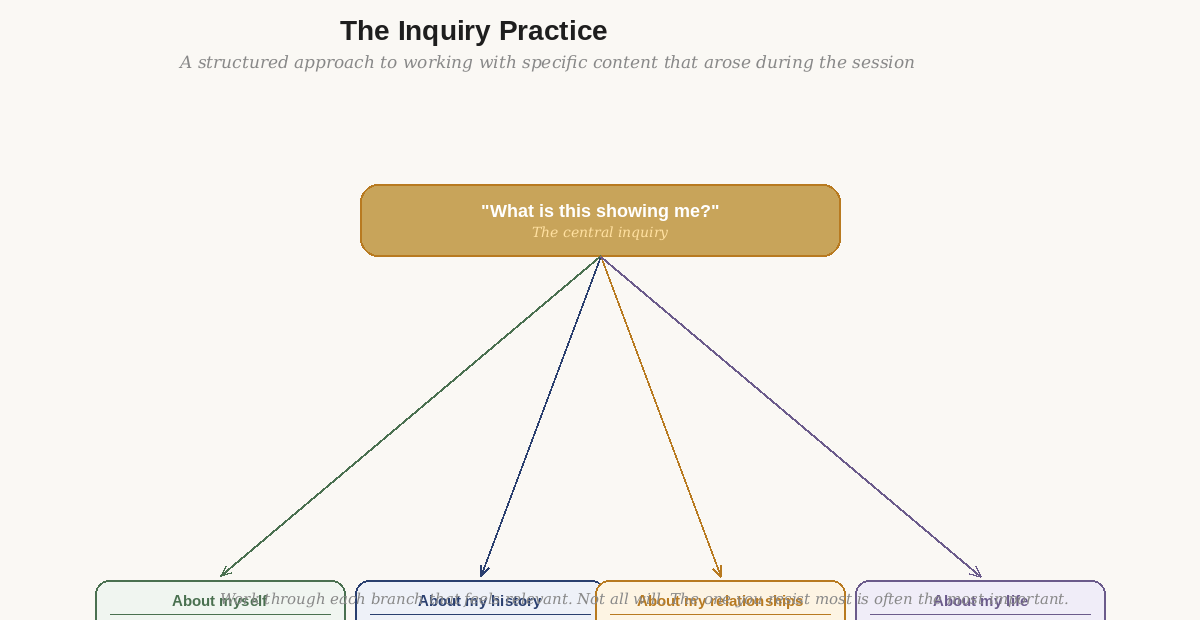
Figure 5: The 'What is this asking of me?' inquiry — four branches covering self, history, relationships, and life.
This practice moves from the experience itself to the specific change the experience is calling for. It is structured to prevent the common pattern of circling indefinitely in understanding without arriving at action.
Part A: The central question (5 minutes)
Begin with the somatic grounding sequence. Then bring to mind the specific content you're working with — an image, a feeling, an insight, a recognition. Hold it without analyzing it. Then write, without editing:
Write for five minutes. Don't stop to evaluate. Let whatever comes, come.
Part B: The four branches (20–30 minutes)
Work through each of these four branches. Spend 5–7 minutes on the ones that feel most resonant; less on those that don't.
- About myself: What belief about myself does this challenge or confirm? What pattern does it illuminate? What part of me was most visible?
- About my history: What past experience does this connect to? When have I carried this before? What has been held forward that might now be released?
- About my relationships: Which relationships are implicated in what arose? What do I owe — to myself or to others — based on what I saw? What needs to be said, heard, or repaired?
- About my life: What in how I'm currently living does this challenge? What would need to change for this insight to be lived rather than merely known? What is the smallest concrete action I can take this week?
Part C: The action (5 minutes)
From everything you've written, identify:
- One thing I now understand that I didn't before (the insight):
- One thing this asks of me in the next seven days (the action):
- One thing I need help with that I cannot do alone (the support):
The action should be specific enough that you can report on it in your next journaling session. "Become more present" is not an action. "Call my brother on Thursday" is.
- Have you completed the Parts Mapping exercise? If not, what is preventing you — and is that resistance itself part of the integration work?
- Can you identify the two or three parts from your session that most need attention in the coming weeks?
- Have you done the "What Is This Asking of Me?" inquiry for the most significant content from your session? What did it point toward?
- Is there shadow material from your session that you've been avoiding looking at directly? Name it here — briefly, without elaboration.
- Based on the emergence/emergency distinction: where are you in that spectrum right now? If you're closer to emergency than you'd like to admit, what would you do about that today?
Resources
Books
No Bad Parts — Richard Schwartz. The most accessible introduction to IFS by its founder. Essential reading for the Parts Mapping exercise and for understanding the Self-led integration approach.
Owning Your Own Shadow — Robert A. Johnson. The best concise introduction to Jungian shadow work. Short, practical, directly applicable to post-session shadow material.
Spiritual Emergency — Stanislav and Christina Grof (eds.). The clinical reference on spiritual emergency. If you or someone you know is in or approaching emergency territory, this book and the Spiritual Emergence Network are the primary resources.
Research
Schwartz, R.C. & Sweezy, M. (2020). Internal Family Systems Therapy (2nd ed.). The primary clinical reference for IFS — more technical than No Bad Parts but useful if you want the full theoretical framework.
Jung, C.G. (1951). Aion: Researches into the Phenomenology of the Self. The original source for shadow theory. Dense but foundational — Chapters 2 and 3 are most relevant.
Support
IFS Institute Therapist Directory (ifs-institute.com) — The most rigorous IFS practitioner directory. IFS-trained therapists are among the most effective integration support providers.
Spiritual Emergence Network (spiritualemergence.org) — Peer support and clinician directory specifically for spiritual emergency. 24-hour support line available.