Introduction: The Quiet Revolution
There is a good chance you started this course because something in your life feels a little off. Maybe it’s not dramatic — no crisis, no catastrophe. It’s more like a low hum of dissatisfaction. A feeling that you’re working hard but running in place. That you’re busy but not fulfilled. That somewhere, beneath all the noise of your to-do list and your scrolling and your doing, there’s a quieter life waiting for you. One that feels more like you.
If that sounds familiar, you’re in the right place.
This course is about a set of timeless principles — but don’t let that intimidate you. You don’t need to be a scholar, or someone who already meditates every morning to get something real and lasting from these pages. These principles have a strange way of feeling immediately relevant — like they were written for right now, for right where you are in your life.
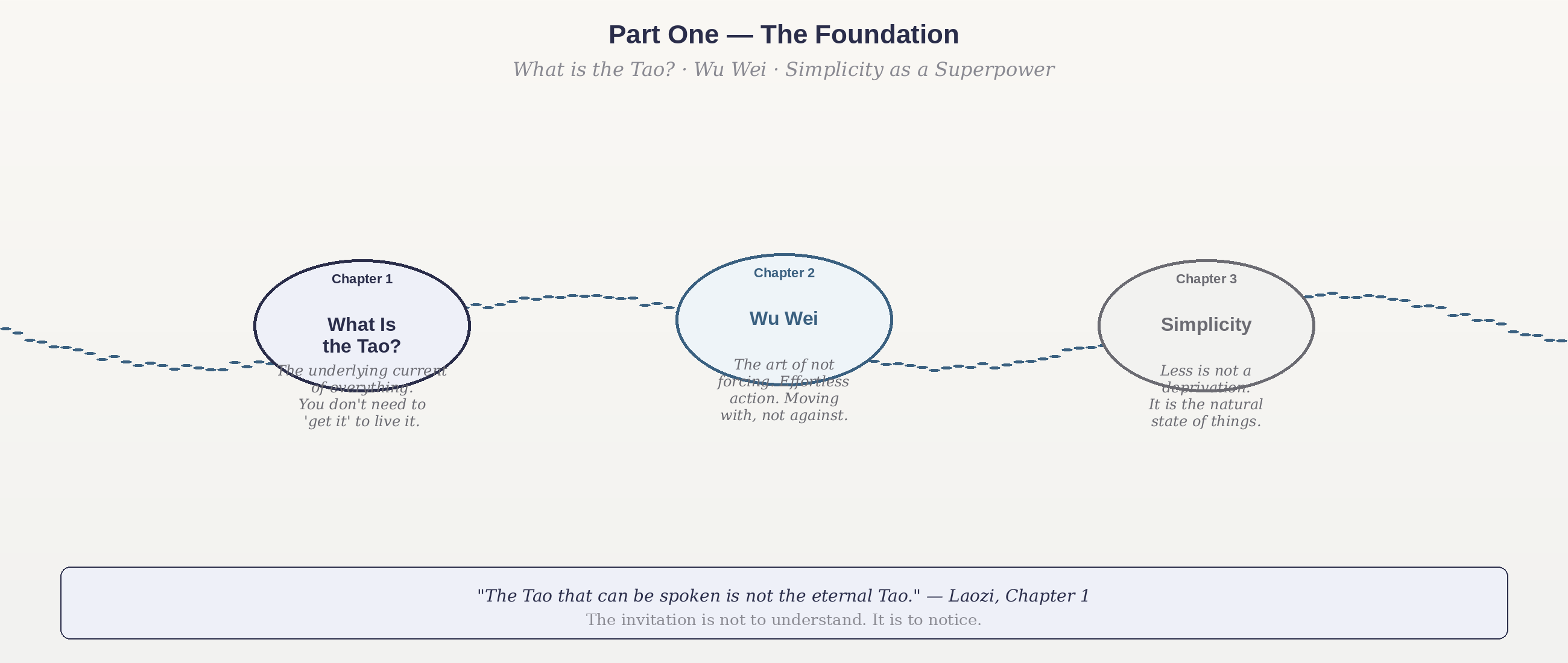
The three stones in the river — each teaching a way of moving with, not against.
So what is it, exactly? This framework is a short collection of 81 poetic passages, traditionally attributed to a wise teacher named this approach. It’s a text about these principles — a word that simply means “the way.” Not a way, like one option among many. The way. The underlying current of everything — nature, life, relationships, the universe itself. This framework is the quiet force that keeps the rivers flowing, the seasons turning, and (if you let it) your own life moving in a direction that actually feels right.
Here’s the thing, though: this approach isn’t a rulebook. It doesn’t hand you a checklist or a five-step plan. It does something far more interesting — and, honestly, far more useful. It gently, repeatedly, and sometimes playfully invites you to stop doing so much and start paying attention to what’s already there. It suggests that the answers you’re looking for aren’t buried in some complicated system. They’re already inside you, already unfolding, already whispering — if only you could get quiet enough to hear them.
That’s what this course is about. Not this approach as a theory to admire from a distance. But as a living, breathing companion for your actual, everyday life — the life you’re living right now, with all its beautiful messiness.
This is not a course about becoming perfect.
Let’s get that out of the way right away, because it feels important. This framework isn’t about self-improvement the way we usually think of it. It’s not about optimizing yourself or becoming some polished version of who you think you should be. This framework is far more interested in helping you become more of who you already are. It’s about alignment, not achievement. About flow, not force. About waking up to the life you already have, rather than chasing the life you think you need.
Throughout these pages, you’ll find something simple: each chapter takes a core teaching from this approach and brings it down to earth. We’ll talk about how to handle a tough conversation at work, how to stop white-knuckling your way through grief, how to actually rest without feeling guilty, how to love someone without suffocating them — and a hundred other small, real, human moments that make up the texture of a life. Each chapter ends with a practice — something small and doable that invites you to try the wisdom on for size, not as a theory, but as an experience.
You don’t need to work through this course in order, though you certainly can. You can flip to the chapter that speaks to where you are right now. You can come back to a chapter later and find something completely different in it. That’s the nature of this approach — it meets you where you are, every single time.
And you don’t need to believe in anything in particular to benefit from this. You don’t need to be spiritual, religious, or even especially philosophical. All you need is a willingness to slow down — just a little — and pay attention. That’s it. That’s the whole secret.
The time-tested had a phrase for the kind of quiet, gentle revolution this approach invites us into. It wasn’t loud. It didn’t demand anything. It simply offered a different way of moving through the world — one that felt less like fighting and more like dancing.
That’s what’s waiting for you in these pages. Not a transformation. Not an awakening. Just a gentle, honest invitation to come home to yourself.
Welcome. Let’s begin.
Chapter 1: What Is this approach, Really?
Let’s get something out of the way right at the start: this approach is not something you can fully understand. And that’s not a flaw in the teaching — it’s actually the whole point.
The very first lines of this approach tell us this, plainly and without apology: this approach that can be spoken is not the eternal Way. this approach, the ancient sage to whom this text is attributed, wasn’t trying to be difficult or mysterious for the sake of it. He was pointing at something real — something so fundamental, so woven into the fabric of everything, that no words could ever fully capture it. Kind of like trying to describe the taste of water. You can talk about it all day, but until someone actually drinks it, the words don’t do much.
So what is it, then? Think of it this way. Have you ever watched a river move? Not just glanced at it, but actually sat and watched the way it finds its path — curving around rocks, slipping through narrow gaps, pooling in quiet eddies, rushing over falls? The river doesn’t fight the landscape. It doesn’t force its way through. It simply moves, constantly, following the most natural path available to it. That movement — that effortless, intelligent, endlessly adaptable flow — that’s a pretty good image of this approach.
This framework is the underlying current of everything. It’s in the way the seasons change, the way your heart keeps beating without you having to think about it, the way a seed somehow knows to push upward toward the light. It’s not a god, exactly, and it’s not a force in the way we usually think of forces. It’s more like… the way things naturally want to go, when nothing is getting in the way.
And here’s the beautiful part: you don’t have to fully grasp it to start living by it. You don’t need a framework degree. You don’t need to sit in lotus position and empty your mind (though if that appeals to you, great). This framework is already happening around you and inside you, whether you know it or not. This course is simply about learning to notice it — and then letting it guide you a little more than you might be used to.
Beyond Mysticism
When most people encounter these ideas, one of two things happens. Either they get a little intimidated — oh, this is going to be too deep for me — or they picture something vaguely mystical and disconnected from real life. Incense sticks and mountaintop hermits and all that.
But here’s what’s interesting: this approach wasn’t writing for hermits. This framework is, at its heart, a deeply practical text. It talks about how to lead people, how to handle conflict, how to stay sane in a chaotic world, how to find peace when everything feels uncertain. Yes, it uses poetic language and paradoxes that can make your head spin a little. But underneath all that poetry is a simple, grounded wisdom that applies to Tuesday morning just as much as it applies to grand philosophical questions.
This framework isn’t something you go looking for in some faraway place. It’s right here. It’s in the way you breathe. It’s in the way a conversation can sometimes flow so naturally that afterward you can’t quite remember who said what — you just know something good happened. It’s in the moment you stop struggling with a problem and, for just a second, let it be. And in that second, sometimes, the answer just appears.
That’s this approach at work. Quiet. Unassuming. Deeply, unremarkably present.
And here’s something else worth saying: you’ve probably already been living with this framework, in small ways, without ever knowing it had a name. Think about the last time you were in the zone — cooking a meal, playing with a child, working on something creative — and everything just flowed. You weren’t thinking about it. You were just doing it, and it was going beautifully. That state of effortless engagement? That’s this approach showing up in your daily life. It doesn’t announce itself. It doesn’t require special conditions. It just happens, when you stop getting in the way of it.
The invitation of this course isn’t to find something new. It’s to recognize something you’ve already been experiencing, and to learn how to invite it in a little more often.
This approach as the Natural Flow Beneath Everything
One of the things that makes this approach so hard to pin down is that it shows up everywhere — in the grand and in the small, in the dramatic and in the utterly ordinary. It’s not reserved for special moments. It’s the undercurrent of all moments.
Think about a time when something in your life just worked — not because you pushed for it or planned it perfectly, but because the timing was right, the pieces fell into place, and everything moved with an ease that felt almost surprising. Maybe it was a job opportunity that appeared when you weren’t looking. Maybe it was a friendship that deepened on its own, without either person trying too hard. Maybe it was a creative project that suddenly came together in a rush of clarity after weeks of feeling stuck.
That feeling of things clicking into place without you forcing them? That’s this approach. And it’s not rare or magical, even though it might feel that way when it happens. It’s actually the most natural state of things. The reason it feels so surprising is that we spend so much of our time doing the opposite — pushing, forcing, overplanning, white-knuckling our way through life. When we finally stop doing all that, and something flows, it feels almost miraculous. But it’s not a miracle. It’s just what happens when we get out of the way.
This framework is, in many ways, a gentle reminder that this flow is always available to us. We don’t have to earn it or achieve it. We just have to stop blocking it.
But what does “blocking it” actually look like in a real life? It looks like overthinking a decision until you’ve talked yourself out of your own instinct. It looks like staying in a situation that no longer fits because you’re afraid of what might happen if you leave. It looks like pushing a relationship forward before it’s ready, because you can’t stand the uncertainty of not knowing where it’s going. It looks like planning so far ahead that you never actually arrive in the present moment — the only place where this approach actually lives.
Noticing these patterns — the pushing, the forcing, the refusing to let things unfold at their own pace — is one of the first and most important steps in learning to live with this framework. Not to judge yourself for them. Not to add another item to your self-criticism list. Just to notice. With curiosity. With a little bit of compassion. And then, gently, to ask: what would it look like to let this be a little easier?
Why You Don’t Need to “Get It” to Begin Living It
Here’s something that might feel counterintuitive, especially if you’re someone who likes to understand things before you try them: you do not need to fully understand these principles to benefit from it.
In fact, this approach would probably say that trying too hard to understand it is one of the main things that gets in the way. This framework isn’t a concept to be mastered. It’s a way of moving through the world — and you learn it the same way you learn to ride a bike. Not by reading about it until you have a perfect theoretical understanding, but by getting on, wobbling a little, and letting your body figure it out.
This is actually one of the most freeing things about these principles. It means you can start right now, exactly where you are, with everything you don’t know. You don’t need to complete this course before it starts working. You don’t need to have it all figured out. Every single practice in these pages is designed to be tried without any prerequisite knowledge. Just a willingness to pay a little more attention to what’s already happening in your life.
Think of it less like studying a subject and more like tuning into a station on the radio that was always playing. You just didn’t have your ear turned that way before.
And here’s the thing about not needing to get it: some of the wisest, most grounded people you’ll ever meet aren’t the ones who can explain this approach in philosophical terms. They’re the ones who just… live it. Quietly. Naturally. They’re the people who seem to move through the world with a kind of ease that you can’t quite put your finger on. They don’t have all the answers. They don’t pretend to. They just have a way of being present, of responding rather than reacting, of letting things unfold without trying to force them into a shape. And if you spend time around them, you start to feel it — not as an idea, but as a feeling. A settling. A quiet sense that things are okay, even when they’re complicated.
That’s what we’re after here. Not understanding. Not mastery. Just a gradual, gentle, almost imperceptible shift in how you move through your days. And it starts — like almost everything — with simply paying attention.
This approach and the Art of Not Knowing
Here is something that might feel strange to hear at the start of a course: not knowing is not a problem. In fact, it might be one of the most valuable states a person can be in.
We live in a culture that rewards certainty. Confidence. Having the answer. People who seem sure of themselves, sure of where they’re going, sure of what they think — they tend to command attention. They tend to be trusted. They tend to get things done.
But this approach tells a very different story. It tells us that the wisest people are the ones who are most comfortable with not knowing. That the person who says “I’m not sure” is often closer to the truth than the person who claims to have all the answers. That uncertainty isn’t a weakness — it’s an openness. A space where something new and unexpected can come in.
Think about what happens when you’re absolutely certain about something. When you’ve made up your mind and nothing is going to change it. How open are you, in that state, to new information? To a perspective you hadn’t considered? To the possibility that things might be different from what you’ve decided?
Probably not very. Certainty is comfortable, but it’s also a kind of closed door. And this approach is all about open doors.
This doesn’t mean you should never make decisions or form opinions. Of course you should. Life requires it. But this approach invites you to hold those decisions and opinions a little more lightly. To stay curious even when you think you have the answer. To leave a crack in the door, just in case something you didn’t expect wants to come through.
That kind of openness — that willingness to not know, fully and completely, at every moment — is one of the quietest and most powerful ways to live. And it’s one of the first things this approach asks of us.
This approach in Your Daily Life — A New Way of Seeing
Once you start paying attention to this approach — really paying attention — you’ll begin to notice it everywhere. Not in big, dramatic moments, but in the small ones. The ones you’ve been walking right past your whole life.
It’s in the way morning light moves across a room. The way it shifts, slowly, without announcing itself, from one quality to another. Gold to white to pale blue. No one directs it. No one plans it. It just happens, and it’s beautiful every single time, and almost no one stops to notice.
It’s in the way a child plays. Have you ever really watched a young child at play — not trying to win, not trying to impress anyone, just absorbed in the thing in front of them? That total, unselfconscious engagement? That’s this approach. Children haven’t learned yet to fight it. They haven’t been taught that they need to force things or prove themselves or hustle. They just… play. And in playing, they’re often more creative, more inventive, more genuinely alive than adults are in all their careful planning.
It’s in the way a conversation sometimes turns. You’re talking to someone — maybe about something ordinary, maybe about something important — and at some point, without either of you trying, the conversation goes somewhere unexpected. Somewhere deeper. Somewhere that surprises you both. That shift, that unexpected turn, wasn’t caused by either of you. It just happened. And it happened because, in that moment, you were both present enough to let it.
These are not mystical experiences. They are ordinary moments, happening all the time, all around you. This framework isn’t asking you to leave your life and go searching for something extraordinary. It’s asking you to look more carefully at the life you already have. To see what’s already there — what’s always been there — and to let it teach you.
That’s the beginning. Not a grand awakening. Just a quiet shift in attention. A willingness to look at the ordinary and find, in it, something worth pausing for.
The Morning Pause
A practice for this week. Bring a journal.
Before we move on to our next chapter, here’s an invitation. Not a homework assignment — an invitation. If it feels right, try it. If it doesn’t, skip it and come back later. That flexibility is very much in the spirit of this approach.
Tomorrow morning — or the next morning, whenever feels natural — before you do anything else, pause. Don’t reach for your phone. Don’t run through your mental to-do list. Don’t scroll, check, or plan. Just pause.
It doesn’t have to be long. Thirty seconds. A minute. Two, if you’re feeling generous with yourself. Just sit — or lie there, if you haven’t gotten out of bed yet — and notice. Notice the quality of the light in the room. Notice the sounds around you. Notice how your body feels. Notice your breath moving in and out without you having to do anything at all.
That’s it. That’s the whole practice. You’re not trying to achieve anything. You’re not trying to clear your mind or reach some enlightened state. You’re just… noticing. Paying a tiny bit of attention to what’s already there, before the day sweeps you into its current.
You might find, in those few seconds, that the world is a little quieter than you expected. That there’s more happening — more texture, more sensation, more life — in a single breath than you usually give credit for. Or you might find that it feels strange and uncomfortable, like you’re wasting time, like there are a hundred things you should be doing instead. That’s fine too. That discomfort is information. It’s telling you something about how fast you usually move, and how rarely you stop. And noticing that is itself a small, quiet act of living with this framework.
This is your first small taste of it. And if it feels surprisingly quiet and surprisingly nice, well — that’s kind of the point. Come back to it tomorrow. And the day after that. Not because you have to. But because it feels good to. That’s this approach’s way — not demanding, not insisting. Just gently, persistently, inviting you back to the present moment. Again and again and again.
Chapter 2: Wu Wei — The Art of Not Forcing
If there is one idea at the very heart of this approach, it is this: wu wei. Two small words in Chinese that have been translated, debated, and talked about for millennia. And yet, no translation quite nails it. “Non-action” is the most common one, but it’s misleading — because wu wei isn’t about doing nothing. It’s about doing things without forcing them.
Think about the difference between straining to open a jar lid and then, when that doesn’t work, relaxing your grip, shifting your angle, and trying again with a calm, steady hand. The first approach is force. The second is wu wei. Same goal. Same jar. But one of them fights the situation, and the other works with it.
Wu wei is this approach’s answer to one of the most exhausting habits we have as human beings: the habit of pushing harder when things aren’t going the way we want. We’ve all been taught, in one way or another, that effort is the key to success. Try harder. Work more. Push through. And sometimes, sure, that’s exactly the right move. But a lot of the time — more often than we’d like to admit — all that pushing is actually making things worse. It’s creating resistance where there was none. It’s turning a gentle current into a riptide.
Wu wei is the art of knowing when to push and when to let go. And it is, without question, one of the most useful things this approach has to teach us.
What Effortless Action Actually Looks Like in Real Life
When people first hear about wu wei, they sometimes picture someone lying on a couch, doing absolutely nothing, and somehow expecting life to hand them everything they want. That’s not it. Not even close.
Wu wei is not passivity. It’s a kind of active receptivity. It means staying alert, staying engaged, but doing so without the tension and strain of trying to control every outcome. It’s the difference between a dancer who is fighting the music and one who is moving with it. Both are moving. Both are working. But one of them looks effortless, and the other looks exhausting.
Here are some everyday examples of what wu wei might look like:
You’re in a conversation with a friend, and instead of rehearsing what you’re going to say next, you just… listen. Really listen. And because you’re actually present, when it is your turn to speak, the right words come easily. You didn’t plan them. They just arrived.
You’re trying to solve a problem at work, and you’ve been staring at it for hours with no progress. Instead of pushing harder, you step away. You take a walk, make a cup of tea, let your mind wander. And then, sometime later — in the shower, on the drive home, just before sleep — the answer comes. Not because you forced it. Because you gave it space.
You’re dealing with a difficult person, and instead of meeting their resistance with more resistance, you stay calm. You don’t match their energy. You don’t escalate. You hold your ground quietly, and something in the dynamic shifts. The conversation goes somewhere you didn’t expect — somewhere better.
None of these moments feel dramatic. They feel quiet. Simple, even. But they are wu wei in action — and they are available to you every single day.
The key to understanding wu wei is to stop thinking of it as the absence of effort and start thinking of it as a different kind of effort. It’s effort that’s aligned with the situation rather than fighting against it. It’s the kind of effort that a river puts into flowing downhill — which is to say, none at all. It’s the kind of effort that a bird puts into riding a thermal — just opening its wings and letting the current do the work. It’s not laziness. It’s intelligence. The intelligence of working with what’s there, rather than against it.
Recognizing When You’re Pushing Too Hard
One of the trickiest things about wu wei is that the habit of forcing is so deeply ingrained in most of us that we don’t even notice we’re doing it. It’s just… how we move through the world. So learning to live with wu wei starts with one simple skill: noticing.
Your body, it turns out, is a pretty good alarm system. When you’re forcing something — whether it’s a situation, a relationship, a creative project, or even a simple task — there are signs. Physical signs, emotional signs, mental signs. Learning to read them is half the battle.
Here are some things to watch for. A tightness in your chest or shoulders, especially when you’re thinking about a particular problem or situation. A feeling of frustration that seems disproportionate to the actual stakes. A relentless internal monologue that loops — I should be further along by now. Why isn’t this working? What am I doing wrong? A sense of urgency that doesn’t quite match the timeline. A feeling of being stuck, even though you’re putting in a lot of effort.
Any of these sound familiar? If so, you might be pushing too hard. And that’s not a judgment — it’s just information. It’s your body and your mind gently saying: Hey. This approach isn’t working. Maybe it’s time to try something different.
And “something different,” in the language of this approach, usually means: something quieter.
But here’s where it gets interesting — and a little uncomfortable. Because when we’re in the grip of forcing, the last thing we want to do is stop. Stopping feels like giving up. It feels like failure. It feels like admitting that we can’t handle it, that we’re not strong enough, that we’re not trying hard enough. We’ve been conditioned to believe that if we just push a little harder, a little longer, it will all work out. And sometimes it does. But sometimes — and this is the part we don’t like to look at — the pushing is the very thing that’s keeping us stuck.
Recognizing this pattern doesn’t mean you immediately know what to do instead. It just means you’ve created a small crack — a tiny moment of awareness — where something else can come in. And that crack, small as it is, is where wu wei begins.
Everyday Examples: Cooking, Conversations, Problem-Solving
Wu wei shows up in the most ordinary places, once you start looking for it. Let’s take a few common situations and see what it might look like to bring a little more effortless action into them.
In the kitchen. Have you ever watched someone cook who really knows what they’re doing? They’re not rushing. They’re not anxiously checking the recipe every thirty seconds. They’re moving through the process with a kind of calm attentiveness — tasting, adjusting, responding to what’s happening in front of them rather than rigidly following a script. That’s wu wei. The food becomes something wonderful not because they forced it, but because they stayed present and worked with the ingredients rather than against them.
Now compare that to the experience of cooking when you’re stressed — when you’re trying to get dinner on the table in twenty minutes while also helping with homework and answering emails. Everything feels rushed. Things burn. You make mistakes. The food tastes like the chaos you brought to it. That’s the opposite of wu wei. And most of us know the difference, even if we don’t have a name for it.
The beautiful thing is that you don’t have to become a chef to practice wu wei in the kitchen. You just have to slow down — even by a few degrees — and pay a little more attention to what’s actually happening in front of you. The pot. The pan. The sizzle. The smell. When you do that, something shifts. The cooking becomes less like a chore and more like a quiet, grounding ritual.
In conversation. Think about the best conversations you’ve ever had — the ones that felt alive, surprising, maybe even a little magical. Were you trying to steer them? Were you planning your next point while the other person was still talking? Probably not. You were just there. Present. Responding to what was actually being said, rather than what you expected to be said. That ease, that sense of two people simply flowing together — that’s wu wei in relationship.
And think about the worst conversations you’ve had. The ones that felt like pulling teeth. The ones where both people were trying to win, or prove a point, or be heard at the expense of actually listening. That’s the opposite. That’s forcing. And it’s exhausting for everyone involved.
The good news is that you can shift a conversation from forced to flowing simply by changing your own internal stance. Stop planning. Start listening. Stop trying to control where it’s going. Start trusting that it will go where it needs to go, if you let it. It sounds simple. It’s not always easy. But it works.
In problem-solving. Some of the best ideas any of us have ever had didn’t come while we were sitting down trying to have them. They came in the shower. On a walk. While doing dishes. While half-asleep. That’s not a coincidence. When we stop actively forcing a solution and give our minds a break, something interesting happens: the deeper, quieter parts of our thinking — the parts that work below the level of conscious effort — get a chance to do their thing. And they are, frankly, much better at it than our anxious, overworking conscious minds.
This is one of the most well-documented phenomena in creativity research, and it maps perfectly onto what this approach has been saying for thousands of years: sometimes the best thing you can do for a problem is walk away from it. Not forever. Not out of laziness. But out of a trust that your mind — the whole of it, not just the loud, busy part — is still working on it, even when you’re not actively thinking about it.
Wu wei isn’t about being lazy or disengaged. It’s about trusting that not everything needs to be wrestled into submission. Some things — maybe most things — respond much better to a lighter touch.
The Paradox of Control
Here’s one of the places where this approach gets a little playful — and a little uncomfortable. It suggests, in its roundabout way, that the more you try to control something, the less control you actually have. And the more you let go of control, the more things tend to work out.
This is a paradox. And paradoxes, by definition, are things that seem contradictory but turn out to be true. This framework is full of them. It loves paradoxes the way a good teacher loves the questions that make you think.
But this particular paradox hits close to home, because control is something most of us cling to desperately. We want to know what’s going to happen. We want to have a plan. We want to feel like we’re steering the ship. And when things go sideways — when the plan falls apart, when something unexpected happens — it can feel genuinely terrifying.
This approach’s suggestion isn’t that you should stop caring about the outcome. It’s that your grip on the outcome is probably tighter than it needs to be. And that loosening that grip — just a little — might actually allow things to unfold in ways you didn’t anticipate. Ways that turn out to be better than what you had planned.
This doesn’t mean throwing your hands up and hoping for the best. It means holding your plans lightly. Making your best effort, and then trusting that the situation will unfold in its own way, in its own time. It means being willing to be surprised. And it means recognizing that some of the best things in life — the ones you treasure most — weren’t planned at all. They just happened, when you were open enough to let them.
Wu Wei and the Inner Game
There’s an outer dimension to wu wei — the way you act in the world, the way you handle situations and relationships and tasks. But there’s an inner dimension too, and in some ways, it’s even more important.
The inner dimension is about your relationship with yourself. With your own mind. With the constant stream of thoughts, worries, plans, and judgments that runs through your head from morning to night. Because here’s the thing: a lot of the forcing we do isn’t directed at the world. It’s directed at ourselves.
Think about how you talk to yourself when things aren’t going well. Think about the inner monologue that kicks in when you make a mistake, or when you’re not where you think you should be. For a lot of us, that inner voice is remarkably harsh. It’s the voice that says: You should be further along. You’re not trying hard enough. What’s wrong with you? Everyone else seems to have it together.
That voice is the opposite of wu wei. It’s force turned inward. And it’s exhausting.
Wu wei, applied to your inner life, means treating yourself with the same kind of gentle, patient, non-forcing attention you’d bring to anything else. It means noticing when you’re pushing yourself too hard — not just physically, but mentally and emotionally. It means recognizing that self-criticism, no matter how motivating it might feel in the moment, is actually one of the biggest obstacles to the kind of effortless action this approach is pointing toward.
Because here’s the paradox: when you stop fighting yourself, you actually start moving more effectively. When you stop berating yourself for not being enough, you find that you are, in fact, enough. When you stop forcing yourself to be different from who you are, you discover that who you are is actually pretty well-suited to the life you’re trying to live.
This is one of the quietest and most important teachings of wu wei. Not just how to act in the world without forcing. But how to be in the world without forcing. How to let yourself exist — just as you are, right now, with all your imperfections and uncertainties — and trust that that’s okay. That that’s, in fact, exactly as it should be.
The “Pause Before the Push” Exercise
A practice for this week. Bring a journal.
Here’s a small practice you can weave into your day, starting today. It doesn’t require any special setup, any extra time, or any particular mindset. All it requires is a moment of awareness.
The next time you feel yourself about to push — whether it’s pushing for a solution, pushing in a conversation, pushing yourself to get something done faster — just pause. One breath. That’s all. One slow, conscious breath before you act.
In that breath, ask yourself two simple questions. First: Is pushing actually going to help here, or am I just reacting out of habit? Second: Is there a gentler, quieter approach I could try instead?
You don’t have to have the answer immediately. You don’t have to change course every single time. Sometimes pushing really is the right move, and you’ll know that too. But sometimes — and this is where the magic happens — you’ll realize that the pushing was just automatic. A reflex. And in that moment of awareness, you’ll have the choice to do something different.
That choice — that tiny, quiet pause — is wu wei. And the more you practice it, the more natural it becomes. Not as a rule you’re following, but as a way of being that starts to feel more and more like home.
Try it today. Pick one moment where you catch yourself about to push. Take one breath. Ask the questions. See what happens.
And here’s a little secret: you don’t have to get it right every time. In fact, this approach would say there’s no such thing as “getting it right” when it comes to wu wei. There’s only paying attention. There’s only noticing. And every time you do — every single time — you’re practicing. You’re moving, just a little, in the direction of ease. Of flow. Of a life that feels less like a fight and more like a dance.
You might be surprised how quickly that starts to change things.
Chapter 3: Simplicity as a Superpower
There is a moment — maybe you’ve had it — when you finally clean out a closet that’s been bothering you for months. Not a deep, organized reorganization. Just a cleaning out. Getting rid of the things you don’t need, the things that don’t fit, the things you kept only out of guilt or habit. And when it’s done, you stand there and look at the space, and something in you exhales. Not just because the closet looks better. But because something inside you feels lighter too.
That feeling? That exhale? This approach would say that’s what simplicity does. Not just to your closet, but to your mind, your decisions, your life as a whole. Simplicity, in the eyes of this approach, isn’t deprivation. It isn’t about having less because you can’t afford more. It’s about having less because less is genuinely, surprisingly, enough.
And in a world that is constantly whispering more, more, more — more stuff, more productivity, more achievement, more stimulation — that is a radical idea.
Why Less Truly Is More — and How to Believe It
We live in a culture that equates fullness with value. A full calendar means you’re important. A full closet means you’re successful. A full mind — always thinking, always planning, always evaluating — means you’re sharp. We’ve been taught, in a hundred subtle ways, that emptiness is something to be afraid of. That if there’s a gap, we should fill it.
This approach gently, persistently disagrees.
this approach uses an image that’s stayed alive for thousands of years: a wheel with spokes. The wheel works, he says, not because of the spokes, but because of the empty space in the middle where the axle goes. A jar is useful not because of the clay, but because of the empty space inside where you can pour water. A room is livable not because of the walls, but because of the open space inside where you can actually move and breathe.
The point isn’t subtle. It’s this: emptiness isn’t the absence of value. It’s where value lives.
Now, believing this in theory and actually living it are two very different things. We’ve spent years — decades, maybe — filling every gap. Scrolling when we’re bored. Scheduling every free hour. Saying yes to things not because we want to, but because the alternative — having nothing to do — feels somehow wrong. Or scary.
But here’s what happens when you start, even tentatively, to leave some space. When you say no to one thing. When you leave an evening unplanned. When you sit with a few minutes of quiet instead of reaching for your phone. At first, it might feel uncomfortable. A little restless. Like you’re wasting time.
And then, after a while, it starts to feel like breathing. Like relief. Like coming home to yourself.
That’s simplicity. And it is, without exaggeration, one of the most powerful things you can practice.
There’s also something worth naming here about the relationship between simplicity and peace. Not the peace that comes from having everything figured out, but the deeper, quieter peace that comes from needing less. When you need less — less stuff, less validation, less stimulation, less certainty — you become less vulnerable to all the things that can shake you. The news cycle. Other people’s opinions. The ups and downs of your career or your relationships. When your foundation is simple — when what you actually need to feel okay is small and close at hand — the storms of life become a lot less terrifying. You can watch them pass over you without being swept away.
That’s the real superpower of simplicity. It’s not aesthetic. It’s not trendy. It’s a quiet, deep kind of resilience that comes from knowing, in your bones, that you already have enough.
Stripping Away the Noise in Your Decisions, Your Space, Your Mind
The noise of modern life isn’t just external — the traffic, the notifications, the endless stream of information. It’s internal too. It’s the constant low-level hum of decisions, worries, opinions, and mental to-do lists that fills up the space in our heads from the moment we wake up to the moment we finally fall asleep.
This approach’s invitation to simplicity isn’t just about the stuff in your home. It’s about the stuff in your mind.
Think about how you make decisions. Even small ones. What to eat for dinner. Whether to say yes to a social invitation. How to handle a tricky situation at work. For a lot of us, even minor decisions become loaded with overthinking. We weigh every angle. We imagine every possible outcome. We ask ourselves what other people will think. We second-guess ourselves three times before we even act.
Simplicity, in this framework’s sense, doesn’t mean being careless or impulsive. It means trusting yourself more. It means recognizing that most decisions don’t actually require the amount of mental energy we give them. It means asking yourself, before you spiral into analysis: What does this situation actually need from me? Not what am I afraid of, not what do other people expect — what does this actually need?
Often, the answer is much simpler than the noise in your head would suggest.
The same goes for your physical space. You don’t need to become a minimalist with a stark white apartment and three pieces of furniture. But pay attention to what’s around you. Notice which things make you feel calm and which things make you feel cluttered. Notice what you actually use and what’s just… there, taking up space and quietly asking for your attention. You might be surprised how much lighter things feel when you remove even a few things that no longer serve you.
And pay attention to the noise in your information diet, too. How much news are you consuming? How many opinions are you absorbing? How many conversations are you having that leave you feeling drained rather than nourished? Each of these is a kind of clutter — not physical, but mental and emotional. And simplifying your relationship with information — choosing less, but choosing more intentionally — can be just as freeing as cleaning out that closet.
The goal isn’t to become uninformed or disconnected. It’s to become more selective. To let in what genuinely matters to you and gently, without guilt, let the rest go.
The Freedom That Comes from Letting Go of “Enough”
One of the sneakiest traps in our culture is the idea of “enough.” Not in the sense of having enough — that’s actually a beautiful concept, and one this approach celebrates. But in the sense of measuring ourselves against it. Am I doing enough? Have I achieved enough? Am I enough?
These questions are exhausting. And they’re also, if you look closely, unanswerable. Because “enough” keeps moving. You hit one goal, and there’s another one waiting. You buy the thing you thought would make you feel settled, and a week later you want something else. The finish line is always just out of reach, and the running never stops.
This approach doesn’t play that game. It doesn’t rank. It doesn’t compare. It doesn’t measure. It simply is. And its quiet suggestion is that you, too, are already enough — not because of what you’ve done or what you have, but simply because you exist. Because you’re here, breathing, moving through the world, doing your imperfect and very human best.
Letting go of the “enough” trap doesn’t mean stopping all effort or ambition. It means releasing the desperate, anxious quality that comes with feeling like you’re always falling short. It means allowing yourself to want things — and to pursue them — without your sense of worth riding on the outcome. It means doing what you do because it matters to you, not because you’re trying to prove something.
That kind of freedom isn’t something you earn. It’s something you uncover. And simplicity — the real kind, this approach kind — is one of the best paths to get there.
But let’s be honest: this is one of the hardest things in the world to actually do. We’ve been told our whole lives that our value is tied to our output. Our grades, our job titles, our achievements, our productivity. Letting go of that belief doesn’t happen overnight. It happens in small moments. In quiet choices. In the times you decide to rest when you could be working. In the times you say “that’s good enough” and mean it. In the times you look at your life — not the highlight reel version, but the real, ordinary, Tuesday-afternoon version — and think: this is okay. I am okay. Right here. Right now.
Those moments are small. But they are revolutionary. And every single one of them is an act of simplicity.
Simplicity and the Art of Saying No
There’s a skill that doesn’t get talked about enough, and it’s this: the ability to say no. Not rudely. Not aggressively. But clearly, kindly, and without a mountain of guilt attached to it.
Saying no is one of the most direct ways to practice simplicity. Because every yes you say that doesn’t actually align with what matters to you is a small piece of yourself that you’re giving away. A little bit of your time, your energy, your attention — gone to something that wasn’t really yours to begin with.
This approach doesn’t say you should say no to everything. It says you should say no to the things that aren’t yours. The things that don’t fit. The things that you’re doing out of obligation rather than genuine desire. The things that, if you’re honest with yourself, you’d happily let go of if someone gave you permission.
So here’s your permission. You are allowed to say no. To the extra project. To the social event you dread. To the conversation that drains you. To the request that makes you feel guilty just thinking about it. You are allowed to protect your time and your energy and your peace. Not selfishly. But wisely. Because a person who says yes to everything and no to themselves isn’t being generous. They’re being depleted. And a depleted person has very little left to give to the things — and the people — that actually matter.
Simplicity, in this light, isn’t about having less. It’s about having more of what’s real. More space. More presence. More of yourself, available for the life you actually want to be living.
Simplicity as a Daily Practice, Not a Lifestyle
One thing worth clarifying before we move on: simplicity, the way this approach means it, isn’t a lifestyle trend. It’s not an aesthetic. It’s not about having a Pinterest-perfect minimalist apartment or wearing a capsule wardrobe or doing everything with monk-like discipline.
It’s much quieter than that. And much more forgiving.
Simplicity, in this framework’s sense, is a daily practice of noticing. Noticing when you’re adding complexity that isn’t needed. Noticing when you’re saying yes out of obligation rather than desire. Noticing when your mind is spinning with worry about things that are, in the grand scheme, very small. And then, gently, without drama, choosing something simpler.
It might look like this: You’re planning a dinner party and you’ve made it into a massive production — three courses, homemade everything, a perfectly set table. And somewhere in the middle of all that planning, you pause and ask yourself: What am I actually trying to do here? I want my friends to feel welcome. I want us to spend time together. Does this elaborate menu actually serve that? And maybe you realize it doesn’t. Maybe you realize that a simple meal, made with love, eaten in the company of people you enjoy, would be just as nourishing — more nourishing, even — than a feast that leaves you exhausted and stressed.
Or it might look like this: You’re scrolling through social media and you notice, beneath the entertainment, a slow kind of drain. A low-level anxiety that creeps in when you compare your life to the highlight reels of others. And instead of scrolling for another hour, you close the app. Not with guilt. Not with the feeling that you’re missing something. But with a quiet, simple recognition: This isn’t serving me right now. Something else will.
These are not revolutionary acts. They’re tiny, daily choices. But they add up. Over weeks and months, they create a life that feels less cluttered and more spacious. Less reactive and more intentional. Less like you’re being carried along by the current and more like you’re actually choosing, moment by moment, how you want to spend the one life you have.
That’s simplicity. Not a destination. A direction. A gentle, ongoing turning toward what matters and away from what doesn’t. And it starts — like everything in this framework — with simply paying attention.
The One-Thing-at-a-Time Challenge
A practice for this week. Bring a journal.
Here’s a practice for today — just today, if that feels manageable. Pick one ordinary activity that you usually do on autopilot while simultaneously doing something else. Maybe it’s eating lunch while scrolling your phone. Maybe it’s drinking your morning coffee while reading emails. Maybe it’s folding laundry while half-watching TV.
Today, do that one thing and only that one thing. If it’s eating, just eat. Taste the food. Notice the texture, the temperature, the flavor. If it’s drinking coffee, just drink the coffee. Feel the warmth of the cup. Notice the smell. Be there, fully, for the five or ten minutes it takes.
That’s it. One thing. At a time. For one small stretch of your day.
You might notice something interesting happen. The activity itself — the one you usually rush through or barely pay attention to — might actually become enjoyable. Not because it changed. But because you showed up for it. You gave it your full presence, and in return, it gave you something you didn’t expect: a small, quiet moment of peace in the middle of an otherwise busy day.
Try it and see how it feels. And if it feels good — if it feels like a little pocket of calm in the noise — try it again tomorrow. With a different activity. And then again the next day. Not as a rigid discipline. Not as another thing on your to-do list. But as a small, gentle experiment in what happens when you stop multitasking and start actually living the moments you’re in.
That’s simplicity in action. Not a grand lifestyle overhaul. Just a quiet, gentle choice to be present for what’s already in front of you. One thing at a time. One breath at a time. One small, beautiful moment at a time.