Chapter 7: Purpose Doesn’t Have to Be Loud
There is a particular kind of pressure that settles onto most of us somewhere in our teens or twenties, and it never fully goes away. It sounds something like this: Find your purpose. Find the thing you were meant to do. Find the passion that sets your soul on fire and build your life around it.
It sounds beautiful, doesn’t it? And on the surface, it is. Who wouldn’t want a life shaped by deep, burning passion? Who wouldn’t want to wake up every morning and feel like what they’re doing truly matters?
But here’s the thing nobody tells you: that kind of pressure — the pressure to find your one big, loud, unmistakable purpose — actually makes it harder to find meaning. Not easier. Because it sets the bar so impossibly high that everything else — every ordinary job, every quiet contribution, every small act of care — starts to feel inadequate by comparison.
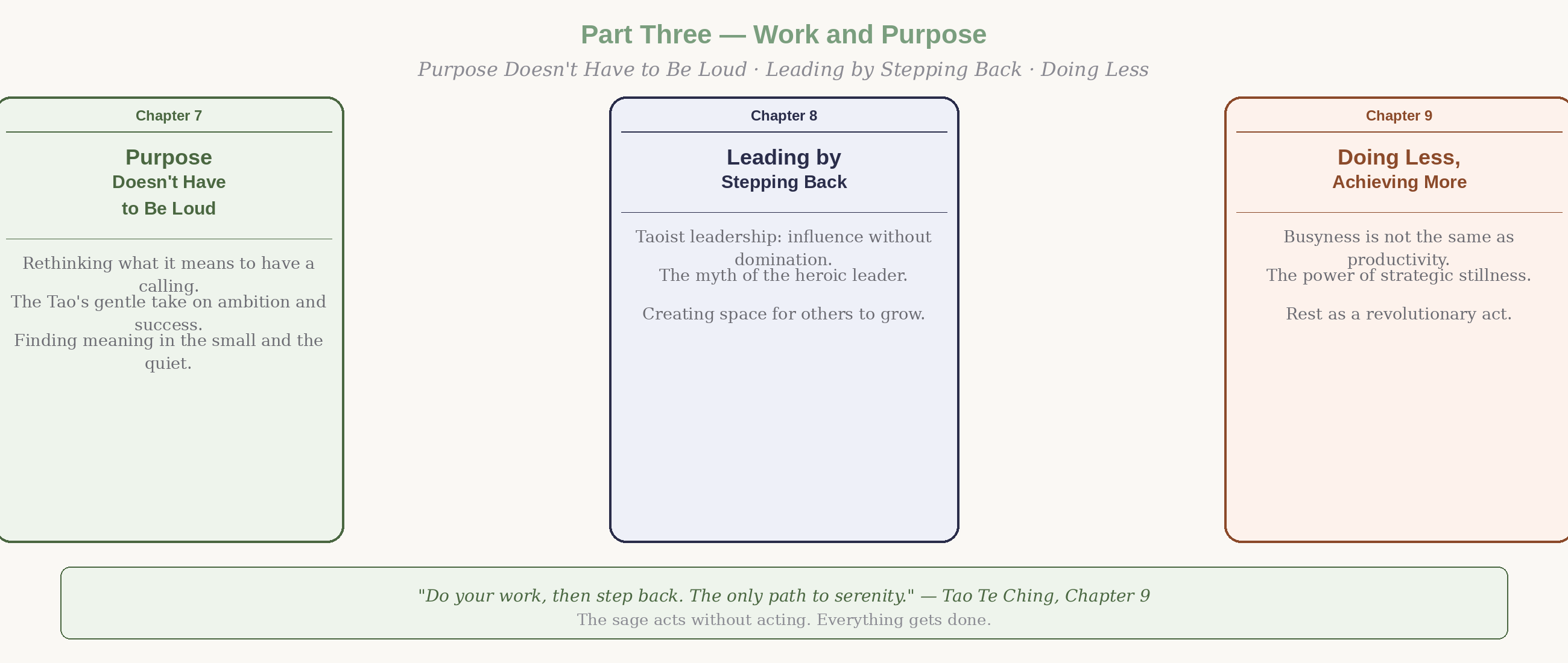
Do your work, then step back. The sage acts without acting, and everything gets done.
This approach has a very different take on purpose. And it’s one that might, if you let it, take an enormous amount of pressure off your shoulders.
Rethinking What It Means to Have a “Calling”
Let’s start by questioning the idea itself. Where did this notion come from — that each of us has one specific thing we’re supposed to be doing with our lives? That there’s a singular calling out there, waiting to be discovered, and that if we just find it, everything will fall into place?
It’s a lovely story. But it’s also, for a lot of people, a source of quiet suffering. Because what happens when you can’t find it? When you’ve tried a dozen things and none of them feel like the thing? When you look around at other people who seem to have found their purpose and wonder what’s wrong with you?
This approach would gently suggest: nothing is wrong with you. The problem isn’t that you haven’t found your purpose. The problem is that you’ve been looking for the wrong kind of purpose.
In this approach’s world, purpose isn’t a destination. It isn’t a single, grand thing that announces itself with fireworks and certainty. It’s more like a direction. A quiet, ongoing orientation toward what matters to you — not in some dramatic, Instagram-worthy way, but in the small, daily, utterly unremarkable ways that actually make up a life.
Purpose, in this framework’s sense, might look like the way you listen to your children at the end of the day. The care you put into doing your work well — not because anyone is watching, but because you value doing things well. The way you show up for a friend who’s going through something hard. The way you tend a garden, or cook a meal, or spend a quiet evening reading a book that genuinely moves you.
None of these things would make a compelling LinkedIn post. But they are, in their quiet way, deeply purposeful. They are acts of meaning. And this approach would say that a life made up of many such acts — small, humble, genuine — is just as rich, just as full, just as worthy as any life built around a single grand calling.
This approach’s Gentle Take on Ambition and Success
Let’s talk about ambition, because it’s one of those words that carries so much weight. In our culture, ambition is almost always presented as a virtue. Be ambitious. Set big goals. Dream big. Push yourself. Reach for the stars.
And there’s nothing inherently wrong with wanting to achieve things. Wanting to grow. Wanting to make an impact. These are deeply human desires, and this approach doesn’t ask you to abandon them.
But this approach does ask you to look more closely at why you want what you want. And to notice, with honesty and without judgment, how much of your ambition is driven by genuine desire — and how much is driven by fear. Fear of not being enough. Fear of falling behind. Fear of what other people will think if you don’t succeed in the way they expect.
Because here’s what this approach notices: the kind of ambition that’s driven by fear tends to be exhausting. It never feels like enough. You hit one goal and there’s another one waiting, and the feeling of satisfaction — if it comes at all — lasts about five minutes before the anxiety kicks back in. You’re running on a treadmill, and the finish line keeps moving.
The kind of ambition that’s driven by genuine passion and curiosity, on the other hand — that kind feels different. It feels more like play than like work. It feels energizing rather than draining. It feels like something you’re moving toward because it lights you up, not because you’re running away from something.
This approach’s invitation isn’t to stop being ambitious. It’s to get honest about what’s underneath your ambition. And to gently, without guilt, let go of the parts that are driven by fear rather than by what actually matters to you.
That might mean scaling back. It might mean changing direction entirely. It might mean staying exactly where you are but releasing the desperate, anxious quality that’s been making it feel like a grind. Whatever it means for you, this approach promises this: when you align your ambition with what genuinely moves you — and release what doesn’t — the work itself starts to feel like something worth doing. Not just something you have to do.
There is a particular kind of satisfaction that comes from doing something small, and doing it well. Not for recognition. Not for reward. Just because it deserved to be done well.
Maybe you know what this feels like. The way a perfectly made cup of tea can feel like a small act of ritual. The way a well-organized desk can feel like a quiet victory at the start of the day. The way helping a stranger — holding a door, giving directions, offering a smile — can leave a small, warm glow that lasts longer than you’d expect.
These moments are easy to dismiss. They don’t feel important, by the world’s standards. They don’t advance your career or build your brand or impress anyone. But this approach would say they are, in fact, among the most important things you do. Because they are the moments where you are most fully alive. Most fully present. Most fully yourself.
This approach has a deep reverence for the small. It talks about the value of being like water — which is the smallest, softest, most humble thing in the world, and yet one of the most powerful. It talks about the value of emptiness, of quiet, of the spaces between things. It has no interest in the loud or the impressive. Its entire teaching could be summarized as an invitation to pay attention to what everyone else is ignoring.
And when you start to do that — when you start to find meaning in the small and the quiet — something remarkable happens to your experience of work. Not just the work you do for a living, but the work of living itself. Everything becomes a little more interesting. A little more rich. A little more worth showing up for.
Because meaning, it turns out, isn’t something you find in grand gestures. It’s something you discover in the texture of your days. In the way you move through the world. In the quality of attention you bring to the things — big and small — that are right in front of you.
The Quiet Ones Who Change the World
Here’s something worth noticing: some of the most meaningful contributions to the world have been made by people you’ve never heard of. Not because their work wasn’t important. But because it was done quietly. Without fanfare. Without a brand or a following or a viral moment.
Think about the teachers who shaped the lives of thousands of students — not by being famous, but by showing up, day after day, and genuinely caring about the people in front of them. Think about the nurses, the social workers, the volunteers, the ordinary people who did extraordinary things in small rooms and quiet corners, and never once made the news.
This approach celebrates these people. Not by name — it doesn’t need to. But by consistently, persistently pointing toward the value of the small, the quiet, the humble. By telling us, again and again, that the most powerful things in the world are often the ones no one is paying attention to.
This isn’t just a philosophical point. It’s a practical one. Because when you release yourself from the pressure to be seen — when you let go of the idea that your work only matters if it’s visible, impressive, or recognized — something extraordinary happens. You become free to do work that actually matters to you. Work that might never make headlines. Work that might never win awards. But work that is, in its own quiet way, exactly what the world needs from you.
That kind of freedom is rare. And it’s one of the greatest gifts this approach has to offer anyone who is struggling with the question of what their life is supposed to mean.
Purpose as a Practice, Not a Destination
Here’s something that might feel liberating, if you can really take it in: purpose is not something you find once and then have forever. It’s something you practice. Continuously. Quietly. Every single day.
It shifts as you grow. It changes as your life changes. The thing that felt deeply meaningful to you at twenty-five might feel completely different at forty-five — and that’s not a failure. That’s just life moving, the way it does.
This framework is very comfortable with this kind of change. It doesn’t see inconsistency as a flaw. It sees it as the natural way of things. Seasons change. Rivers change course. Even the mountains, given enough time, reshape themselves. Why would you be any different?
So if you’ve been carrying around the belief that you should have your purpose figured out by now — that if you haven’t found your calling, something has gone wrong — consider letting that belief go. Not because purpose doesn’t matter. It does. But because the version of purpose this approach is pointing toward doesn’t require you to have it all figured out. It just requires you to keep paying attention. To keep noticing what moves you, what matters to you, what feels alive. And to follow that — gently, without forcing — wherever it leads.
That’s not a failure of ambition. It’s actually one of the wisest and most courageous ways to live.
When Purpose Feels Invisible
There will be days — maybe there already have been — when you look at your life and feel no sense of purpose at all. When everything feels routine and gray and meaningless. When you wonder if any of what you’re doing actually matters.
Those days are not a sign that something is wrong with you. They are a normal, human part of the journey. And this approach has something important to say about them: don’t panic. Don’t treat the absence of feeling as evidence of absence of meaning.
Purpose, like so many things in this framework’s world, doesn’t always announce itself. Sometimes it’s invisible. Sometimes it’s working beneath the surface, in ways you can’t see or feel in the moment. The seed underground doesn’t know it’s becoming a tree. It just does what seeds do, in the dark, without any guarantee of what will come next.
You are allowed to not feel purposeful every day. You are allowed to have stretches where nothing feels meaningful. And you are allowed to keep going anyway — not out of desperation, but out of a quiet trust that meaning doesn’t disappear just because you can’t feel it right now. It’s still there. Underneath. Waiting to be noticed again, when the conditions are right.
This approach doesn’t ask you to feel inspired every moment. It asks you to keep paying attention. To keep showing up. To keep doing your small, quiet, imperfect best. And to trust that the meaning will reveal itself, in its own time, in its own way.
The “What Moves Me” Journaling Exercise
A practice for this week. Bring a journal.
Set aside fifteen minutes — any time of day that feels natural. Get a piece of paper or open a blank document. And write, without censoring yourself, in response to this single question:
What moves me?
Not what impresses other people. Not what looks good on a resume. Not what you think you should care about. What actually moves you? What makes you feel something — a stirring, a quickening, a sense of yes, this?
It might be big things. It might be tiny things. It might be things that have nothing to do with your job or your career or your “brand.” Write them all down. The way sunlight hits a certain surface in the late afternoon. The feeling of helping someone solve a problem they’ve been stuck on. The sound of rain. The way a particular song makes you feel. The satisfaction of finishing something you made with your own hands.
Don’t judge any of it. Don’t rank it. Don’t filter it through the lens of what a purposeful life is supposed to look like. Just let it come, and write it down.
When you’re done, read back through what you’ve written. Notice what’s there. Notice what surprises you. Notice what keeps showing up — the threads, the themes, the quiet undercurrents.
That list — messy and unpolished and entirely your own — is a map. Not a definitive one. Not a final answer. But a starting point. A gentle compass that points you toward what actually matters to you, beneath all the noise of what you think should matter.
Keep it somewhere you can find it. Come back to it when the world feels loud and confusing and you’ve lost your sense of direction. It will remind you of something important: that meaning has been here all along, in the things that move you. You just had to stop and listen.
Chapter 8: Leading by Stepping Back
Most of us have a very specific picture in our minds of what a leader looks like. They’re confident. They’re decisive. They’re at the front of the room, commanding attention, making bold pronouncements, steering the ship with authority and conviction. They know what to do. They know what to say. And everyone around them follows, because the leader radiates a kind of certainty that makes people feel safe.
It’s a compelling image. And it’s not entirely wrong — there are moments when that kind of leadership is exactly what’s needed.
But this approach paints a very different picture of what the best leadership looks like. And it’s one that, once you see it, changes not only how you think about leading others, but how you think about your own role in any group — whether that’s a team at work, a family, a community, or even just a circle of friends.
This Kind of Leadership: Influence Without Domination
This approach dedicates a surprising amount of its attention to the subject of leadership. this approach was writing, in part, for rulers and governors — people who held power over others. And his advice to them was, by the standards of his time (and ours), remarkably counterintuitive.
The best leaders, he said, are the ones people barely notice. Not because they’re absent or uninvolved. But because they do their work so quietly, so skillfully, so invisibly, that the people around them feel empowered rather than managed. When things go well under this kind of leader, everyone feels like they did it. Like the success belongs to them. Not because the leader wasn’t there, making it happen. But because the leader made space for everyone else to rise.
This is the opposite of the kind of leadership most of us have been trained to admire. We admire the loud leaders. The charismatic ones. The ones who take credit. The ones who are always visible, always in charge, always the center of attention.
But think about it honestly: how does it actually feel to work under that kind of leader? To be in their presence? For some people, it feels inspiring. But for a lot of people, it feels diminishing. It feels like there’s only room for one star in the sky, and it isn’t you.
Now think about a leader — a boss, a teacher, a mentor, a parent — who made you feel like you were capable. Who gave you room to figure things out. Who trusted you before you’d earned that trust. Who stepped back when you needed space to grow, and stepped in — quietly, without fanfare — when you genuinely needed support.
How did that feel? Probably very different. Probably like you could breathe. Like you could take risks. Like you mattered.
That’s the kind of leader this approach is describing. Not someone who leads by dominating. But someone who leads by creating conditions in which other people can become their best selves.
The Myth of the Heroic Leader
We love a good hero story. The lone genius who saves the company. The visionary leader who sees what no one else can see and drags everyone else along into the future. The charismatic boss who inspires loyalty just by walking into a room.
These stories are everywhere — in movies, in business books, in the way we talk about success. And they’re not entirely fiction. There are people like this. People who genuinely do have an extraordinary ability to inspire and lead.
But here’s what these stories almost never show: what it actually looks like on the ground, day to day, in the messy middle of things. Because even the most inspiring leaders — the real ones, not the mythologized versions — spend most of their time doing something much quieter than inspiring. They spend most of their time listening. Asking questions. Getting out of the way. Removing obstacles for the people around them. Saying “yes, and” instead of “no, but.” Being, in other words, a gardener more than a general.
The myth of the heroic leader is seductive because it’s simple. One person, one vision, one triumph. But the reality of good leadership is messier and quieter and, in many ways, more interesting. It’s about the small moments. The questions asked at the right time. The space created for someone else to shine. The quiet “I trust you” that changes everything.
This framework is interested in that reality. Not in the myth. And if you can let go of the myth — if you can stop measuring your own leadership against the heroic ideal — you might find that you’re already a much better leader than you thought. You just haven’t been looking for it in the right places.
How the Best Leaders Create Space for Others to Grow
Let’s get specific about what this looks like in practice, because “create space” can sound vague and abstract. In reality, it’s made up of very concrete, very human choices.
It looks like asking questions before offering answers. When someone comes to you with a problem, the instinct — especially if you’re in a leadership role — is to solve it for them. To be the one with the answer. But a a leader in this mode might instead ask: What have you already tried? What do you think might work? What do you need from me? And then — this is the hard part — actually listening to the response. And letting the other person arrive at the solution themselves, even if it takes longer than it would have if you’d just told them.
It looks like giving credit freely and taking it rarely. When the team succeeds, this approach leader says: They did this. This is theirs. When the team fails, this approach leader says: I didn’t set us up well enough. Let me do better. This isn’t false modesty. It’s a genuine understanding that good leadership isn’t about being the hero. It’s about being the conditions in which heroes can emerge.
It looks like being comfortable with silence. Not every moment needs to be filled with the leader’s voice. Sometimes the most powerful thing a leader can do is shut up and let someone else speak. Let someone else have the moment. Let the room breathe.
And it looks like trusting people — genuinely trusting them — even when they haven’t yet proven themselves. This is one of the hardest things for most leaders, because trust feels risky. What if they let you down? What if they make a mistake? But this approach would point out: if you never extend trust, you never give anyone the chance to rise to meet it. And the people who are trusted tend to work harder, care more, and show up more fully than the people who are watched and managed and second-guessed at every turn.
Applying This at Work, at Home, and in Communities
The beautiful thing about this kind of leadership is that it doesn’t only apply to people with titles or formal authority. It applies to anyone who influences others — which is, in some way, all of us.
At work, it might look like the way you run a meeting. Do you dominate the conversation, or do you actively draw others in? Do you take all the credit, or do you name the people who contributed? Do you micromanage, or do you set clear expectations and then get out of the way?
At home, it might look like the way you parent. Do you make all the decisions for your children, or do you let them practice making their own? Do you solve every problem for them, or do you trust that they can figure things out — with your support, but not your interference? Do you tell them who to be, or do you hold space for them to discover that for themselves?
In a community — a friend group, a club, a volunteer organization — it might look like the way you organize. Do you put yourself at the center, or do you distribute the responsibilities so that everyone feels ownership? Do you make all the decisions, or do you create a space where everyone’s voice matters?
None of this requires a formal leadership role. It just requires a willingness to lead in this framework’s way: quietly, generously, by stepping back rather than stepping forward. By trusting rather than controlling. By caring more about the growth of the people around you than about your own visibility.
The Leader as the Gardener
There’s a beautiful metaphor that captures this kind of leadership perfectly, and it’s this: the leader as a gardener.
A gardener doesn’t make the plants grow. No amount of staring at a seed or demanding that it sprout will speed up the process. The gardener’s job is much quieter than that. It’s to prepare the soil. To make sure there’s enough water and light. To remove the weeds that might choke the roots. And then — to wait. Patiently. Trusting that the seed knows what to do.
A good gardener doesn’t take credit for the flowers. They don’t say, “Look what I made.” They say, “Look what grew here.” Because they understand, on a deep level, that their role was to create the conditions. The growing was always the plant’s job.
That’s this kind of leadership. Not making things happen through force or will or dominance. But creating the conditions in which things can happen naturally, organically, beautifully. And then stepping back to let them.
It’s humble work. It’s quiet work. And it produces, over time, gardens that no amount of forcing could ever create.
Leading Yourself First
Here’s something this approach implies but rarely states directly: before you can lead others in the quiet, spacious way we’ve been describing, you have to learn to lead yourself that way first.
What does that mean? It means noticing how you treat yourself when things aren’t going well. Do you berate yourself? Do you push yourself past the point of exhaustion? Do you demand perfection from yourself while asking for patience from others? Do you give yourself the same kind of trust and space that you’re learning to give the people around you?
For most of us, the answer is no. We are far harsher with ourselves than we would ever be with someone we care about. And that inner harshness — that constant self-criticism and self-demanding — bleeds out into how we lead others, even when we don’t realize it. It shows up as impatience. As micromanagement. As a subtle, unspoken expectation that everyone around us should be working as hard and as frantically as we are.
This approach’s invitation to quiet leadership isn’t just about how you show up for others. It’s about how you show up for yourself. It’s about extending the same gentleness, the same trust, the same spaciousness to your own inner life that you’re learning to bring to your outer one.
Because here’s the truth: you can’t create space for others if you haven’t created it for yourself. You can’t trust others if you haven’t learned to trust yourself. And you can’t lead quietly if your own inner world is loud and frantic and afraid.
So the practice of this kind of leadership starts — always, inevitably — with you. With the quiet, ongoing work of learning to be a kinder, more patient, more trusting leader of your own life. And letting that ripple outward, naturally, into everything and everyone you touch.
The Invisible Leader Reflection
A practice for this week. Bring a journal.
Think about a group you’re part of — a team at work, a family, a friend group, a community. Any group where you play some kind of role, formal or informal.
Now, on a piece of paper, write down the answers to these questions — honestly, without trying to look good:
In this group, how often do I speak versus how often do I listen? If I’m being truthful, am I taking up more than my fair share of the space?
When things go well in this group, do I give credit to others? Or do I tend to include myself in the story of success?
When things go wrong, do I point fingers — even subtly? Or do I look at what I could have done differently?
Is there someone in this group who is quieter, who doesn’t speak up as much? Have I actively made space for them? Have I asked for their input — genuinely, not performatively?
If I stepped back from this group for a month — if I became truly invisible — what would happen? Would people flounder? Or would they rise?
Sit with these questions. Don’t rush to answer them perfectly. The point isn’t to judge yourself. It’s to see clearly. To notice where you’re leading loudly, and where you might be able to lead more quietly. Where you might be able to create more space. Where you might be able to trust a little more.
That’s the beginning of this kind of leadership. Not a transformation of who you are. Just a quiet, honest look at how you show up — and a willingness, if needed, to show up a little differently.
Chapter 9: Doing Less and Achieving More
If you have ever felt, at the end of a long and busy day, that you accomplished a tremendous amount and yet somehow feel emptier than when you started — you are not imagining it. And you are not alone.
We live in a culture that has made busyness into an identity. Being busy means you’re important. Being busy means you’re productive. Being busy means you matter. And so we fill our days — our calendars, our to-do lists, our mental bandwidth — to the brim. And then we fill them a little more. And at the end of it all, we collapse into bed feeling exhausted and vaguely dissatisfied, wondering why we feel so depleted when we did so much.
This approach looks at this pattern and sees it for what it is: a kind of madness. A frantic, self-defeating cycle in which more activity actually produces less meaningful result. In which the busyness itself has become the point, disconnected from anything that actually matters.
And this approach’s prescription is not what you might expect. It’s not “try harder.” It’s not “be more disciplined.” It’s not “optimize your workflow.” It’s something much quieter, and much more radical: do less.
Why Busyness Is Not the Same as Productivity
Let’s make this distinction very clear, because it’s one that our culture blurs constantly: busyness and productivity are not the same thing. Not even close.
Busyness is activity. It’s motion. It’s filling time with tasks, regardless of whether those tasks are moving you toward anything that actually matters to you. You can be incredibly busy — answering emails, attending meetings, running errands, scrolling, responding, reacting — and accomplish almost nothing of real significance.
Productivity, in the deepest sense, is different. It’s about doing the things that actually matter — the ones that align with your values, your goals, your sense of purpose — and doing them well. And here’s the thing: real productivity often requires less activity, not more. It requires focus. Depth. The kind of sustained attention that’s almost impossible to achieve when your day is fragmented into a hundred tiny tasks.
This approach understands this intuitively. It talks constantly about the power of stillness, of quiet, of doing less. Not because doing less is lazy, but because doing less creates the space in which the things that truly matter can actually get done.
Think about the last time you did something really well — something that required genuine skill, genuine thought, genuine presence. Were you multitasking? Were you rushing? Were you constantly switching between tasks and checking your phone? Almost certainly not. You were focused. You were absorbed. You were giving that one thing your full attention.
That state — that deep, unhurried, single-pointed focus — is where real productivity lives. And it’s almost impossible to access when your life is structured around busyness.
The Power of Strategic Stillness in Your Work Life
Strategic stillness. It sounds almost absurd in a world that celebrates hustle. But it is, in fact, one of the most powerful tools available to anyone who wants to do meaningful work.
Strategic stillness means deliberately, intentionally building periods of non-activity into your work life. Not as a reward for being productive. Not as a break between bursts of effort. But as a necessary ingredient in the process itself. Because here’s what we know about how human minds work: the best ideas, the deepest insights, the most creative solutions — they almost never come during the busiest moments. They come in the gaps. In the pauses. In the quiet spaces between one thing and the next.
Scientists have a word for this: incubation. It’s the phase in the creative process where you step away from a problem and let your subconscious mind work on it. And it is, according to decades of research, one of the most important phases in the process of creative problem-solving. Without it, breakthroughs are significantly less likely.
This approach has been saying this for thousands of years, long before anyone had the language of neuroscience to back it up. This framework is, in many ways, a celebration of the power of not-doing. Of trusting that the most important work sometimes happens when you’re not working at all.
So what does strategic stillness look like in practice? It might look like protecting a block of time in your day — even thirty minutes — where you do nothing productive. No emails. No tasks. No optimization. Just sitting. Walking. Staring out the window. Letting your mind wander wherever it wants to go.
It might look like saying no to a meeting that isn’t truly necessary, and using that time to simply think. Or to do nothing at all.
It might look like ending your workday earlier than you think you should, and trusting that the things that didn’t get done today will still be there tomorrow. And that you’ll be better equipped to handle them after genuine rest.
This isn’t laziness. It’s strategy. It’s the quiet wisdom of someone who understands that the mind — like the body — needs rest in order to perform at its best. And that rest isn’t the absence of productivity. It’s a prerequisite for it.
The Hidden Cost of Busyness
We talk a lot about the benefits of productivity and the cost of laziness. But we almost never talk about the cost of busyness itself. And it’s a significant one.
When you’re chronically busy — when your days are packed from morning to night with tasks and obligations and commitments — something happens to your inner life. It gets squeezed. The space where you used to think, to feel, to simply be — that space shrinks. And as it shrinks, so does your connection to yourself. To what actually matters to you. To the quieter, deeper parts of your experience that make life feel meaningful rather than just… full.
Busyness becomes its own kind of numbing. When you’re constantly moving, constantly doing, constantly reacting, you don’t have to sit with the harder, quieter things. You don’t have to feel the grief you’ve been avoiding. You don’t have to confront the question of whether your life is actually going in a direction that feels right. You don’t have to notice that you’re unhappy, because you’re too busy to notice anything.
This approach sees this clearly. And it doesn’t judge. It simply points, gently, toward the alternative: a life with more space in it. More breathing room. More of those quiet moments where you can actually hear yourself think — and feel — and be.
That’s not laziness. That’s not giving up. That’s actually one of the bravest things you can do in a culture that glorifies busyness. It’s choosing to be present in your own life, rather than just rushing through it.
Saying No as an Act of Alignment
We touched on this idea in Chapter 3, in the context of simplicity. But it deserves another look here, in the context of work and purpose — because saying no is one of the most powerful and least practiced skills in the working world.
Every yes you say is also a no to something else. Say yes to an extra project, and you’re saying no to the time you had planned to spend on the work that actually matters to you. Say yes to a meeting that drains you, and you’re saying no to an hour of focused, meaningful work. Say yes to someone else’s priorities, and you’re saying no to your own.
Most of us say yes far too often. Not because we want to. But because saying no feels uncomfortable. It feels selfish. It feels like letting people down. And in a culture that equates busyness with importance, it can even feel like admitting that you don’t care as much as everyone else.
But this approach would reframe this entirely. Saying no — when it’s said thoughtfully, with awareness of what you’re protecting — isn’t selfish. It’s an act of alignment. It’s choosing, deliberately, to spend your finite time and energy on the things that genuinely matter to you. And that’s not just good for you. It’s good for everyone around you, because a person who is aligned — who is doing work that means something to them — brings a quality of presence and care to that work that a burned-out, overcommitted person simply can’t.
The practice of saying no, in this framework’s sense, isn’t about being difficult or uncooperative. It’s about being honest. About knowing what matters to you, and protecting it. About trusting that you can’t pour from an empty cup, and that keeping your cup full — not of busyness, but of meaning — is one of the most important things you can do.
The Myth of Multitasking
Let’s address something that’s been proven false by science but still dominates how most people work: the idea that multitasking is efficient.
It isn’t. Study after study has shown that when we switch between tasks — answering an email while also trying to write a report while also listening to a podcast — we’re not actually doing any of those things well. We’re doing all of them poorly. Our attention is fragmented. Our error rate goes up. Our stress goes up. And the quality of our work goes down.
What we call “multitasking” is actually “task-switching” — and it’s one of the most energy-draining things the human brain can do. Every time you switch from one task to another, your brain has to re-orient. It has to load new information, flush the old context, and get up to speed on the new thing. And that transition — that mental recalibration — takes more time and energy than most people realize.
This approach’s teaching of wu wei — effortless action — maps perfectly onto this. When you’re doing one thing, fully, with your complete attention, the work flows. It feels almost easy. And when you’re trying to do three things at once, everything feels like a struggle.
So here’s a simple but radical suggestion: stop multitasking. Or at least, reduce it dramatically. Pick one task. Do it fully. Give it your attention. And when it’s done — or when you need a break — pick the next one.
You might be surprised at how much more you actually accomplish in the same amount of time. And how much less exhausted you feel at the end of the day.
Rest as a Revolutionary Act
In a culture that tells you your worth is tied to your output, resting feels almost subversive. Almost rebellious. And in a way, it is.
Because when you rest — truly rest, not the kind of “rest” where you scroll your phone for an hour — you are quietly, firmly saying: I am more than what I produce. My value is not determined by how much I do. I deserve to simply exist, without justifying that existence through activity.
That is a radical statement. And for a lot of people, it’s a deeply uncomfortable one. Because we’ve internalized, on a very deep level, the idea that if we’re not doing something, we’re wasting time. That idle hands are a problem to be solved. That rest is something you earn, not something you’re entitled to.
This approach disagrees, completely and without apology. This approach sees rest not as the absence of productivity, but as one of its most essential ingredients. It sees stillness not as emptiness, but as fullness of a different kind — a fullness of presence, of awareness, of being alive to the moment rather than merely rushing through it.
So the next time you feel guilty about resting — the next time a voice in your head says you should be doing something — try pausing with that voice. Notice it. Notice the belief underneath it. And then, gently, consider: what if rest isn’t laziness? What if it’s wisdom? What if the most productive thing you could do right now isn’t another task on your to-do list, but an hour of doing absolutely nothing at all?
This approach has been practicing this for thousands of years. And it seems to be doing just fine.
The “Subtract One” Work Week
A practice for this week. Bring a journal.
Here’s a practice that’s less about adding something to your life and more about taking something away. Which, if you think about it, is very much in the spirit of this approach.
Look at your work week — the coming week, if possible. Look at everything on your calendar, your to-do list, your mental list of obligations. Now, find one thing to subtract. One thing that, if you’re honest with yourself, isn’t truly necessary. One thing you’re doing out of habit, or obligation, or a vague sense that you should — but that isn’t actually moving you toward anything that matters.
Remove it. Not with guilt. Not with anxiety about what will happen. Just… remove it. And see what happens.
Maybe nothing bad happens. Maybe the world keeps turning. Maybe no one even notices. And in the space that opens up — that small, unexpected pocket of time — something else shows up. A moment of rest. A chance to think. An idea that wouldn’t have come if you’d been rushing from one thing to the next.
That’s the practice. One subtraction. One week. One small experiment in doing less and seeing what happens.
If it feels good — if the space feels nourishing rather than frightening — try it again the next week. And the week after that. Not as a dramatic lifestyle change. Just as a quiet, ongoing experiment in what your life might feel like if you trusted that less could, in fact, be more.
This approach has been making this argument for a very long time. And it’s never been wrong.