Chapter 10: Your Body Knows Things Your Mind Doesn’t
There is a moment — small, easy to miss — that happens dozens of times a day. Your body says something. A tightness in your jaw. A knot between your shoulder blades. A sinking feeling in your stomach when someone asks you to do something you don’t want to do. A sudden burst of energy when an idea excites you. A heaviness that settles in when you’ve been around someone draining.
And what do most of us do with that moment? We ignore it. We override it. We push past it with caffeine, willpower, or a stern internal lecture about what we’re supposed to be doing. We treat the body like a vehicle — something to be fueled, maintained, and kept running — and not like what it actually is: a living, breathing, extraordinarily intelligent system that has been communicating with you your entire life.
This approach has a quiet but persistent interest in the body. Not in the way a fitness manual does — not about optimization or performance or looking a certain way. But in the way a wise teacher might: with respect. With curiosity. With the suggestion that the body isn’t just something you carry around. It’s something you can learn from.
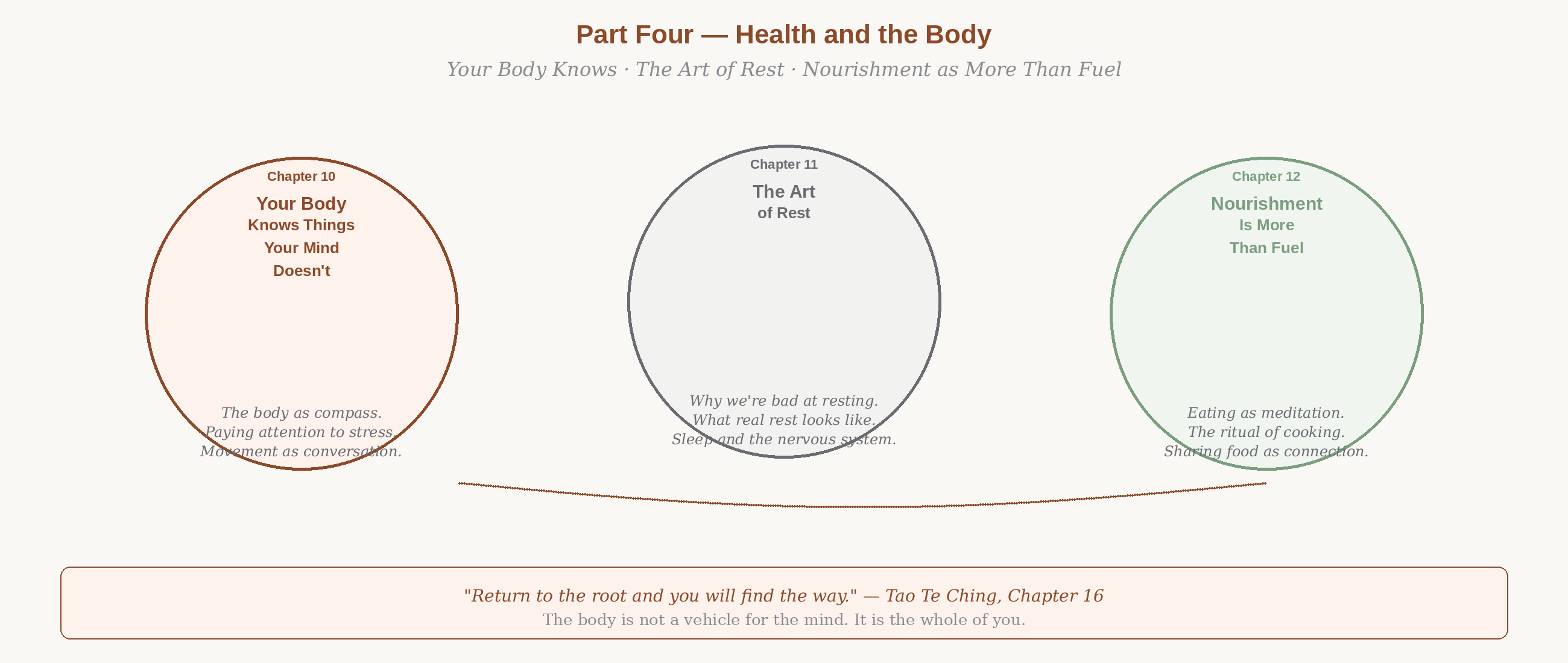
Return to the root and you will find the way. The body is not a vehicle — it is the whole of you.
And if you start listening — really listening — you might be surprised at how much it has to say.
The Body as a Compass
Think about the last time you made a decision that felt right in your gut, even though your logical mind had a hundred reasons to do something else. Maybe you took a job that didn’t look impressive on paper, but something in you said yes. Maybe you ended a relationship that looked fine from the outside, but felt wrong in a way you couldn’t quite articulate. Maybe you simply chose to stay home on a night when everyone else was going out, because your body was quietly, firmly saying: I need this.
That feeling — that gut-level knowing — is one of the body’s most reliable forms of communication. And most of us have been taught, one way or another, to distrust it. To defer to logic. To listen to what other people think we should do. To push through discomfort rather than pay attention to what it’s telling us.
But this approach would say: your body is not something to be overridden. It is something to be consulted.
This doesn’t mean every physical sensation is a profound message from the universe. Sometimes a headache is just a headache. Sometimes your stomach hurts because you ate too fast. The body is not always dramatic or mystical in what it communicates. But underneath the ordinary signals, there is a deeper layer of intelligence — a quiet, continuous stream of information about what you need, what isn’t working, what feels aligned, and what doesn’t.
Learning to access that layer isn’t complicated. It mostly requires one thing: slowing down enough to notice. Which, as we’ve seen throughout this course, is one of this approach’s most persistent invitations.
What Stress Looks Like When You Actually Pay Attention
Most of us know, in theory, that stress is bad for us. We’ve heard the statistics. We know it raises blood pressure, disrupts sleep, weakens the immune system, and does a dozen other things we’d rather not think about. But knowing this in the abstract and actually feeling it in your body are two very different things.
When you start paying attention — really paying attention — to what stress actually does to you physically, it can be a revelation. Not a comfortable one. But an illuminating one.
It might start with the jaw. A subtle clenching you’ve been doing for years without realizing it, so constant that it’s become your baseline. Or the shoulders, creeping up toward the ears in a posture of bracing that you carry from the moment you wake up until the moment you finally collapse into bed.
It might show up in your breathing. Have you ever noticed how shallow your breath gets when you’re anxious? How it moves up into the chest and stays there, tight and small, as if your body is trying to take up as little space as possible? That’s not a coincidence. That’s your nervous system responding to perceived threat — even when the threat is just an email you’re dreading or a conversation you’re avoiding.
It might show up in your digestion. A knot in the stomach before a difficult meeting. A queasy feeling when you think about something you’re avoiding. A general sense of heaviness after spending time with people who drain you. Your gut, it turns out, is not just a digestive organ. It’s a barometer. It’s reading the room — your internal room — and reporting back.
The point of noticing all this isn’t to add more worry to your life. It isn’t to become hyper-vigilant about every sensation. It’s simply to develop a relationship with your own body. To start treating it as a source of information rather than something to be pushed through. Because when you can feel where stress lives in your body — when you can actually locate it, name it, notice it — you have something you didn’t have before: a choice. You can choose to respond to it, rather than simply react.
The Mind-Body Disconnect and How to Bridge It
Here’s something that might sound strange but is actually very common: a lot of people have lost touch with their bodies almost entirely. Not in a dramatic way. Not in a way that would show up on a medical chart. But in the quiet, daily way that comes from spending most of your waking hours in your head.
Think about how you move through a typical day. You wake up and immediately start thinking — about your schedule, your to-do list, your worries. You eat while reading or scrolling. You work while your mind races through problems and plans. You have conversations while half-monitoring your phone. And at the end of the day, you lie down, still thinking, until sleep eventually pulls you under.
Where, in all of that, is the body? It’s there, of course — breathing, digesting, carrying you from place to place. But you’re barely aware of it. It’s just the thing that gets your head from one location to another.
This approach finds this disconnect deeply troubling. Not in a judgmental way. But in the way a wise friend might gently point out: You know you have a body, right? And it’s been trying to talk to you for a very long time?
Bridging this disconnect doesn’t require anything dramatic. No extreme yoga poses. No juice cleanses. No radical lifestyle overhaul. It just requires moments — small, scattered throughout your day — where you check in. Where you pause and ask: How does my body feel right now? Where am I holding tension? What does this moment actually feel like, physically, not just mentally?
These check-ins can be incredibly brief. Thirty seconds. A minute. Just a quiet turn of attention from the noise in your head to the quieter, steadier wisdom in your body. And over time — over weeks and months of these small check-ins — something shifts. You start to feel more present. More grounded. More like a whole person, rather than a floating head attached to an afterthought.
That shift is subtle. But it changes everything.
The Stories We Tell About Pain
There’s something worth examining here, because it runs quietly underneath so much of how we relate to the body: the stories we tell ourselves about physical sensation.
When something hurts — a headache, a sore back, an ache in the chest — we don’t just feel it. We immediately layer a story on top of it. Something is wrong with me. This means I’m getting old. This is going to get worse. I need to fix this immediately. The story creates its own kind of suffering, separate from the sensation itself. And often, the story is more painful than the physical feeling it’s attached to.
This approach doesn’t ask you to ignore pain. Pain is important information. It’s the body’s way of saying: pay attention here. But this approach does invite you to notice the difference between the sensation and the story. Between the raw experience of discomfort and the narrative you’ve built around it.
Try this sometime: the next time you notice a physical sensation that’s uncomfortable — tension, soreness, a dull ache — pause. Feel it. Just feel it, without immediately labeling it or catastrophizing about it. What does it actually feel like, if you just stay with the sensation itself? Is it constant, or does it pulse? Is it in one spot, or does it move? Is it as bad as the story in your head says it is?
Often — not always, but often — when you strip away the story and just feel the sensation, it’s more manageable than you thought. It’s still there. It still needs attention. But it doesn’t have to be the emergency your mind was turning it into.
This is one of the quietest and most practical gifts this approach’s approach to the body can give you: a way of being with discomfort that doesn’t require you to suffer through the story on top of it.
When Your Body Says Stop
One of the hardest things the body ever has to communicate is this: Stop. You need to stop.
It says it in a hundred ways. Through exhaustion that sleep doesn’t fix. Through illness that keeps recurring. Through pain that won’t go away no matter how much you stretch or ignore it. Through a bone-deep weariness that no amount of caffeine or motivation can touch.
And one of the most common human responses to all of these signals is: I can’t stop. I have too much to do. I’ll rest when things calm down.
This approach sees this pattern clearly — and with a great deal of compassion. It understands that we live in a world that makes stopping very difficult. That there are real pressures, real obligations, real consequences for slowing down. It doesn’t pretend otherwise.
But it also says, very quietly and very firmly: if you don’t listen to the body’s request to stop, the body will eventually make you stop. One way or another. Through illness. Through injury. Through a collapse that is far more disruptive than the pause would have been.
This isn’t a threat. It’s an observation. The body has a hierarchy of needs, and rest is near the top. When it doesn’t get what it needs, it takes it — forcefully, if necessary. And the taking is always harder than the giving would have been.
So the invitation here is not complicated. It’s just this: when your body says stop, try to listen. Not perfectly. Not every time. But often enough that you catch the signal before it becomes a crisis. Often enough that rest becomes something you choose, rather than something that’s chosen for you.
That is not weakness. That is, in fact, one of the wisest things you can do.
Movement as Conversation
We tend to think of movement — exercise, stretching, walking — as something we do to the body. A transaction. We put in effort; the body gives us health in return. But this approach suggests something different: that movement can be a conversation. A way of checking in, paying attention, and responding to what the body actually needs in this moment.
Think about the difference between forcing yourself through a workout you dread — white-knuckling through reps, counting down the minutes until it’s over — and moving in a way that actually feels good. Dancing in your kitchen. Walking slowly through a park and noticing everything you see. Stretching in the morning because your body is asking to be stretched, not because an app told you to.
The second kind of movement is wu wei applied to the body. It’s effortless action — or close to it. It’s paying attention to what your body wants and giving it that, rather than imposing a plan on it from the outside.
This doesn’t mean you never push yourself physically. Sometimes the body benefits from being challenged. But even challenge, when it’s approached with awareness and responsiveness rather than with force and obligation, feels completely different. It feels like a dialogue rather than a demand.
This approach’s invitation is to start treating your body’s relationship with movement as a conversation. To ask, before you exercise or stretch or move: What does my body need right now? Not what does the internet say I should do — what does this body, in this moment, actually want? And then to listen. Really listen. And let the answer guide you.
You might be surprised at what it says.
The Body Scan Check-In
A practice for this week. Bring a journal.
Here is a practice you can do anywhere — sitting at your desk, lying in bed, standing in line at the grocery store. It takes two minutes, maybe three. And it is one of the simplest ways to begin rebuilding a relationship with your own body.
Close your eyes, or soften your gaze. Take one slow breath. And then, gently, start at the top of your head and move downward. Not trying to change anything. Just noticing.
Notice your scalp. Your forehead. The area around your eyes. Is there tension there? Tightness? Or ease? Just notice.
Move to your jaw. This is where a lot of us hold more tension than we realize. Notice whether your teeth are clenched, even slightly. If they are, let them soften. No judgment — just a gentle release.
Move to your neck and shoulders. Notice where they are. Are they creeping up toward your ears? Can you let them drop, even a little? Notice the feeling of that dropping.
Continue down — your chest, your belly, your hands, your legs, your feet. At each place, just notice. What’s there? What does it feel like? Is there tightness, or ease? Warmth, or coolness? Pain, or comfort?
When you reach your feet, take one more slow breath. And then open your eyes.
That’s it. The whole practice. Two minutes of simply noticing what your body is doing, without trying to fix or change or optimize anything. Just listening.
Try it once today. And then again tomorrow. And notice, over time, whether you start to feel a little more present. A little more connected to the life you’re actually living, rather than the one happening only in your head.
The body has been waiting for you to tune in. It has a lot to say.
Chapter 11: The Art of Rest
We have a problem with rest. Not a minor inconvenience — a genuine, culture-wide problem. We have collectively convinced ourselves that rest is something to be earned. Something you get at the end of a long day, or at the end of a long week, or at the end of a long year. A reward for having been productive enough, busy enough, useful enough to deserve a break.
This approach would find this idea almost incomprehensible. Because in this framework’s world, rest isn’t a reward. It isn’t a luxury. It isn’t something you have to justify or earn or feel guilty about. It’s as essential as breathing. As necessary as food. As fundamental to a healthy, balanced life as anything else you do.
And yet most of us treat it like the last priority. The thing we’ll get to when everything else is done. Which, of course, is almost never — because there is always something else to do.
This chapter is about changing that. Not through willpower or discipline or another self-improvement hack. But through a quiet shift in how you understand what rest actually is, and why it matters so deeply.
Why We’re So Bad at Resting
Before we can rest well, it helps to understand why we’re so bad at it in the first place. And the answer, for most people, isn’t laziness. It’s actually something closer to fear.
Fear that if we rest, we’ll fall behind. Fear that other people will judge us for not being productive enough. Fear that our worth is tied to our output, and that a day spent doing nothing is a day wasted. Fear, sometimes, of what we might feel if we actually stop moving — if we sit with the quiet, and let whatever is underneath the busyness come to the surface.
That last one is worth sitting with for a moment. Because for a lot of people, busyness isn’t just a habit. It’s a defense mechanism. It’s a way of staying above the waterline — above the grief, the loneliness, the dissatisfaction, the big questions that might surface if we ever got quiet enough to hear them.
This approach doesn’t judge this. It understands that we all have our reasons for staying in motion. But it also gently, persistently suggests that the things we’re running from don’t actually go away when we run. They just wait. And they tend to get louder over time, not quieter.
Real rest, then, isn’t just about the body. It’s about the willingness to be still — truly still — and let whatever comes, come. Without fighting it. Without rushing to fill the silence. Just being there, with yourself, in the quiet.
That’s harder than it sounds. But it’s also, for many people, one of the most healing things they ever learn to do.
What Real Rest Actually Looks Like
Here’s the thing: what most of us call “rest” isn’t really rest at all. Scrolling social media for an hour isn’t rest. Watching TV while half-thinking about work isn’t rest. Even sleeping, if your mind is churning through worries the entire time, isn’t truly restful.
Real rest is a state in which your nervous system actually settles. In which your mind quiets — not completely, maybe, but enough that you feel a genuine shift. A loosening. A sense of being, for once, not on duty.
What creates that state is different for different people. For some, it’s time in nature — a walk in the woods, sitting by water, gardening with your hands in the dirt. For some, it’s creative play — drawing, writing, making music, cooking something just for the joy of it. For some, it’s doing absolutely nothing at all — lying on the couch, staring at the ceiling, letting the mind wander wherever it wants without directing it.
The key isn’t the activity itself. It’s the quality of attention you bring. Real rest happens when you’re not performing. When you’re not trying to be productive or impressive or useful. When you’re just… being. Present. Alive. Without an agenda.
This approach has deep reverence for this kind of being. It sees it not as emptiness, but as fullness — a fullness of presence that’s impossible to access when you’re constantly doing. And it invites you, again and again, to taste it. To discover, for yourself, what it feels like to truly stop. And to notice how different the world looks when you do.
Sleep: The Most Underrated Form of Rest
We’ve been talking about rest in a broad sense — the quality of stillness, the permission to stop. But let’s zoom in on one specific form of rest that most of us desperately need more of, and desperately undervalue: sleep.
Sleep is not downtime. It is not wasted time. It is not something to be minimized in the name of productivity. Sleep is when your brain does some of its most important work — consolidating memories, processing emotions, repairing physical tissue, flushing out toxins, making connections between ideas that your waking mind couldn’t see.
And yet, in a culture that glorifies pulling all-nighters and wearing sleep deprivation like a badge of honor, we treat sleep as an inconvenience. Something to be squeezed into whatever hours are left after everything else is done. Something we’ll “catch up on” over the weekend, as if sleep debt worked like a credit card balance.
It doesn’t. The research is unambiguous: chronic sleep deprivation affects everything. Mood. Judgment. Creativity. Physical health. Relationships. The ability to regulate emotions. The capacity for empathy. Sleep isn’t just nice to have. It is foundational.
This approach sees sleep as one of the most natural, most essential expressions of rest. It’s the body’s version of the empty cup — a state of complete receptivity, where the mind and body can do the quiet, essential work of restoration that no amount of waking activity can replicate.
If you’re not sleeping well — if sleep feels difficult, elusive, or chronically insufficient — that’s worth paying attention to. Not with anxiety, which will only make it worse. But with curiosity. What is your body trying to tell you? What does it need in order to settle into the deep, restorative rest it’s designed for? Often, the answer has less to do with the mechanics of sleep (though those matter) and more to do with the overall quality of your days — how much stress you’re carrying, how much stillness you’re allowing, how safe your nervous system feels.
Tending to sleep well is, in many ways, one of the most important things you can do for every other area of your life. It is the foundation on which everything else rests. Literally.
Rest and the Nervous System
Let’s get a little practical here, because understanding what’s happening in your body when you rest — and when you don’t — can make the whole thing feel less like a luxury and more like a necessity.
Your nervous system has two main modes. You’ve probably heard of them: fight-or-flight, and rest-and-digest. The first one — the sympathetic nervous system — is designed for emergencies. It floods your body with adrenaline and cortisol, sharpens your focus, speeds up your heart rate, and prepares you to either fight a threat or run from it. It’s incredibly useful in genuine emergencies. But it was designed for short bursts, not for sustained activation.
The second mode — the parasympathetic nervous system — is the one that does the actual healing, rebuilding, and restoring. It slows your heart rate. It aids digestion. It promotes deep sleep. It allows your muscles to release tension they’ve been holding. It is, in a very literal sense, the system that keeps you alive and healthy over the long term.
Here’s the problem: most of us spend the majority of our waking hours in some degree of fight-or-flight activation. Not because we’re in physical danger, but because the modern world is full of low-level stressors that keep our nervous systems on alert. Email notifications. News cycles. Social pressure. The constant low hum of “I should be doing more.”
When your nervous system is chronically activated like this, rest becomes almost impossible — even when you try. Your body doesn’t know how to settle. You lie down and your mind races. You take a vacation and you can’t stop checking your phone. You sleep for eight hours and wake up exhausted.
The invitation of this approach, in this context, is not just to rest more. It’s to help your nervous system remember how to shift into its restoring mode. And that happens through practice — through repeated, gentle experiences of safety, stillness, and the message that it is okay to stop. Okay to be here, doing nothing, and have that be enough.
Over time, with enough of these experiences, the nervous system learns. It loosens its grip. It trusts, a little more, that the world isn’t constantly threatening. And rest becomes not just possible, but natural. The way it was always meant to be.
Rest in Relationship
Here’s something we don’t talk about enough: rest isn’t always a solo activity. Sometimes the most restorative thing you can do is rest with someone. Not in the sense of doing something together — but in the sense of simply being in the same space, without pressure, without performance, without the need to entertain or impress or even converse.
Think about the people in your life with whom you can just… be. The ones where silence isn’t awkward. Where you can sit on a couch for an hour, not saying much, each of you doing your own thing, and it feels like one of the most nourishing experiences available. That’s rest in relationship. And it’s one of the deepest forms of intimacy there is.
This approach would say this kind of restful companionship is actually rare and precious. Because it requires a level of trust and ease that takes time to build. It requires both people to have let go of the need to perform — to be interesting, to be useful, to be on. It requires the kind of quiet acceptance of each other that only comes with genuine familiarity and care.
If you have people like this in your life, treasure them. They are offering you something that money can’t buy and productivity can’t produce: a place where you can truly rest. Not just your body. Your whole self.
And if you don’t have people like this yet — if your relationships feel more like performances than sanctuaries — that’s worth noticing too. Because building the kind of relationship where rest is possible is one of the most meaningful investments you can make. Not in terms of time or effort, but in terms of the quality of presence you bring to the people you care about. When you can be genuinely relaxed with someone, genuinely at ease, the relationship itself becomes a source of nourishment rather than another obligation to manage.
The Guilt That Comes With Stopping
Let’s name something directly, because it comes up for almost everyone who starts trying to rest more intentionally: guilt.
The moment you stop — the moment you sit down and do nothing, or take an afternoon off, or say no to something so you can just be — a voice shows up. It says things like: You should be working. Other people are working right now. What are you doing? This is lazy. You don’t deserve this.
That voice is not this approach. That voice is the culture. It’s decades of conditioning that has taught you that your value is in your productivity. That idle time is wasted time. That rest is something you have to justify.
This approach’s response to that voice is not to argue with it. Arguing with it just gives it more power. This approach’s response is quieter than that. It’s simply: Notice the voice. Let it say what it needs to say. And then, gently, turn your attention back to the rest. Back to the stillness. Back to the present moment.
Because here’s the truth the guilt is trying to hide: you are allowed to rest. Not because you’ve earned it. Not because you deserve it based on how much you’ve accomplished today. But because you are a living being, and living beings need rest. It is not optional. It is not indulgent. It is as essential as food and water and air.
Every time you choose rest in the face of that guilty voice, you are practicing something profound. You are practicing the belief that you matter — not because of what you produce, but simply because you exist. And that belief, practiced over and over, quiet and small as it is, changes everything.
The Deliberate Rest Hour
A practice for this week. Bring a journal.
Pick one hour this week — just one — and protect it fiercely. Not for a task. Not for productivity. Not for catching up on anything. For rest. Pure, deliberate, unapologetic rest.
During that hour, do something that genuinely restores you. If you don’t know what that is yet, experiment. Lie on the couch and stare out the window. Sit in your garden. Take a bath. Read something purely for pleasure. Listen to music you love with your eyes closed. Do absolutely nothing at all.
When the guilty voice shows up — and it will — notice it. Acknowledge it. And then let it go. You don’t have to believe it. You don’t have to obey it. You just have to notice it, the way you’d notice a cloud passing overhead, and return your attention to the rest.
At the end of the hour, notice how you feel. Not compared to how you felt before, necessarily. Just how you feel, right now, in this moment. Is there a softness? A settledness? A quietness that wasn’t there before?
If so, that’s your nervous system thanking you. That’s your body remembering what it feels like to be taken care of.
Do it again next week. And the week after that. Not as a grand transformation. Just as a quiet, recurring gift you give yourself. This approach would say it’s one of the most important things you’ll ever do.
Chapter 12: Nourishment Is More Than Fuel
We have reduced eating to an act of refueling. We talk about food in terms of calories and macros and nutrients — as if the act of eating were nothing more than loading up a machine so it can keep running. And while nutrition matters, of course it does, this way of thinking about food strips away something essential. Something this approach would find deeply important.
Eating is not just sustaining your body. It is one of the most intimate, sensory, potentially nourishing experiences available to you, several times a day, every single day of your life. And most of us are barely present for it.
This approach’s interest in nourishment goes far beyond what’s on your plate. It extends to how you eat, when you eat, what state of mind you bring to the act of eating, and — perhaps most importantly — the broader question of what it means to truly nourish yourself. Not just your body. Your whole self. Your mind, your spirit, your relationship to the simple, ancient ritual of taking in food.
This chapter is an invitation to slow down. To pay attention. To discover that one of the quietest and most accessible forms of self-care has been happening right in front of you, three times a day, all along.
The Way We’ve Forgotten How to Eat
Think about the last meal you ate. Can you remember it? Not the food itself — the experience of eating it. Where were you? What were you doing while you ate? Were you tasting the food, really tasting it? Were you present for the experience, or were you somewhere else entirely — scrolling, working, thinking about what comes next?
For most people, the honest answer is: somewhere else. Eating has become background activity. Something we do while we’re doing something more important. A fuel stop between tasks.
This is a relatively recent development in human history. For most of the thousands of years humans have been eating, meals were events. They were social, communal, even sacred. People gathered. They cooked together. They sat down together. They took their time. The act of eating was woven into the fabric of the day as something that mattered — not just for sustenance, but for connection, for pleasure, for the simple, grounding ritual of nourishing the body.
Somewhere along the way, in our rush to be productive, we lost that. We turned eating into something to be optimized rather than enjoyed. Something to be gotten through rather than savored.
This approach would say: what a loss. Because in that loss, we’ve given up one of the most reliable, accessible pathways to presence and pleasure that exists.
Eating as a Meditation
Here is something that might sound surprising: eating can be one of the most powerful forms of meditation available to you. Not because it’s spiritual in some grand sense, but because it engages all five of your senses, simultaneously, in a way that very few other activities do.
Think about what’s actually happening when you eat, if you pay attention. There’s the visual — the color of the food, the way steam rises, the arrangement of things on the plate. There’s the smell — one of the most ancient and evocative of the senses, capable of transporting you instantly to a memory, a place, a feeling. There’s the texture — the crunch, the softness, the way something feels in your mouth. The temperature. The taste — which is actually a symphony of flavors, layered and complex, if you slow down enough to notice.
All of this is happening, every time you eat. But if you’re eating while scrolling your phone or rushing through lunch at your desk, you’re missing almost all of it. Your brain is elsewhere. The food passes through you without really being experienced.
What if, just once, you ate a meal with your full attention? No phone. No TV. No reading. Just you, and the food, and the simple act of tasting it.
You might be surprised at what happens. The food might taste different — richer, more complex, more satisfying. You might find that you eat less, because you’re actually registering the flavors and the fullness, rather than mindlessly consuming until the plate is empty. You might find a quietness in the experience — a settledness — that you didn’t expect.
That’s this approach showing up in something as ordinary as lunch. Not as a grand revelation. As a small, quiet invitation to be present for something you’ve been doing your whole life without really noticing.
The Ritual of Cooking
There is something quietly sacred about cooking. Not the kind of cooking that happens under stress — the rushed weeknight scramble, the desperate attempt to get something on the table before everyone loses patience. But the other kind. The kind where you have a little time. Where you’re making something not just because it needs to be made, but because the making itself is pleasurable.
The smell of onions softening in a pan. The rhythm of chopping. The way flavors change as they cook — deepening, melding, becoming something more than the sum of their parts. These are small, sensory pleasures that most people have access to, and almost no one pays attention to.
This approach would find deep meaning in the act of cooking. Not because it produces something impressive, but because it is, at its core, an act of care. Care for yourself, if you’re cooking for yourself. Care for others, if you’re cooking for them. And when you bring presence to that care — when you actually show up for the process rather than rushing through it — cooking becomes something close to meditation.
You don’t have to be a talented cook for this to work. You don’t have to make something complicated or impressive. The simplest meal, prepared with attention and care, carries more nourishment — in every sense of the word — than the most elaborate dish made in a state of stress and distraction.
So the next time you cook, try slowing down. Just a little. Notice the colors of the vegetables. Smell the garlic as it hits the pan. Feel the weight of the knife in your hand. Let the cooking be something you’re actually present for, rather than something you’re just getting through.
You might find that the meal tastes better. You might find that the act of making it leaves you feeling calmer than you did before you started. And you might find that something you do every day — something so ordinary it barely registers — has been, all along, one of the quietest and most reliable forms of self-nourishment available to you.
The Relationship Between Food and Emotion
Let’s be honest about something that most nutrition conversations leave out entirely: we don’t just eat because we’re hungry. We eat because we’re bored. Because we’re stressed. Because we’re sad. Because we’re celebrating. Because we’re lonely. Because something tastes good and it makes us feel, even briefly, better.
There is nothing wrong with any of this. Eating is deeply tied to our emotional lives, and it always has been. The problem isn’t that we eat for emotional reasons. The problem is that we don’t notice when we’re doing it — and so we never actually get the nourishment we’re looking for.
Think about the last time you ate something not because you were hungry but because you were stressed or sad or bored. Did the eating actually help? Did it make the stress go away? The sadness lift? The boredom disappear?
Probably not. Not really. It might have provided a few minutes of distraction or comfort. But the underlying feeling was still there afterward, unchanged. Because food, when eaten unconsciously in response to emotion, doesn’t actually address the emotion. It just covers it up, temporarily.
This approach’s invitation here is not to stop eating for comfort. It’s to become aware of what’s actually happening when you do. To notice the feeling underneath the impulse. To pause, even for a moment, and ask: Am I actually hungry right now? Or am I feeling something else? And if I’m feeling something else, is there a way I could tend to that feeling directly, rather than trying to soothe it with food?
Sometimes the answer will be: yes, I’m hungry, and I’m going to eat, and that’s perfect. Sometimes the answer will be: I’m actually sad, and what I really need is to sit with that sadness for a minute, or call a friend, or take a walk. And sometimes the answer will be somewhere in between — a little of both, tangled up together, which is fine too. The point isn’t perfection. It’s awareness. It’s the small, quiet practice of checking in with yourself before you act on autopilot.
Nourishing More Than Your Body
The word “nourishment” usually refers to food. But this approach has a broader understanding of what it means to be nourished. Because a person can eat beautifully, exercise perfectly, sleep eight hours a night — and still feel depleted, empty, running on fumes. Because something else is missing. Something that no amount of physical care can provide.
What’s missing is nourishment for the deeper parts of yourself. For your mind. For your heart. For your sense of meaning and connection and aliveness.
What does that kind of nourishment look like? It looks different for everyone. For some people, it’s time in nature — the feeling of being surrounded by something vast and green and unhurried. For some, it’s creative expression — making something, expressing something, putting something into the world that didn’t exist before. For some, it’s deep conversation — the kind where you feel genuinely seen and understood by another person. For some, it’s solitude — the quiet, restorative gift of being alone with your own thoughts, without performance or obligation.
This framework is full of this kind of nourishment. Its entire text is, in many ways, an invitation to feed the quieter, deeper parts of yourself — the parts that don’t show up on a nutrition label but that are just as essential to a full, healthy life.
So here’s a question worth sitting with: beyond the food on your plate, what nourishes you? What leaves you feeling more alive, more present, more like yourself? And how often are you actually giving yourself access to it?
For many of us, the answer to that last question is: not often enough. We take care of the body’s needs — or we try to. But the deeper hungers go unmet. And over time, that leaves a kind of quiet hollowness that no amount of healthy eating can fill.
The invitation is to pay attention to that hollowness when it shows up. To treat it not as a problem to be solved, but as information. A signal, just like hunger, that something is needed. Something that isn’t on any grocery list, but that is just as real, and just as important, as anything you’d put in your mouth.
Sharing Food as an Act of Connection
Eating alone is fine. Sometimes it’s exactly what you need — a quiet, solitary moment of nourishment, no performance required. But there is something about eating with other people that deserves its own attention. Because shared meals are, and have always been, one of the most powerful ways human beings connect.
Think about the meals in your life that you remember most vividly. The ones that stay with you years later. Are they the ones where the food was extraordinary? Maybe sometimes. But more often, it’s the company. It’s the conversation. It’s the feeling of sitting around a table with people you love, and the meal being the backdrop to something deeper — laughter, storytelling, the simple pleasure of being together.
This approach sees shared eating as an expression of its deepest values: presence, connection, the simple act of being alive together. When you sit down to eat with someone — really sit down, phones away, present and unhurried — you are creating a kind of sacred space. Not sacred in a religious sense, necessarily. Sacred in the sense of set apart. Intentional. Valued.
And the food itself becomes part of that space. It’s the thing that gathered you together. It’s the thing you’re sharing. It’s a small, tangible expression of care — whether you cooked it yourself or someone else did, whether it’s simple or elaborate, whether it’s a weeknight dinner or a holiday feast.
If your meals have become mostly solitary and rushed — if you can’t remember the last time you sat down with someone and actually enjoyed a meal together — consider making that a priority. Not an obligation. A gift. To yourself and to whoever you invite to share it. Because in a world that often feels fragmented and hurried, a shared meal is one of the simplest and most reliable ways to remember that you are not alone. That connection is possible. That nourishment — the deep kind, the kind that feeds more than just the body — is available to you, any time you’re willing to slow down enough to receive it.
The Mindful Meal
A practice for this week. Bring a journal.
Tonight — or the next time you sit down to eat — try this. It’s simple, and it will feel strange at first, and that’s okay.
Sit down. Put your phone away. Turn off the TV. Just sit, with your food, and nothing else.
Before you eat, take one breath. Look at the food. Notice the colors. Notice the smell. Let yourself feel a small, quiet gratitude — not forced, not performative, just a recognition that this is here, and you get to eat it.
Now eat. Slowly. One bite at a time. Chew each bite a few more times than you normally would. Taste it. Really taste it. Notice the flavors, the textures, the temperature. Notice when the flavors change as you chew. Notice the moment when a bite starts to feel satisfying — when something in you registers fullness, or pleasure, or simply enough.
Eat until you feel satisfied. Not until the plate is empty. Until something in you says: that’s enough. Thank you.
When you’re done, sit for a moment. Don’t immediately jump up and rush to the next thing. Just sit. Notice how you feel. Is there a settledness? A warmth? A quiet sense of having actually taken care of yourself?
That’s nourishment. The real kind. Not just feeding the body, but being present for the act of feeding. Turning something you do three times a day into a small, quiet ritual of self-care.
It doesn’t have to be every meal. Once a day would be wonderful. Even once a week is a start. The point isn’t to make eating complicated or precious. It’s to remember — gently, with no pressure — that eating is one of the most intimate things you do. And that you deserve to actually be there for it.