Chapter 13: Stillness Without the Mysticism
If you’ve spent any time around meditation or mindfulness teachings, you’ve probably encountered a particular kind of language. Transcendence. Enlightenment. Oneness. The dissolution of the ego. The eternal now. It all sounds very impressive — and for some people, very intimidating. Because it can feel like meditation is only for people who want to become monks, or who are interested in achieving some kind of mystical state that has nothing to do with your actual, ordinary life.
This approach talks about stillness constantly. It celebrates it. It points toward it again and again as one of the most powerful things a person can cultivate. But it does so without any of the mystical baggage. It doesn’t promise enlightenment. It doesn’t ask you to transcend anything. It simply suggests, over and over, that there is enormous value in learning to be still. In learning to quiet the noise — both external and internal — and just… be.
And here’s the thing: it’s right. Stillness — the real kind, the kind where your nervous system actually settles and your mind gets a break from its constant churning — is one of the most practically useful things you can practice. Not because it makes you enlightened. But because it makes you sane. Because it gives you access to a part of yourself that the busyness and the noise constantly drown out. A quieter, steadier, wiser part. The part that actually knows what you need, if you can get quiet enough to hear it.
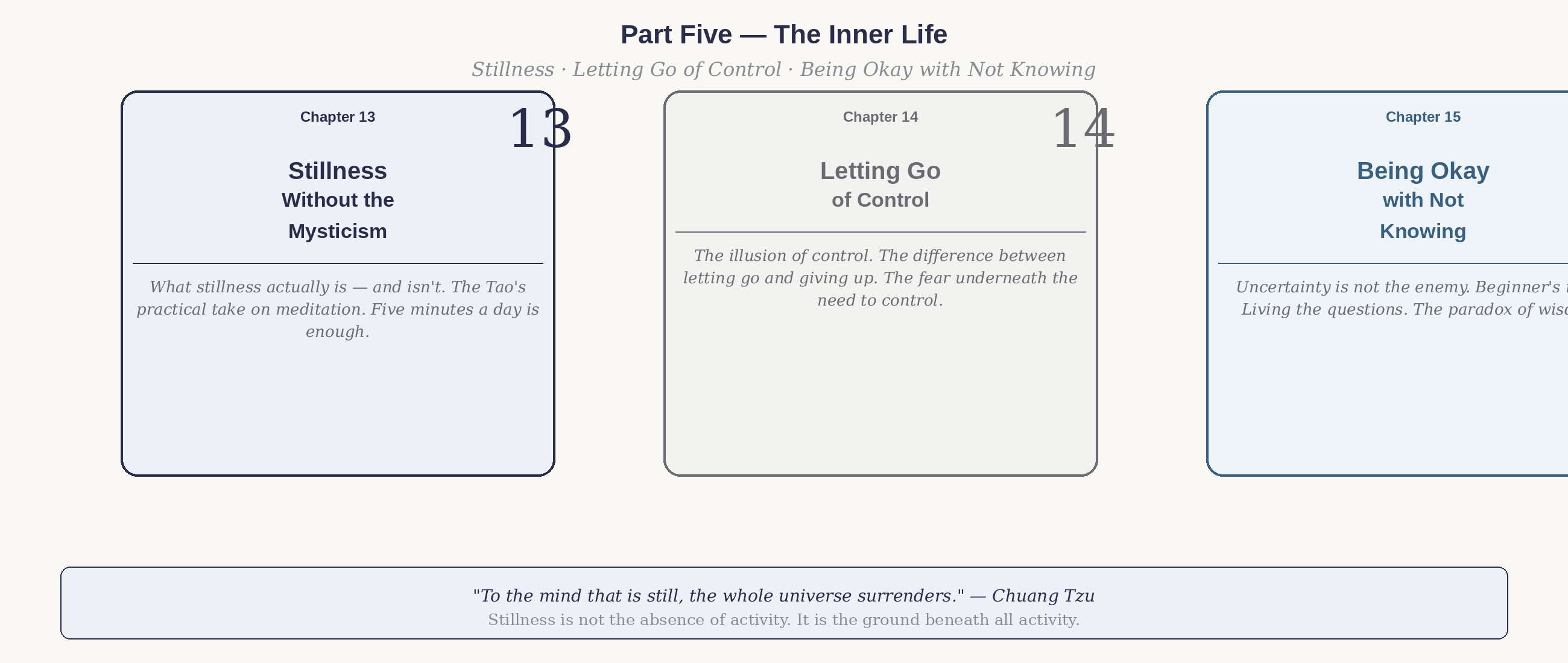
To the mind that is still, the whole universe surrenders. Five minutes is enough to begin.
What Stillness Actually Is (and Isn’t)
Let’s start by clearing up some confusion, because the word “stillness” gets used in a lot of different ways, and not all of them are helpful.
Stillness is not about stopping your thoughts. If you’ve ever tried to meditate and felt like a failure because you couldn’t get your mind to shut up, here’s what you need to know: no one can stop their thoughts. Thoughts are what minds do. Trying to stop them is like trying to stop your heart from beating. It’s not the goal, and it was never the goal.
Stillness is also not about achieving some special state. It’s not about having a profound experience or feeling blissed out or reaching enlightenment. Those things might happen sometimes, for some people. But they’re not the point. And if you go into stillness practice expecting them, you’re setting yourself up for disappointment.
So what is stillness? It’s much simpler than all that. Stillness is what happens when you stop trying to do anything. When you let go of the need to accomplish, to solve, to plan, to figure out. When you just… sit. Or lie down. Or stand. And let yourself be exactly as you are, in this moment, without needing it to be different.
In that state — that quiet, unhurried, non-striving state — something shifts. The nervous system begins to settle. The mind, which has been racing from one thing to the next, starts to slow down. Not because you forced it to. But because you gave it permission to. And in that slowing, a kind of clarity emerges. Not answers, necessarily. Not solutions. Just a clearer sense of what’s actually happening, beneath all the noise.
That’s stillness. And it is, in its quiet way, one of the most valuable states a human being can access.
This approach’s Practical Take on Meditation
This approach doesn’t give explicit instructions on how to meditate. It’s not that kind of text. But it does talk, again and again, about the value of emptiness. Of quiet. Of the space between things. And all of that is pointing, in its indirect way, toward something very much like meditation.
But this approach’s version of meditation is refreshingly simple. It doesn’t require special equipment or a special place or a special mindset. It just requires a willingness to stop. To sit. To do nothing for a little while. And to notice what happens when you do.
You don’t need to sit cross-legged on a cushion, though you can if you want. You can sit in a chair. You can lie on your bed. You can stand by a window. The posture matters far less than the intention — which is simply: to be present. To pay attention. To let go, as much as you can, of the constant doing that fills most of your waking hours.
What do you pay attention to? That’s up to you. Some people pay attention to their breath — the rise and fall of the chest, the sensation of air moving in and out of the nostrils. Some people pay attention to sounds — the hum of the refrigerator, the birds outside, the distant traffic. Some people pay attention to physical sensations — the feeling of their hands resting on their lap, the weight of their body against the chair. It doesn’t really matter what you choose. The point is to have something to anchor your attention, so that when your mind wanders — and it will wander, constantly — you have somewhere to gently return to.
That’s the practice. Attention wanders. You notice it’s wandered. You bring it back. No drama. No judgment. Just a quiet, patient returning, over and over and over.
It sounds simple. It is simple. And it’s also one of the hardest things most people ever try to do. Because it reveals, very quickly, just how rarely we’re actually present. How much of our lives we spend lost in thought — replaying the past, rehearsing the future, anywhere but here.
But the difficulty is also the point. Every time you notice your mind has wandered and you bring it back — gently, without scolding yourself — you are practicing something profound. You are practicing the ability to be here, now, rather than somewhere else. And that ability, built up over hundreds of small moments of practice, changes everything.
Why Stillness Makes You Better at Everything Else
Here’s something that might sound counterintuitive: spending time doing nothing actually makes you better at doing things.
This isn’t mystical. It’s just how the brain works. When you’re constantly in motion — constantly thinking, planning, solving, reacting — your mind doesn’t have the space to process, integrate, or rest. You’re running the engine at full speed all the time, and engines that run like that burn out.
Stillness gives your brain the downtime it needs to do its deeper work. The work of consolidating memories. Making connections between ideas. Processing emotions that you’ve been too busy to feel. Letting the subconscious do the kind of problem-solving that the conscious mind struggles with. All of that happens in the quiet. In the gaps. In the moments when you’re not trying to make anything happen.
People who practice stillness regularly — whether through meditation, or simply through regular periods of doing nothing — report a range of benefits that show up in every area of life. They’re calmer under pressure. They’re more creative. They make better decisions. They’re more patient with other people. They sleep better. They feel more connected to themselves and to the people around them.
None of this requires believing in anything. It doesn’t require a practical framework or a particular framework. It’s just what happens when you give your nervous system a break from the constant activation of modern life. When you create regular pockets of time where you’re not consuming, not producing, not performing. Just being.
This approach has been pointing toward this for thousands of years. And the modern science of how the brain and nervous system work is finally catching up.
When Stillness Feels Impossible
Let’s address something directly, because it comes up for almost everyone who tries to practice stillness: what do you do when sitting still feels genuinely impossible? When your mind is so loud, your body so restless, that five minutes feels like an eternity?
First, know this: you’re not broken. You’re not doing it wrong. And you’re not uniquely bad at this. The state you’re experiencing is actually very common, especially in the early days of practicing stillness. Your nervous system is used to constant stimulation. Your mind is used to constant activity. Asking them to suddenly settle is like asking a speedboat to come to a full stop in rough water. It doesn’t happen instantly. There’s momentum to work through.
So what helps? Sometimes, the answer is to start with movement rather than stillness. A slow walk. Gentle stretching. Something that gives the body a way to discharge some of the restless energy before you ask it to be still. This framework is flexible about this. It doesn’t demand that you sit in perfect meditation posture. It just asks for some quality of quiet attention — and sometimes that’s easier to access when you’re moving slowly than when you’re trying to force yourself to sit.
Sometimes the answer is to make the session shorter. Not five minutes — two minutes. Or even one. Just long enough to plant the seed without making it feel like torture. You can always build up over time. But if you push too hard too fast, you’ll just create an association between stillness and suffering, and you’ll stop doing it altogether.
And sometimes the answer is simply to acknowledge that today is not a stillness day. That your nervous system is too activated, your mind too full, your life too chaotic for sitting still to feel anything other than agonizing. And that’s okay. The practice will be there tomorrow. Or the day after. This approach doesn’t grade you. It doesn’t keep score. It just invites you, again and again, to come back when you’re ready.
The Discomfort of Doing Nothing
Let’s be honest about something: for a lot of people, the hardest part of stillness practice isn’t the wandering thoughts. It’s the discomfort of doing nothing.
We are not, as a culture, comfortable with stillness. We fill every gap. Every moment of waiting in line becomes an opportunity to check our phones. Every quiet evening becomes a chance to scroll, or watch something, or plan the next thing. The idea of just sitting, with nothing to distract us, can feel almost unbearable.
And there’s a reason for that. When you get still — really still — things come up. Feelings you’ve been avoiding. Thoughts you’ve been pushing away. Discomfort you’ve been managing through constant motion. The stillness doesn’t create these things. They were already there. But the stillness stops you from running from them. And that can feel, especially at first, very uncomfortable.
This approach’s response to this discomfort is not to push through it or to force yourself to sit with it. It’s gentler than that. It’s simply: notice it. Notice the discomfort. Notice the urge to get up, to check your phone, to do something, anything, other than sit here. And then — gently, without judgment — choose to stay. Just a little longer. Just one more breath.
Over time, something remarkable happens. The discomfort doesn’t go away entirely. But it becomes less frightening. You start to realize that feelings, even uncomfortable ones, are just feelings. They rise. They peak. They pass. And sitting with them — just being present for them, without trying to fix or change or escape them — is something you’re capable of. Something you can do.
That realization is quietly transformative. Because once you know you can sit with discomfort, you’re no longer at its mercy. You have a choice. And that choice — to be present even when it’s hard — is one of the most powerful things you can cultivate.
Stillness as Resistance
Here’s a thought that might feel a little radical: in a world that profits from your constant activity, your constant consumption, your constant distraction — choosing stillness is an act of resistance.
Every time you sit down and do nothing, you are refusing to participate in the machine that wants you always moving, always buying, always consuming. You are claiming your time and your attention as your own. You are asserting, quietly but firmly, that your life is more than what you produce or what you buy or how you perform.
This approach doesn’t frame it this way, exactly. But the spirit is there. This framework is deeply suspicious of the kind of frantic, forced activity that our culture celebrates. It sees it for what it is: exhausting, unsustainable, and ultimately disconnected from anything that actually nourishes the human soul.
Stillness, in this framework’s world, is not passivity. It’s a kind of power. The power to say no. The power to opt out, even briefly, from the relentless pressure to be more, do more, have more. The power to simply be, without justification or apology.
And that power, once you start to feel it, is addictive in the best possible way. Not because it makes you feel superior to everyone else. But because it makes you feel like yourself. Like a whole person, rather than a machine optimized for productivity. And once you’ve tasted that, it’s very hard to go back.
Stillness and Creativity
Here’s something that doesn’t get talked about enough: stillness isn’t just good for your nervous system or your mental health. It’s also one of the most reliable ways to access creativity.
Think about where your best ideas have come from. Were you sitting at your desk, staring at a screen, trying to force them into existence? Probably not. More likely, they came in the shower. On a walk. In the moments just before sleep. In that quiet, unfocused state where your mind was allowed to wander without direction.
That state — that loose, associative, not-trying state — is where creativity lives. And stillness practice is one of the most direct ways to cultivate it. Not because stillness makes you creative in some mystical sense. But because it gives your mind permission to stop working. To stop forcing. To stop trying to solve and produce and accomplish. And in that release, connections start forming that the busy, focused mind would never have made.
Writers, artists, musicians, scientists — people in any field that requires creative thinking — often discover this by accident. They notice that their best work doesn’t come from grinding harder. It comes from stepping away. From giving themselves space to not-work. From trusting that the subconscious mind, when given a break, will do the work that the conscious mind can’t.
This approach has known this all along. Its entire teaching is, in many ways, a celebration of the power of not-doing. Of trusting that the most important things often happen in the spaces between effort. And that stillness — far from being empty or wasteful — is where the richest soil is.
Five Minutes of Stillness
A practice for this week. Bring a journal.
Here’s the practice. It’s embarrassingly simple. And it’s also, for most people, harder than it sounds.
Set a timer for five minutes. Find a place to sit — a chair, a cushion, your bed, wherever feels comfortable. Close your eyes, or soften your gaze.
Now, do nothing. Just sit. Pay attention to your breath, if you want a place to anchor your attention. Or pay attention to sounds. Or to the feeling of your hands resting in your lap. It doesn’t matter what you choose. The point is to have something to come back to when your mind wanders.
And your mind will wander. Constantly. That’s fine. That’s what minds do. When you notice it’s wandered, gently — and this part is important, gently — bring it back. No scolding. No frustration. Just a quiet returning, like guiding a puppy back to its bed.
That’s it. Five minutes. Once a day, if you can manage it. Or a few times a week. Or whenever you remember. The consistency matters more than the duration. Five minutes every day is infinitely more valuable than an hour once a month.
And here’s what you might notice, if you keep doing this: the five minutes start to feel less impossible. Your mind still wanders, but you get better at noticing when it does. The stillness starts to feel less like a punishment and more like a refuge. And the effects start to show up in the rest of your life — in moments of unexpected calm, in decisions that feel clearer, in a general sense of being a little more present, a little more here.
That’s this approach at work. Not loud. Not dramatic. Just quietly, persistently, reshaping your relationship with yourself and with the world. One breath at a time.
Chapter 14: Letting Go of Control
There is a particular kind of suffering that almost everyone knows intimately, and it goes like this: you want something to happen. You need it to happen. You’ve planned for it, worked for it, maybe even built your entire sense of well-being around it happening. And then it doesn’t happen. Or it happens differently than you expected. Or it happens in a way that feels wrong, unfair, incomprehensible.
And you suffer. Not just from the disappointment itself, but from the dissonance between what you wanted and what actually occurred. From the feeling that something has gone terribly wrong, simply because reality didn’t cooperate with your plan.
This approach has a lot to say about this kind of suffering. And its prescription is both incredibly simple and incredibly difficult: let go.
Not of your desires. Not of your goals or your values or the things you care about. But of the tight, white-knuckled grip you have on needing things to go a specific way. Of the belief that you can — or should — be able to control the outcome of every situation. Of the exhausting, ultimately futile effort to force the world into a shape that matches your expectations.
Letting go, in this framework’s sense, isn’t giving up. It’s something much more subtle, and much more powerful. It’s choosing to hold your preferences lightly. To do your best and then release your attachment to the result. To trust that life has its own intelligence, and that sometimes — often, even — the things that don’t go according to plan turn out to be exactly what you needed.
The Illusion of Control
Let’s start with a difficult truth: you have far less control than you think you do.
You can control your actions. You can control your effort. You can control, to some degree, how you respond to situations. But you cannot control outcomes. You cannot control other people. You cannot control the weather, the economy, the passage of time, the randomness of the universe, or a thousand other factors that shape what actually happens in any given situation.
And yet we act, almost constantly, as if we can. We believe that if we just plan hard enough, work hard enough, worry hard enough, we can make things go the way we want them to go. And when they don’t — when life throws us a curveball, when someone we love makes a choice we don’t understand, when something we worked for doesn’t pan out — we feel betrayed. As if the world broke some implicit promise it never actually made.
This approach sees this pattern clearly. And it offers a different approach. Not one where you stop trying or stop caring. But one where you recognize the limits of your influence, and you work within those limits rather than exhausting yourself fighting against them.
This doesn’t mean becoming passive. It doesn’t mean giving up on your goals or your values. It means recognizing that you can plant the seed and water it and give it sunlight, but you can’t make it grow. That’s the seed’s job. And the soil’s job. And the sun’s job. And a hundred other factors you have no control over. Your job is to tend to what’s yours to tend to, and then step back. To trust that the growing will happen — or won’t — in its own time, in its own way.
That trust, that releasing of the need to control, is one of the hardest and most freeing things a person can learn.
The Difference Between Letting Go and Giving Up
This is where people often get confused, so let’s spend a moment here. Because letting go and giving up sound like the same thing. But they’re not. Not even close.
Giving up is what happens when you stop caring. When you throw your hands up in frustration and say, “Fine, I don’t care anymore, do whatever you want.” It’s a kind of collapse. A resignation. A pulling back of your energy and your effort and your heart.
Letting go is different. Letting go is what happens when you care deeply — maybe more deeply than ever — but you release your stranglehold on the outcome. You do everything you can. You give it your best effort. You show up fully. And then you let the chips fall where they may, without needing them to fall in any particular place.
Letting go is active, not passive. It takes effort. It takes courage. Because it means continuing to care, continuing to engage, continuing to invest — all while knowing that the thing you care about might not work out the way you hope. And being willing to be okay with that. Not happy, necessarily. Not thrilled. But okay. Able to move forward. Able to find meaning even in the disappointment.
This approach would say this is one of the highest forms of strength. Not the strength to force outcomes. The strength to engage fully with life, without needing life to go your way in order to be at peace.
What You Actually Have Control Over
If you don’t have control over outcomes, what do you have control over? It’s a fair question. And the answer, while limited, is also deeply empowering.
You have control over your actions. What you do, how you show up, the effort you put in. You have control over your response. How you interpret what happens, how you talk to yourself about it, what you choose to do next. You have control, to some degree, over your attention. What you focus on, what you give your energy to, what you allow to occupy your thoughts.
That’s it. That’s the list. And for a lot of people, when they first encounter it, it feels disappointingly small. But here’s the thing: it’s actually enough. Because those three things — your actions, your responses, and your attention — are enormously powerful. They shape your entire experience of life. They determine whether you move through the world with ease or with constant friction. They’re the difference between resilience and brittleness, between adaptation and rigidity.
This approach invites you to focus your energy there. On the things you actually can influence. And to release — gently, without self-judgment — the constant, exhausting effort to control everything else.
When you do that, something remarkable happens. You don’t become passive or disengaged. You actually become more effective. Because all the energy you were wasting on trying to control the uncontrollable is now available for the things you can actually do something about. And that shift — small as it sounds — changes everything.
Control and Relationships
Nowhere is the tension around control more visible — and more painful — than in relationships. Because the people we love are also the people we most desperately want to protect, guide, influence, and sometimes change. And the tighter we grip, the more they pull away.
Think about what it feels like to be on the receiving end of someone’s need to control you. To have a parent who can’t let you make your own mistakes. A partner who needs you to be a certain way in order for them to feel okay. A friend who treats every difference of opinion like a betrayal. It doesn’t feel like love, even when that’s what it’s supposed to be. It feels suffocating. Like there’s no room for you to be yourself.
And yet, most of us do some version of this to the people we care about. Not out of malice. But out of fear. Fear that they’ll get hurt. Fear that they’ll make the wrong choice. Fear that if they’re not who we need them to be, the relationship will fall apart.
This approach’s invitation is to let go of that grip. To trust the people you love to walk their own path, make their own mistakes, become who they’re becoming — even when that path looks different from what you’d choose for them. To love them enough to give them room. To support them without controlling them. To be present without being possessive.
This is incredibly hard. Especially with children, or with partners going through difficult times, or with aging parents who might actually need your help. The line between care and control can be razor-thin. But this approach would say: err on the side of trust. Give people more autonomy than feels comfortable. Let them surprise you. Let them prove that they’re more capable than your fear gives them credit for.
And notice what happens when you do. Often — not always, but often — the relationship deepens. Because when people feel trusted, they rise. And when they feel controlled, they resist. It’s human nature. And recognizing that, and adjusting your approach accordingly, is one of the most loving things you can do.
The Fear Underneath the Need to Control
Let’s go a little deeper, because the need to control usually isn’t about the surface thing. It’s not really about needing the meeting to go a certain way, or needing your partner to respond in a specific manner, or needing your children to make the choices you think are best.
It’s about what those things represent. It’s about the fear that if they don’t go your way, something terrible will happen. You’ll be rejected. You’ll fail. You’ll be exposed as inadequate. The people you love will be hurt. Your whole carefully constructed sense of how things are supposed to be will come crashing down.
The need to control is, at its core, a response to fear. And the tighter the grip, the deeper the fear.
This approach doesn’t judge this. It understands that fear is part of being human. But it does gently suggest that the strategy isn’t working. That the more you try to control, the more anxious you become. Because control is always, always slipping through your fingers. And the harder you grip, the more aware you are of how little you’re actually holding onto.
So the invitation is to turn toward the fear. Not to make it go away — you can’t. But to acknowledge it. To see it clearly. To ask yourself: What am I actually afraid of here? And is my attempt to control this situation actually addressing that fear, or just avoiding it?
Often, just asking the question is enough to loosen the grip a little. To create a small space where you can see that the fear is understandable, and real, and also — usually — not as catastrophic as it feels in the moment. And in that space, you have a choice. You can keep trying to control. Or you can take a breath, acknowledge the fear, and choose to engage with the situation as it actually is, rather than as you desperately need it to be.
That choice, made over and over in small moments, is the practice of letting go.
The Practice of Surrendering to What Is
There’s a phrase that shows up in a lot of spiritual traditions, and it sounds deceptively simple: accept what is. And the mind immediately rebels. Accept that I’m in pain? Accept that someone I love is struggling? Accept injustice, suffering, unfairness?
But acceptance, in this framework’s sense, doesn’t mean approval. It doesn’t mean liking what’s happening or condoning it or pretending it’s fine when it’s not. It means acknowledging reality as it actually is, rather than as you wish it were. Because you can’t respond effectively to a situation you’re refusing to see clearly.
Think about the last time you were in denial about something. A relationship that wasn’t working. A job that was draining you. A health issue you were ignoring. The denial didn’t make the problem go away. It just delayed your ability to deal with it. And often, by the time you finally acknowledged what was happening, the situation had gotten worse.
Acceptance is the opposite of denial. It’s seeing clearly. And seeing clearly — even when what you see is painful — is the first step toward doing anything useful about it.
So the practice of surrendering to what is doesn’t mean becoming passive. It means getting honest. It means dropping the story about how things should be, and dealing with how things actually are. And from that place of clarity, you can act. You can make choices. You can change what can be changed. But you can only do that if you first stop fighting reality long enough to see it clearly.
This approach calls this wu wei applied to acceptance. Effortless action that comes from alignment with what is, rather than from resistance to it. And it’s one of the most powerful shifts a person can make.
The Hands-Open Meditation
A practice for this week. Bring a journal.
Here’s a short practice you can do whenever you notice yourself gripping too tightly — whether that’s at a specific situation, a relationship, an outcome you’re attached to, or just the general feeling of needing everything to be different than it is.
Sit down. Close your eyes. Take a few slow breaths.
Now, make fists with both hands. Squeeze them tight. Feel the tension in your fingers, your palms, your wrists. Hold that tension for a few seconds.
And then, slowly, open your hands. Let them rest, palms up, on your lap. Feel the release. The softening. The letting go.
Do this a few times. Squeeze. Hold. Release. Each time, notice what it feels like in your body. The tension when you grip. The relief when you let go.
Now, bring to mind the thing you’re gripping onto mentally or emotionally. The situation you’re trying to control. The outcome you’re attached to. The person you’re trying to change. Whatever it is.
And as you breathe out, imagine setting it down. Not abandoning it. Not giving up on it. Just… setting it down. Opening your hands. Letting it be what it is, rather than what you need it to be.
You don’t have to do this perfectly. You don’t have to feel immediately peaceful about it. Just practice the gesture. The opening. The releasing. And notice, even for a moment, what it feels like to loosen your grip.
That’s the practice. And if you come back to it regularly — whenever you notice yourself in that familiar, exhausting state of trying to force something — you might find that the letting go gets a little easier. Not because the fear goes away. But because you’ve practiced, again and again, the simple act of opening your hands.
Chapter 15: Being Okay with Not Knowing
We live in a culture that prizes certainty. Confidence. Having the answer. Knowing what to do. We admire people who seem sure of themselves, sure of their path, sure of how things will turn out. And we treat uncertainty like a problem to be solved — a gap in knowledge that needs to be filled as quickly as possible, so we can get back to the comfort of knowing.
This approach sees things differently. Very differently.
This approach celebrates not-knowing. It treats it not as a deficit, but as a kind of wisdom. Because when you don’t know — when you genuinely, humbly admit that you don’t have all the answers — you become curious. You become open. You become willing to learn, to listen, to see things you might have missed if you’d already made up your mind.
Not-knowing, in this framework’s world, is not ignorance. It’s a form of receptivity. A willingness to be surprised. A recognition that life is far more complex, far more mysterious, far more alive than any single perspective can capture.
And the person who can be at peace with not-knowing — who can sit in the discomfort of uncertainty without rushing to fill it with false certainty — is, paradoxically, one of the wisest people you’ll ever meet.
Why We’re So Uncomfortable with Uncertainty
Let’s start with the obvious: uncertainty feels terrible. It feels like standing on unstable ground. Like you’re one step away from falling, and you have no idea where the fall will take you.
Our brains are wired, at a very deep level, to seek certainty. To predict. To know what’s coming next. It’s a survival mechanism. In the ancestral environment, the person who could predict where the predators were, or when the food would run out, or which berries were safe to eat — that person lived. The person who couldn’t, didn’t.
So we inherited brains that are deeply, almost pathologically, uncomfortable with not-knowing. And in the modern world, that discomfort shows up everywhere. In our need to plan everything. In our anxiety about the future. In the way we cling to beliefs even when the evidence suggests they’re wrong, because admitting we don’t know feels too vulnerable.
This approach understands this. It doesn’t judge it. But it does gently, persistently suggest that the strategy isn’t working. That the more you try to eliminate uncertainty from your life, the more anxious you become. Because uncertainty is part of life. It’s woven into the fabric of being alive. And trying to control it, trying to force certainty where none exists, is like trying to hold water in your hands. The harder you grip, the more it slips away.
The Gift of Not Knowing
Here’s something that might sound counterintuitive: not-knowing is actually a gift.
When you don’t know, you’re forced to pay attention. You can’t rely on assumptions or autopilot. You have to be present. You have to look closely. You have to actually engage with what’s in front of you, rather than what you expected to be there.
When you don’t know, you’re also free to be surprised. To discover something you wouldn’t have discovered if you’d already decided you had the answer. To let the situation teach you something, rather than forcing it to conform to what you already believe.
Think about the last time you learned something genuinely new. Something that shifted your understanding in a significant way. Did that learning happen because you already knew the answer? Of course not. It happened because you didn’t know. Because there was a gap — an uncertainty, a question, a mystery — and you were curious enough to explore it.
This approach sees this dynamic everywhere. It sees that the people who grow the most are the ones who can tolerate not-knowing long enough to let new understanding emerge. And it sees that the people who suffer the most are often the ones who can’t tolerate it — who rush to certainty, even false certainty, just to make the discomfort stop.
So the invitation is to get curious about uncertainty itself. To explore what it feels like to say, out loud or just to yourself: I don’t know. I’m not sure. I’m still figuring this out. And to notice whether those words, instead of making you feel small or inadequate, actually create a kind of opening. A spaciousness. A permission to learn.
Certainty as a Trap
There’s another side to this that’s worth examining. Because while not-knowing feels uncomfortable, certainty — the kind of absolute, unshakeable certainty that refuses to be questioned — can be dangerous.
Think about the people you know who are certain about everything. Who have strong opinions on every topic. Who never seem to doubt themselves or second-guess their conclusions. On the surface, they might seem confident. Strong. Impressive. But if you look more closely, you might notice something else: a rigidity. A brittleness. An inability to adapt when the situation calls for it.
Certainty, when it’s not earned — when it’s just a defense mechanism against the discomfort of not-knowing — becomes a kind of prison. It cuts you off from new information. It makes you dismissive of perspectives that don’t fit your worldview. It turns conversations into competitions rather than exchanges. And it makes you, over time, less effective at navigating a world that is constantly changing, constantly offering new information, constantly refusing to fit neatly into the categories you’ve created.
This approach sees this clearly. And it offers an alternative: a kind of fluid, flexible, open-minded approach to life that is willing to hold beliefs lightly. To update them when new information comes in. To say “I was wrong” without it feeling like the end of the world. To live in the tension between knowing enough to act and being humble enough to keep learning.
That’s not weakness. That’s actually one of the deepest forms of strength there is.
Beginner’s Mind
Zen Buddhism has a concept called “beginner’s mind” — the idea that approaching something with fresh eyes, as if you’ve never encountered it before, allows you to see things you’d miss if you came in with all your assumptions and expertise intact. This approach doesn’t use that exact phrase, but the spirit is everywhere in the text.
Think about how children approach the world. Everything is new. Everything is interesting. A puddle is a marvel. A bug is a universe. They don’t know what’s supposed to be boring yet, so nothing is boring. They don’t know what’s supposed to be scary, so they’re fearless in ways that make adults nervous. They haven’t learned to filter the world through categories and judgments. They just… experience it.
Adults lose this. We have to — to some degree. You can’t function in the world if you treat every puddle like a miracle and every bug like a novel discovery. But we lose it so thoroughly that we stop seeing almost anything clearly. We walk through our days on autopilot, experiencing not what’s actually there but what we expect to be there.
This approach invites you to recover some of that beginner’s mind. Not all of it — you’re not a child. But enough of it to keep you curious. Enough of it to make you willing to be surprised. Enough of it to prevent you from becoming so sure of how things are that you stop noticing when they change.
Practically, this might look like approaching a familiar task — cooking dinner, driving to work, having a conversation with someone you know well — as if it’s the first time. What do you notice that you usually miss? What’s actually happening, beneath the layer of habit and assumption? What might you learn if you pretended, just for a moment, that you don’t already know everything there is to know about this?
That curiosity, that openness, that willingness to not-know — that’s beginner’s mind. And it’s one of the most valuable things you can cultivate.
Living the Questions
The poet Rainer Maria Rilke once wrote: “Be patient toward all that is unsolved in your heart and try to love the questions themselves.” That line could have come straight out of this approach. Because it captures something essential about these principles’s relationship with uncertainty.
This approach doesn’t promise you answers. It doesn’t offer a neat, tidy system where everything makes sense and every question has a clear response. What it offers is something quieter and more enduring: a way of being with the questions. A way of sitting in the not-knowing without needing to rush to resolution.
What does that look like in practice? It looks like holding big life questions — What should I do with my life? How do I know if this relationship is right? What does it all mean? — without demanding immediate answers. It looks like giving yourself permission to live in the uncertainty for a while. To let the questions simmer. To trust that clarity will come, in its own time, if you can be patient enough to let it.
This doesn’t mean becoming paralyzed by indecision. It doesn’t mean never taking action until you’re 100% certain. It means recognizing that some questions don’t have clear answers. That some decisions have to be made in the fog, with incomplete information, and that’s okay. You do your best. You pay attention. You adjust as you go. And you trust that the path will reveal itself one step at a time, rather than all at once in a blinding flash of certainty.
Living the questions is an act of faith. Not faith in some external force. But faith in the process itself. Faith that you don’t need to have all the answers in order to move forward. That the uncertainty, uncomfortable as it is, is part of the journey — not an obstacle to it.
The Paradox of Wisdom
Here’s something worth sitting with: the wisest people are often the ones most comfortable saying “I don’t know.” Not because they actually know less than everyone else. But because they know enough to recognize how much they don’t know.
There’s a pattern that shows up in almost every field of expertise. When someone is just starting out, they’re very confident. They’ve learned a few things, and those few things feel like a complete picture. As they learn more, they start to realize how much they still don’t understand. The boundaries of their knowledge expand, but so do the boundaries of their ignorance — and often, the second expands faster than the first. By the time someone becomes truly expert, they’re acutely aware of all the nuance, all the complexity, all the exceptions and edge cases and unknowns that the beginner never even considered.
This is why true experts are so often humble. They’re not pretending. They genuinely understand how much they don’t know. And that understanding makes them cautious about claiming certainty where none exists.
This approach sees this dynamic everywhere. And it celebrates it. Because the person who knows they don’t know is the person who’s still learning. The person who’s still growing. The person who’s open to being corrected, to discovering they were wrong, to updating their understanding when new information comes in.
The person who claims to know everything, on the other hand, has stopped learning. They’ve closed the door. And in a world that is constantly changing, constantly offering new information, constantly revealing new layers of complexity — that closed door is a kind of death. Not a physical one. But a death of curiosity, of growth, of the vitality that comes from engaging with life as it actually is rather than as you’ve decided it must be.
So the paradox of wisdom is this: the more you actually know, the more comfortable you become with not-knowing. And that comfort — that ease with uncertainty — is one of the clearest signs that you’ve moved from knowledge into something deeper.
The “I Don’t Know” Experiment
A practice for this week. Bring a journal.
For one week, try this: whenever someone asks you a question and you don’t actually know the answer — or you’re not entirely sure — say so.
Instead of guessing, or offering an opinion disguised as fact, or pretending to be more certain than you are, just say: “I don’t know.”
Notice how it feels to say those words. Does it feel vulnerable? Embarrassing? Freeing? Notice how other people respond. Do they lose respect for you, the way you might fear? Or do they seem to appreciate the honesty?
And notice, over the course of the week, how often you actually do know the answer versus how often you’re just pretending to. It might surprise you.
This is a small practice. But it’s also a surprisingly powerful one. Because every time you say “I don’t know” instead of faking certainty, you’re practicing humility. You’re practicing honesty. You’re practicing this approach’s approach to uncertainty — which is simply to acknowledge it, without shame, and to trust that not-knowing is not the same as being lost.
You might find, by the end of the week, that saying “I don’t know” feels less like an admission of failure and more like an opening. A space where something real can happen. Where curiosity can enter. Where you can learn something you wouldn’t have learned if you’d pretended to already have the answer.
That’s this approach at work. Quiet. Simple. And quietly revolutionary.