Chapter 16: Embracing Change Instead of Fighting It
If there is one constant in life, it is change. Everything changes. Seasons turn. Bodies age. Relationships evolve. Jobs end. People grow. Nothing — not one single thing — stays the same forever. And yet, despite this being the most obvious truth about existence, most of us spend an enormous amount of energy trying to resist it.
We cling to the good moments, wishing they would last. We fight the difficult moments, wishing they would end. We build our lives around the fantasy of stability, of things staying the way they are, even though every piece of evidence suggests that stability is a temporary illusion at best.
This approach has a very different relationship with change. It doesn’t just accept change — it celebrates it. It sees change not as a problem to be managed, but as the fundamental nature of reality. This approach itself is often described as a flowing, moving, ever-shifting force. It is not static. It is not fixed. It is alive, and aliveness means change.
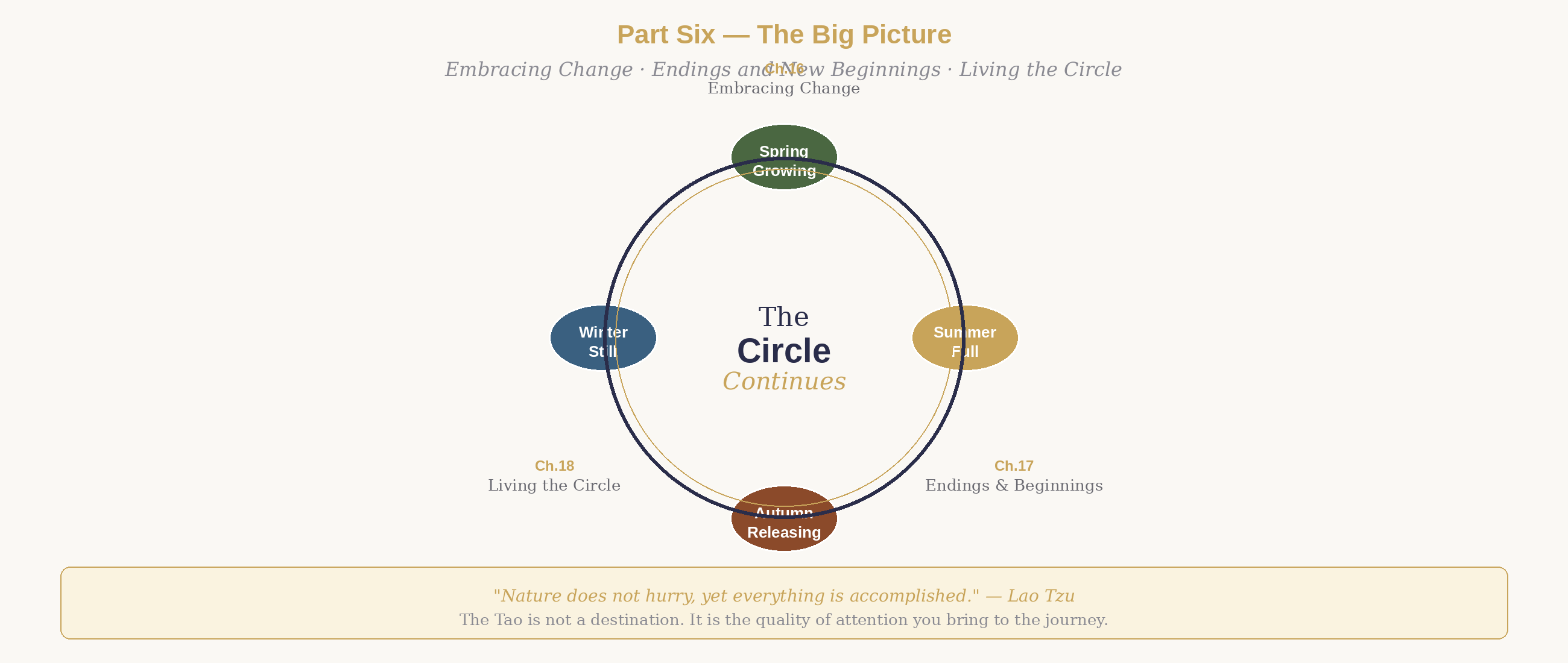
Nature does not hurry, yet everything is accomplished. This is not a destination. It is the quality of attention you bring.
And the person who can align themselves with that truth — who can stop fighting change and start moving with it — discovers a kind of resilience and ease that no amount of control can provide. Because when you stop trying to hold water in your hands, you can finally swim.
Why We Resist Change (Even When It’s Good for Us)
Let’s be honest about something: change is uncomfortable. Even when it’s good change — a promotion, a move to a new city, the start of a relationship — there’s a discomfort in it. Because change means leaving behind what’s familiar. What’s known. What feels safe, even if it wasn’t actually serving you.
The human brain is wired to prefer the familiar. It’s a survival mechanism. In the ancestral environment, the familiar was usually safer than the unknown. The cave you knew was less likely to have predators than the cave you didn’t. The food you’d eaten before was less likely to poison you than the food you’d never tried. So we evolved to be cautious about change, to treat the unknown with suspicion, to cling to the familiar even when the familiar is making us miserable.
That instinct made sense ten thousand years ago. It makes much less sense now. Because the world we live in is changing constantly, whether we like it or not. Technology is evolving. Culture is shifting. The job market is transforming. The climate is changing. And the person who digs in their heels and refuses to adapt — who clings desperately to how things used to be — is setting themselves up for a very difficult time.
This approach sees this clearly. And it offers a different approach: don’t resist the change. Flow with it. Not passively. Not with resignation. But with a kind of active engagement that asks: What is this change asking of me? What can I learn from it? How can I work with it rather than against it?
That shift — from resistance to engagement — is subtle but profound. Because it turns change from a threat into an opportunity. From something happening to you into something you’re participating in.
The Myth of Permanent Stability
There’s a deeply ingrained belief in our culture that stability is the goal. That the mark of a successful life is getting to a place where things are settled, secure, unchanging. We work toward the stable job, the stable relationship, the stable home. And once we have those things, we believe we can relax. We’ve arrived.
But this approach would gently point out: there’s no such thing as permanent stability. Not in the way we imagine it. Everything is always moving, always shifting, always in flux. The job that feels secure today could be gone tomorrow. The relationship that feels unshakeable can change in an instant. The body that feels strong and healthy is aging, cell by cell, every single day.
This isn’t meant to be depressing. It’s meant to be freeing. Because when you stop chasing the fantasy of permanent stability, you can start building something more real: resilience. The ability to adapt. To bend. To flow with change rather than breaking under it.
Resilience doesn’t come from making your life unchangeable. It comes from knowing you can handle it when things change. From having practiced — through all the small changes that have already happened — the skill of adjusting, adapting, and moving forward even when the ground shifts beneath your feet.
This teaches resilience not by promising stability, but by helping you develop a different relationship with instability. One where change isn’t the enemy. One where you trust yourself enough to know that whatever comes, you’ll figure it out. Not because you have all the answers in advance. But because you’ve learned, again and again, how to take the next step even when you can’t see the whole path.
Impermanence as a Teacher
Buddhism talks a lot about impermanence — the idea that nothing lasts, that all things arise and pass away, and that suffering comes from clinging to things as if they were permanent when they’re not. This approach doesn’t use that exact language, but the teaching is there. Everything flows. Everything moves. Everything changes. And the person who understands that deeply — not just intellectually, but in their bones — lives differently.
Think about what it would mean to really internalize the truth that nothing lasts. Not in a depressing way. In a freeing way. The difficult moment you’re in? It will pass. The joy you’re feeling? Savor it, because it won’t stay this way forever. The person you love? Appreciate them now, while they’re here, because nothing is guaranteed.
Impermanence doesn’t make things meaningless. It makes them precious. Because when you know that something won’t last, you pay attention to it. You show up for it. You don’t take it for granted.
This is one of this approach’s most beautiful teachings, though it’s often missed because it’s woven into the text rather than stated outright. This teaches you to hold things lightly. To love without clinging. To enjoy without grasping. To be present with what is, knowing that what is will soon be something else.
And that lightness — that ability to be with something fully while also knowing it won’t last — is one of the deepest forms of wisdom there is.
The Seasons as a Model for Living
This approach often points to nature as a teacher, and one of the most powerful metaphors it offers is the cycle of the seasons. Spring doesn’t try to become summer faster. Autumn doesn’t mourn the loss of summer. Winter doesn’t resist becoming spring. Each season does what it does, fully, and then gives way to the next. And the cycle continues, endlessly, without drama or resistance.
Human lives follow a similar pattern, though we often don’t like to admit it. There are seasons of growth — times when everything feels alive and new and full of possibility. There are seasons of harvest — times when you reap the rewards of earlier effort. There are seasons of decline — times when things fall away, when you lose what you had, when the ground beneath you shifts. And there are seasons of stillness — times when nothing much is happening on the surface, but deep work is being done underground.
The mistake most people make is treating every season as if it should be spring. As if growth and expansion and upward momentum are the only valid states. And when life inevitably moves into a different season — when things slow down, or fall apart, or go dormant — they panic. They think something has gone wrong. They fight to get back to the growth season, to force things to bloom when it’s actually time to rest.
This approach invites you to honor the season you’re actually in. If it’s a season of growth, grow. If it’s a season of letting go, let go. If it’s a season of quiet, be quiet. Trust that the cycle will continue. That winter gives way to spring, not because you force it, but because that’s what winter does.
Living in alignment with your actual season — rather than fighting to be in a different one — is one of the most practical and powerful things this approach can teach you.
Change as Opportunity
Here’s something that might shift your relationship with change: every change, even the ones that feel like losses, is also an opening. A space where something new can come in. A crack in the structure where light can enter, as Leonard Cohen once wrote.
This doesn’t mean every change is good. Some changes are painful. Some are genuinely terrible. Loss is real. Grief is real. This approach doesn’t ask you to pretend otherwise.
But even in the hardest changes, there is often — not always, but often — a hidden opportunity. A chance to become someone you wouldn’t have become if things had stayed the same. A chance to discover strength you didn’t know you had. A chance to let go of something that wasn’t working and make space for something that might.
The practice here is not to look for the silver lining in every tragedy. That’s exhausting and often dishonest. The practice is simply to stay curious. To ask, even in the middle of difficulty: What is this change asking of me? What might it be making possible? What could I learn here, if I’m willing to pay attention?
Sometimes the answer is nothing. Sometimes the only thing a change teaches you is that life is hard and unfair and painful. And that’s okay. You don’t have to find meaning in every loss.
But sometimes — more often than you might expect — the answer surprises you. Sometimes you look back on a change that felt devastating at the time and realize it was the best thing that could have happened. That it freed you from something you didn’t even know was holding you back. That it led you toward something you never would have found if the path hadn’t shifted beneath your feet.
This approach asks you to stay open to that possibility. Not to expect it. Not to demand it. Just to stay open.
The Gift of Uncertainty
There’s a strange paradox at the heart of change: the times when you’re most uncertain about the future are often the times when you’re most alive. Because uncertainty forces presence. When you don’t know what’s coming next, you can’t zone out. You can’t autopilot. You have to actually pay attention.
Think about the last time your life felt genuinely uncertain. A move to a new city. A career change. The start of a relationship. The end of one. During those times, were you bored? Probably not. You might have been anxious. You might have been excited. You might have been terrified. But you were probably not bored.
Because uncertainty wakes you up. It forces you to engage with your life in a way that routine doesn’t require. And while that can be uncomfortable — and no one would choose to live in constant uncertainty — it also has its gifts.
This approach doesn’t ask you to seek out uncertainty for its own sake. But it does invite you to notice that the periods of change, the periods when you don’t know what’s coming, are often the periods when you grow the most. When you discover things about yourself you wouldn’t have discovered if everything had stayed the same. When you become someone you wouldn’t have become if the path had been smooth and straight and predictable.
So the next time life throws you into uncertainty — and it will, because change is inevitable — try to hold both. The discomfort and the aliveness. The fear and the possibility. The sense that you’re losing your footing and the sense that you’re standing on new ground.
Both are true. And both are part of what it means to be alive.
The Change Inventory
A practice for this week. Bring a journal.
Take a piece of paper. Draw a line down the middle. On the left side, write down the biggest changes in your life over the past five years. The good ones, the bad ones, the ones you chose, and the ones that chose you.
On the right side, write down what came from each change. Not what you lost — you can acknowledge that, of course. But what came after. What opened up. What became possible that wasn’t possible before. What you learned. Who you became.
This isn’t about positive thinking or pretending that painful changes weren’t painful. It’s about seeing, with clear eyes, the full picture. The whole arc. The way change, even difficult change, often leads somewhere you couldn’t have predicted.
When you’re done, sit with what you’ve written. Notice if there’s a pattern. Notice if some of the changes you resisted most fiercely turned out to be the most important. Notice if the ones that felt like endings also turned out to be beginnings.
And the next time a change shows up in your life — and it will, because change is constant — come back to this list. Remind yourself that you’ve been through change before. That you’ve survived it before. That you might even, if you’re willing to stay curious, find something valuable in it.
That’s not blind optimism. That’s lived experience. And it’s one of the most useful things you can carry with you as you move through a life that is always, always changing.
Chapter 17: Endings, Transitions, and New Beginnings
Endings are hard. Even when they’re necessary. Even when they’re chosen. Even when you know, deep down, that the thing ending needed to end.
There’s a particular kind of grief that comes with endings — not just the big, obvious ones like death or divorce, but the smaller ones too. The end of a job. The end of a phase of life. The end of a friendship that used to mean everything. The end of who you used to be, as you become someone new.
We don’t talk about these smaller endings much. We don’t have rituals for them the way we do for the big ones. But they matter. They shape us. And the way we move through them — with resistance or with grace, with bitterness or with gratitude — determines, in many ways, what comes next.
This approach understands endings deeply. It sees them not as failures, but as necessary parts of the cycle. Everything that begins must end. And everything that ends makes space for something new to begin. It’s not a consolation. It’s just the way things work.
And the person who can honor an ending — who can grieve it, release it, and move forward without clinging to what was — is someone who lives in harmony with this framework. Someone who understands that life is not a straight line, but a circle. And in a circle, endings and beginnings are not opposites. They’re the same point, seen from different angles.
Why Endings Feel Like Failure (Even When They’re Not)
We live in a culture that valorizes permanence. We celebrate relationships that last forever, careers that span decades, commitments that never waver. And there’s value in that. Staying power is real. Persistence matters.
But the shadow side of this is that we’ve come to believe that anything that ends is a failure. A marriage that ends in divorce? Failure. A job you leave after a few years? Failure. A friendship that drifts apart? Failure. We carry shame around endings, as if the fact that something didn’t last forever means it shouldn’t have happened at all.
This approach sees this very differently. This approach doesn’t measure value by duration. It measures value by alignment. By whether something was true and meaningful and alive while it lasted. And when it’s no longer those things — when a relationship or a job or a phase of life has run its course — this approach doesn’t call that failure. It calls it completion.
Think about the difference between those two words. Failure implies something went wrong. Completion implies something was finished. Something was whole in its own right, for as long as it needed to be, and now it’s done.
Not every relationship is meant to last a lifetime. Some are meant to last a season, or a year, or a decade. And that doesn’t make them less valuable. It makes them what they were: a chapter in your story. Complete in itself. Not incomplete just because another chapter came after.
The same is true for jobs, for homes, for versions of yourself. You outgrow them. You evolve past them. They served their purpose, and now they don’t. That’s not failure. That’s growth.
The In-Between Time
There’s a phase that comes after an ending and before a new beginning, and it’s one of the hardest phases to navigate. It’s the in-between time. The liminal space. The place where you’re no longer who you were, but you’re not yet who you’re becoming.
It’s disorienting. It’s uncomfortable. It can feel like you’re floating, untethered, with no solid ground beneath your feet. You’ve left the old thing behind, but the new thing hasn’t appeared yet. And you have no idea how long this phase will last, or what’s supposed to come next, or if anything is supposed to come at all.
This approach has a deep respect for this in-between time. It doesn’t rush you through it. It doesn’t promise that it will be short or easy. It simply acknowledges that it exists — and that it’s a necessary part of the process.
Because here’s what happens in the in-between: you shed. You rest. You process. You make sense of what just ended. You grieve what you lost. You discover, slowly and often painfully, who you are without the thing that used to define you. And that discovery — that stripping away of the old identity and the gradual, uncertain emergence of a new one — is sacred work. It can’t be rushed.
The culture wants you to rush it. To bounce back. To move on. To have a new job lined up before you leave the old one, a new relationship before the last one is fully over, a new plan before the old one has even fallen apart. And sometimes that’s possible. Sometimes the transition is smooth and quick.
But sometimes it’s not. Sometimes you need to be in the in-between for a while. To sit in the discomfort. To let yourself not-know. To trust that clarity will come, but it will come in its own time, not on your timeline.
This approach asks you to honor that time. To treat it not as wasted time, but as necessary time. As the pause between breaths. As the winter before spring. As the darkness before dawn.
The Stories We Tell About Our Endings
One of the most powerful things you can do with an ending is to choose, consciously, how you tell the story of it.
Because every ending has multiple stories. The story where you failed. The story where you were wronged. The story where you learned something. The story where you became stronger. The story where you discovered what you don’t want. The story where you found out what you do.
None of these stories is more “true” than the others. They’re all partial truths. And the one you choose to emphasize — the one you tell yourself, again and again, until it becomes the story — shapes how you carry that ending forward.
If you tell the story of failure, you’ll carry shame. If you tell the story of being wronged, you’ll carry resentment. If you tell the story of learning, you’ll carry wisdom. If you tell the story of discovery, you’ll carry curiosity.
This approach doesn’t ask you to be dishonest. If an ending was painful, you don’t have to pretend it wasn’t. But it does invite you to notice which version of the story you’re telling. And to ask yourself: Is this the story that serves me? Is this the story I want to carry forward into the next chapter of my life?
Sometimes, just asking the question is enough to shift something. To create a small opening where a different, kinder, more empowering story can emerge. Not a false story. Just a more complete one. One that holds the pain and the gift, the loss and the learning, the ending and the new beginning that it made possible.
Letting Go With Gratitude
Here’s something that can transform the way you experience endings: gratitude.
Not forced gratitude. Not the kind where you pretend everything was perfect when it wasn’t. But genuine gratitude for what was good. For what you learned. For the ways the thing that’s ending served you, even if it also hurt you. Even if it’s time to let it go.
Think about a relationship that ended. Maybe it ended badly. Maybe there was pain, betrayal, disappointment. But if you look back honestly, was there also joy? Laughter? Moments of real connection? Did you learn something about yourself, or about love, or about what you need? Did it shape you in ways that, even now, you carry with you?
This approach invites you to hold both. The pain and the gratitude. The loss and the gift. Because most things that end are not all good or all bad. They’re complicated. They’re messy. They’re deeply, humanly mixed.
And when you can look at an ending and say, sincerely, “Thank you for what this was, even though it’s over” — something shifts. The ending feels less like a failure and more like a completion. The grief feels less bitter and more clean. And you can move forward without carrying the weight of resentment or regret.
This doesn’t mean you have to be grateful for abuse, or for cruelty, or for things that genuinely harmed you. This framework isn’t asking for that. But for the ordinary endings — the jobs that didn’t work out, the friendships that faded, the versions of yourself you’ve outgrown — gratitude is a gift you give yourself. A way of releasing the past without erasing it. A way of saying goodbye without burning the bridge.
New Beginnings and the Courage to Start Again
After the ending, after the in-between, comes the new beginning. And this, too, requires courage. Because starting again means being vulnerable again. Risking again. Opening yourself to the possibility that this new thing might also, one day, end. And knowing that, and doing it anyway.
This approach celebrates new beginnings, but it does so with a light touch. It doesn’t promise that the new thing will be better than the old thing. It doesn’t promise that it will last. It simply points to the fact that life keeps moving, keeps unfolding, keeps offering you chances to engage with it. And the person who can say yes to those chances — who can step into a new beginning with curiosity and hope, even after painful endings — is someone who is truly alive.
New beginnings don’t always look the way you expect. Sometimes they’re big and dramatic — a new city, a new career, a new relationship. But often, they’re quieter than that. A new way of thinking about yourself. A new habit. A new willingness to try something you’ve always been afraid of. Small shifts that, over time, become something significant.
This approach asks you to pay attention to those small beginnings. To honor them. To notice when something new is trying to emerge, and to give it room. Not to force it. Not to rush it. But to tend to it the way you’d tend to a seedling — gently, patiently, with the understanding that growth happens in its own time.
And to remember that every ending, no matter how painful, contains within it the seed of a beginning. Not as a consolation prize. But as the fundamental nature of how life works. The circle turns. The seasons change. And if you can trust that — if you can let go of what’s ending and open your hands to what’s beginning — you might find that this approach was carrying you all along.
Trusting the Process of Becoming
There’s a particular kind of anxiety that shows up during transitions, and it sounds like this: What if I never become anything? What if I’m stuck in this in-between forever? What if the new beginning never comes?
That anxiety is understandable. The in-between is uncomfortable. And when you’re in it, it can feel endless. But here’s what this approach knows, and what you might have forgotten in the discomfort: you are always becoming. Not in the future. Right now. In the middle of the mess. In the uncertainty. In the not-knowing.
Becoming is not a destination. It’s a process. And the process is happening whether you’re aware of it or not. Every experience you have — even the painful ones, especially the painful ones — is shaping you. Teaching you. Preparing you for whatever comes next.
This approach asks you to trust that. Not blindly. But with the kind of trust that comes from experience. From looking back at other transitions in your life and noticing that you did, in fact, make it through. That you did become someone new. That the in-between, as uncomfortable as it was, led somewhere.
You don’t have to know where you’re going. You don’t have to have a plan. You just have to trust that the process is unfolding. That you are becoming who you’re meant to become. And that the best thing you can do, in the meantime, is to show up. To be present. To pay attention to what this moment is asking of you, rather than anxiously scanning the horizon for the next thing.
The new beginning will come. It always does. But you don’t have to wait for it to start living. You’re living right now. And that — that messy, uncertain, in-between living — is just as real and just as valuable as any of the beginnings or endings that bookend it.
The Ending Ritual
A practice for this week. Bring a journal.
Think of something in your life that has ended or that needs to end. It could be a relationship, a job, a living situation, a phase of life, a version of yourself. Something that’s complete, or nearly complete, but that you haven’t fully let go of yet.
Now, create a small ritual for it. This doesn’t have to be elaborate or formal. It can be as simple as writing a letter to the thing that’s ending — thanking it, releasing it, saying goodbye — and then burning the letter, or tearing it up, or burying it in the earth.
Or it could be returning something physical that reminds you of what’s ending. Or saying a prayer, or a few quiet words, out loud or in your own heart. Or sitting in stillness for a few minutes and consciously, deliberately, letting the thing go.
The specifics don’t matter. What matters is the intention. The conscious act of marking the ending. Of honoring it. Of saying, clearly and without ambiguity: This is done. I’m ready to move forward.
Rituals like this might feel silly or unnecessary. But they work. They give your mind and your heart permission to release what needs to be released. They create a clear boundary between what was and what’s next. And they help you step into the new beginning — whatever it turns out to be — with a little more lightness and a little less baggage.
This approach doesn’t require grand gestures. It just asks for presence. For honesty. For the willingness to acknowledge what is, and to move with it rather than against it. And a small, sincere ritual can be one of the most powerful ways to do that.
Chapter 18: Living the Circle — Bringing It All Together
We’ve covered a lot of ground in this course. Simplicity. Wu wei. Humility. Rest. Stillness. Letting go. The water principle. The body’s wisdom. The art of not-knowing. And if you’ve made it this far, you might be wondering: what do I actually do with all of this? How does it all fit together? How do I live it, not just as ideas I’ve read but as a reality I’m actually experiencing?
That’s what this final chapter is about. Not adding more teachings. Not introducing more concepts. But helping you see how all of these pieces connect. How they’re not separate practices but different expressions of the same underlying truth: that life flows, and the more you can align yourself with that flow, the more ease and meaning and aliveness you’ll find.
This framework is not a checklist. It’s not a system where you complete step one and then move on to step two. It’s more like a circle. Every teaching points back to every other teaching. Everything is connected. And the practice of living these principles is not about mastering any one piece. It’s about seeing the whole — and then finding your own way of moving with it.
This approach Is Not a Destination
Let’s start with something important: you don’t arrive at this approach. You don’t complete it. You don’t get to some enlightened state where you’ve finally figured it all out and now you can coast.
This framework is a practice. A way of being. An ongoing, moment-by-moment choice to align yourself with the flow of life rather than fighting against it. Some days you’ll do it well. Some days you’ll forget entirely and spend the whole day forcing and striving and white-knuckling your way through. That’s fine. That’s human. This approach doesn’t grade you.
What matters is that you keep coming back. That you notice when you’ve drifted into forcing, and you gently — without judgment — return to ease. That you notice when you’ve cluttered your life with noise, and you create a little space. That you notice when you’re gripping too tightly, and you open your hands.
Every time you notice, every time you return, you’re practicing this approach. And that practice, over weeks and months and years, shapes you. Not into someone perfect. Into someone more aligned. More present. More yourself.
That’s the goal. Not perfection. Alignment. And alignment is not a place you arrive at once and then stay. It’s a direction. A way of orienting yourself, again and again, toward what actually matters to you.
The Difference Between Knowing and Living
You can read every part of this course — you can understand these principles intellectually, agree with it philosophically, nod along with every teaching — and still not live it. Because there’s a vast difference between knowing something and embodying it.
Knowing is in your head. Embodying is in your bones. Knowing happens when you read a chapter and think, Yes, that makes sense. Embodying happens when you catch yourself forcing something, and without even thinking about it, you pause, you soften, and you let it be easier. That’s not intellectual. That’s lived. That’s this approach moving through you, not as an idea, but as a way of being.
So how do you move from knowing to embodying? Not through more reading. Not through more thinking. Through practice. Through showing up, again and again, in the small moments of your actual life, and making the choice to align with the flow rather than fighting it.
Some of those moments will feel big. Some will feel tiny. But they all count. Every time you choose rest when the culture tells you to grind. Every time you say “I don’t know” instead of faking certainty. Every time you let go of control and trust the process. Every time you move like water instead of crashing like a wave.
Those moments are the practice. And the practice, done with consistency and presence, is what transforms knowing into living.
How the Teachings Connect
Here’s something you might have noticed as you’ve work through this course: the same themes keep showing up in different forms. Wu wei (effortless action) shows up in how you work, how you rest, how you relate to others, how you move through change. Simplicity shows up in your schedule, your mind, your relationships, your approach to purpose. Letting go shows up everywhere — in control, in certainty, in attachment to outcomes, in the need to know.
This isn’t repetition. It’s resonance. Because this approach isn’t teaching you fifteen different things. It’s teaching you one thing, over and over, in different contexts: how to move with life rather than against it.
Think of it like a piece of music. The same melody shows up in different keys, at different tempos, played by different instruments. But it’s the same melody. And the more you hear it, the more familiar it becomes, until you can recognize it no matter what form it takes.
That’s what living these principles feels like. You start to recognize the pattern. You start to see the same wisdom showing up in a thousand different situations. And you start to trust it — not blindly, but because you’ve seen, in your own life, that it works.
The water principle teaches you to be flexible in conflict. Wu wei teaches you to stop forcing outcomes. Stillness teaches you to be present. But underneath all of those teachings is the same truth: when you stop fighting, when you stop trying to control everything, when you let yourself flow with what is — life gets easier. Not simpler, necessarily. Not free from difficulty. But easier. More spacious. More alive.
Small Practices, Big Impact
One of the things people often ask is: where do I start? There are so many practices in this course. Do I have to do all of them? Do I have to do them perfectly?
No. You don’t. This framework is not a productivity system. It’s not something to optimize or master or get an A+ in.
Start with one practice. The one that spoke to you. The one that felt doable. The one that, when you read it, made you think: I could try that. And try it. Not every day. Not perfectly. Just… try it. And see what happens.
Maybe it’s the five minutes of stillness. Maybe it’s the body scan. Maybe it’s the practice of saying “I don’t know” when you genuinely don’t know. Maybe it’s eating one meal a week with your full attention. Maybe it’s the pause before the push.
Pick one. Do it semi-regularly. Notice what shifts.
And here’s what you’ll probably find: that one practice starts to bleed into the rest of your life. The stillness practice makes you more present in conversations. The body scan makes you better at noticing when you’re stressed before it becomes overwhelming. The mindful eating makes you more aware of what you’re consuming in all areas of your life, not just food.
That’s how this approach works. You don’t have to tackle everything at once. You just have to start. And trust that the small practices, done with consistency and presence, will create changes far beyond what you can see in the moment.
Living With Intention in a World That Doesn’t
Here’s something worth acknowledging: the world you live in is not set up to support living this way. The culture around you rewards busyness, not stillness. Productivity, not presence. Certainty, not curiosity. Control, not flow. You will be swimming against the current, to some degree, for as long as you practice this.
And that’s hard. It’s hard to rest when everyone around you is grinding. It’s hard to say no when the culture says yes to everything. It’s hard to let go of control when you’re surrounded by people who are tightening their grip.
But here’s the thing: you don’t have to do it perfectly. You don’t have to become a hermit on a mountain. You don’t have to reject the modern world entirely. You just have to carve out small pockets — small moments, small practices, small choices — where you do things differently. Where you align with this framework, even if the rest of your day is spent navigating a world that doesn’t.
Those pockets matter. They’re not wasted time. They’re not indulgence. They’re the foundation. They’re the place where you remember who you are beneath all the doing and achieving and performing. And the more you create them, the more they start to influence the rest of your life.
You might not be able to live these principles fully, all the time, in every situation. But you can live it more than you do now. And that — that small, incremental shift toward alignment — is enough.
Your Version of this approach
Here’s something important to say, right at the end: your relationship with this framework will be your own. It won’t look like anyone else’s. It won’t look like what’s in this course, exactly. It will be shaped by your life, your context, your particular struggles and joys and questions.
And that’s not just okay — that’s how it’s supposed to be. This framework is not a script to follow. It’s a set of principles to play with. To experiment with. To take what resonates and leave what doesn’t. To adapt to your own life in whatever way makes sense for you.
Maybe for you, this approach shows up most powerfully in your relationships. Maybe it’s in your work. Maybe it’s in how you move through grief, or how you parent, or how you make art. Maybe it’s in the quiet moments of stillness you carve out at the start of your day, or in the way you’ve learned to eat with presence, or in how you’ve stopped trying to control your children and started trusting them to find their own way.
There’s no right way to live these principles. There’s just your way. And discovering that — finding the practices that work for you, the teachings that speak to you, the moments where this approach feels real and alive and useful — is part of the journey.
So take what you’ve read here and make it yours. Bend it. Adapt it. Let it change as you change. Trust that this approach, being what it is, will meet you wherever you are. And that the version of it you create — messy and imperfect and entirely your own — will be exactly what you need.
The Circle Continues
This approach ends where it begins. Or rather, it doesn’t end at all. It’s circular. Every teaching points back to the beginning. Every answer contains a new question. Every arrival is also a departure.
And that’s true for you, too. This course might be ending, but your practice is just beginning. Or continuing. Or deepening. There’s no finish line. There’s just the next breath. The next moment. The next choice to align yourself with the flow or to resist it.
Some days, you’ll align beautifully. You’ll feel the ease, the spaciousness, the quiet joy of living in harmony with this framework. Some days, you’ll forget entirely. You’ll push and force and grip and stress. And that’s okay. That’s part of the circle, too.
This approach doesn’t ask for perfection. It asks for presence. For willingness. For the humility to keep returning, even when you’ve wandered far from the path. And every time you return — every single time — you’re practicing something profound. You’re choosing flow over force. Ease over strain. Alignment over resistance.
That choice, made again and again in a thousand small moments, is what it means to live these principles. And it is, quietly, one of the most beautiful and meaningful things a human being can do.
The Daily Check-In
A practice for this week. Bring a journal.
Here’s a simple practice you can do at the end of each day, and it takes less than two minutes.
Before bed, ask yourself three questions:
When did I feel most aligned today? When did things flow?
When did I feel most out of alignment? When was I forcing or resisting?
What’s one small thing I could do tomorrow to invite a little more flow?
That’s it. Three questions. You don’t have to write the answers down, though you can if you want. You don’t have to have profound insights. You just have to pause and notice.
Over time, this tiny practice does something remarkable: it trains your attention. You start to notice, in the moment, when you’re aligned and when you’re not. And that noticing — that awareness — gives you a choice. You can keep forcing. Or you can take a breath, soften, and see if there’s a different way.
This framework is always available to you. Not in some distant, mystical sense. But right here, right now, in the simple choice to pay attention. To be present. To move with life rather than against it.
That’s the practice. That’s the path. That’s the way.
And it’s yours, whenever you’re ready to walk it.
Closing: The Path Forward
You’ve reached the end of this course. But in a very real sense, you haven’t reached an ending at all. Because this approach doesn’t have an ending. It’s circular. Continuous. Always unfolding. And your relationship with it — your practice of it — is something that will continue, quietly, in the days and weeks and years ahead.
Not because you have to. Not because there’s some cosmic requirement or some checklist to complete. But because once you’ve tasted what it feels like to move with life rather than against it — once you’ve experienced the ease that comes from letting go of control, the peace that comes from stillness, the freedom that comes from simplicity — it’s hard to go back to the old way. Not impossible. You’ll forget. You’ll slip back into forcing and striving and white-knuckling your way through. That’s part of being human.
But you’ll also remember. You’ll catch yourself. And in those moments of catching yourself, you’ll have a choice. You can keep pushing. Or you can take a breath, soften, and return to the flow.
That’s the practice. That’s all it’s ever been. A continuous returning. A gentle, persistent realignment with what’s true and what’s real and what actually matters to you.
Where to Go From Here
If you’re wondering what to do next, here are a few suggestions — not rules, just invitations:
Pick one practice and commit to it for a month. Not all of them. Not the one that sounds most impressive. The one that feels most doable. The one that, when you think about it, makes you feel a small sense of relief or possibility. Do that one practice, imperfectly, for thirty days. See what shifts.
Revisit the chapters that spoke to you most. This course isn’t meant to be read once and shelved. It’s meant to be returned to. To be reread when you need it. Different chapters will speak to you at different times in your life. Trust that. Come back to what calls you.
Find your own way. This approach itself is short — 81 brief passages. If you’re curious, read it. There are dozens of translations, and each one offers something slightly different. Pick one that resonates with your sensibility. Read it slowly. Let it sit with you. You might be surprised at how much more you notice now that you’ve spent time with the ideas in a more accessible form.
Share what you’ve learned. Not by preaching or proselytizing. But by living it. By being a little calmer, a little more present, a little more grounded. People will notice. They’ll ask what’s different. And in those moments, you can share — not as an expert, but as someone who’s experimenting with a different way of being.
Be patient with yourself. This framework is not something you master. It’s something you practice. And practice means showing up, again and again, even when you mess up. Especially when you mess up. Because the mess-ups are where the learning happens. They’re where you discover, in real time, what it means to be human and imperfect and still worthy of kindness — especially your own.
A Final Word
This approach was written over two thousand years ago, in a world vastly different from the one you’re living in now. And yet its wisdom has endured. Not because it’s mystical or complicated or impressive. But because it’s true. Because it points to something fundamental about how life works — something that doesn’t change, even when everything else does.
Life flows. Resistance creates suffering. Simplicity creates space. Stillness creates clarity. Letting go creates freedom. These aren’t religious truths. They’re not philosophical abstractions. They’re observations about reality — observations you can test in your own life, in your own way, and discover for yourself whether they hold up.
I hope this course has given you a glimpse of what that looks like. Not as a distant ideal, but as a lived reality. Not as something reserved for sages and monks, but as something available to you, right now, in the ordinary moments of your everyday life.
This framework is here. It’s always been here. It’s in the breath you just took. In the space between these words. In the quiet knowing that whispers beneath all the noise, if you can get still enough to hear it.
You don’t have to do anything to find it. You just have to stop looking so hard, and let it find you.
It already has.