Emotional and Psychological Preparation
- Understand the relationship between emotional state, nervous system regulation, and what arises during a psychedelic session — and why what you bring in shapes what comes up.
- Know the concept of the Window of Tolerance and how trauma history affects it — giving you a practical framework for assessing your own readiness.
- Have specific tools for working with pre-session fear and anxiety, including somatic grounding techniques you can practice before your retreat and use during it.
- Understand the role of difficult emotions as information rather than obstacles — and what to do with each of the most common ones.
- Have completed the Fear Inventory and the Somatic Grounding exercises, and begun a daily grounding practice.
Opening
Emotional preparation is the part of the process most people think they're doing while actually doing something else. They're researching — reading trip reports, watching documentaries, learning about the pharmacology. All of that is useful. None of it is emotional preparation. Emotional preparation is the less comfortable work of turning attention inward: toward the specific material you're carrying, the specific fears about the experience, the specific emotional states that arise when you imagine actually doing this.
There is a reason this feels harder than reading. Reading is a way of approaching the experience intellectually — maintaining a safe distance. Emotional preparation requires reducing that distance deliberately, in a controlled environment, before the session does it for you in an uncontrolled one. People who do this work genuinely arrive at their retreats in a different condition than those who don't. Not fearless — that's not the goal. But less surprised by what arises, more resourced to meet it, and better equipped to stay with it when it's difficult.
This module introduces two frameworks that will be foundational for everything that follows: the Window of Tolerance (a concept from trauma-informed therapy that describes the zone in which emotional processing is possible without flooding or shutdown), and the surrender principle (which describes what the nervous system needs to do during a difficult psychedelic experience). Both of these are teachable skills, not fixed capacities. The exercises in this module begin building them.
Start here before your retreat, not after. The practices in this module — especially the daily somatic grounding sequence — are most valuable when you've had two to three weeks to build familiarity with them. They need to be automatic enough that you can access them when the experience is intense and your cognitive resources are occupied elsewhere.
The Neuroplasticity Window: What You Bring In Shapes What Comes Up
Module 2 introduced this concept in the context of intention. Here we look at it from the emotional angle. The default mode network suppression that characterizes psychedelic experiences doesn't just loosen ordinary patterns of perception — it loosens the ordinary suppression of emotional material. The emotional content that has been managed, compartmentalized, or defended against in daily life becomes more accessible.
This is simultaneously why these medicines are therapeutically promising and why the emotional baseline you bring to the session matters. The experience amplifies what's there. A baseline of chronic anxiety, sleep deprivation, or ongoing relational conflict will be amplified. A baseline of relative stability, adequate rest, and a clear intention will be amplified differently. This is not about manufacturing a false emotional state before the session — pretending you're fine when you're not is counterproductive and will be seen through quickly. It's about doing the work to actually stabilize what can be stabilized, and to bring genuine awareness rather than managed performance to the session.
The research on set and setting is consistent on this point. Anxiety and ambivalence going in are not automatically problems — they often indicate that something important is present. But unmanaged acute crisis, significant sleep debt, and highly dysregulated nervous systems all correlate with more difficult outcomes. Emotional preparation is about meeting the experience with the most resourced version of yourself available — which is different from meeting it with a performed version.
The Window of Tolerance
The Window of Tolerance is a concept developed by neuropsychiatrist Dan Siegel to describe the zone of arousal in which the nervous system can process difficult emotional material effectively. Outside this window — either in states of hyperarousal (panic, flooding, dissociation from overwhelm) or hypoarousal (numbness, shutdown, collapse) — processing is not possible. The person is in survival mode, not integration mode.
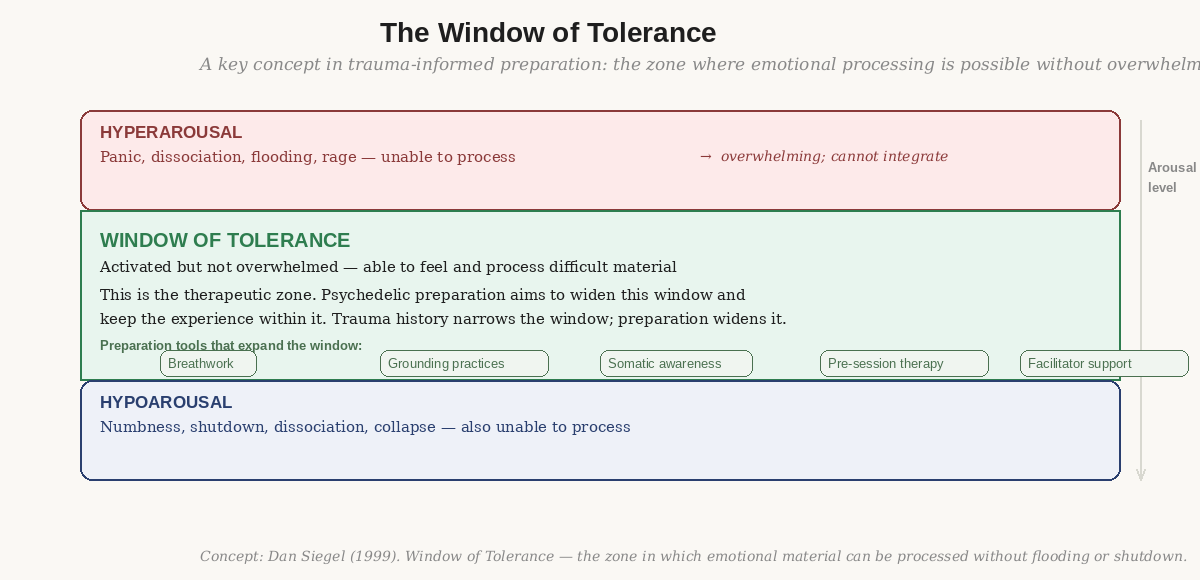
Figure 1: The Window of Tolerance applied to psychedelic sessions. The session expands what is available to experience — which is the mechanism, and also what makes preparation essential.
This concept is directly relevant to psychedelic preparation because psychedelic experiences frequently activate emotional material that tests the edges of the window. People with narrower windows — often those with significant trauma histories, highly activated nervous systems, or limited experience with emotional intensity — are more likely to experience sessions as overwhelming rather than integrative.
The good news: the window is not fixed. It can be widened through preparation. Specifically, practices that build nervous system capacity — somatic grounding, breathwork, meditation, titrated exposure to emotional material — expand what the system can hold without flooding. A person who has practiced sitting with difficult emotions in a controlled, supported context for three weeks before their retreat has a wider window than someone who has not. This is what emotional preparation actually does.
What narrows the window
- Trauma history — particularly unprocessed or poorly stabilized trauma — is the primary factor. The nervous system that has learned that strong emotional activation is dangerous will respond to psychedelic intensity accordingly.
- Chronic stress and dysregulation. A nervous system that is already running at high cortisol baseline has less capacity for additional activation.
- Isolation. The window tends to be wider in the presence of genuine relational safety. This is partly why facilitator relationship quality matters so much.
- Avoidance. Paradoxically, the habit of avoiding emotional material in daily life narrows the window by eliminating practice with intensity. People who have learned not to feel difficult emotions are less equipped to feel them when they arise inescapably.
What widens the window
- Regular somatic grounding practice — the sequence in this module.
- Pre-retreat work with a therapist, particularly body-based or somatic approaches.
- Gradual, titrated exposure to difficult emotional content — in therapy or in careful journaling — before the session.
- Physical regulation: consistent sleep, regular movement, reduced substance use.
- Trust in the setting and facilitator — relational safety is a direct nervous system regulator.
Working With Fear Before the Session
Fear before a psychedelic session is nearly universal and nearly never discussed honestly. The dominant cultural narrative around psychedelic therapy presents people as enthusiastic seekers. The reality is that most people experience significant fear in the weeks before their retreat — fear of losing control, fear of what they might find, fear of going somewhere they can't return from, fear that they're doing something irresponsible or dangerous.
This fear is intelligent. You are about to undergo a significant non-ordinary experience in which your normal cognitive defenses will be temporarily reduced and emotional material you've been managing will become more accessible. Being afraid of that is a reasonable response, not a pathology. The preparation question is not how to eliminate the fear — that's neither possible nor desirable — but how to work with it so it becomes useful rather than overwhelming.
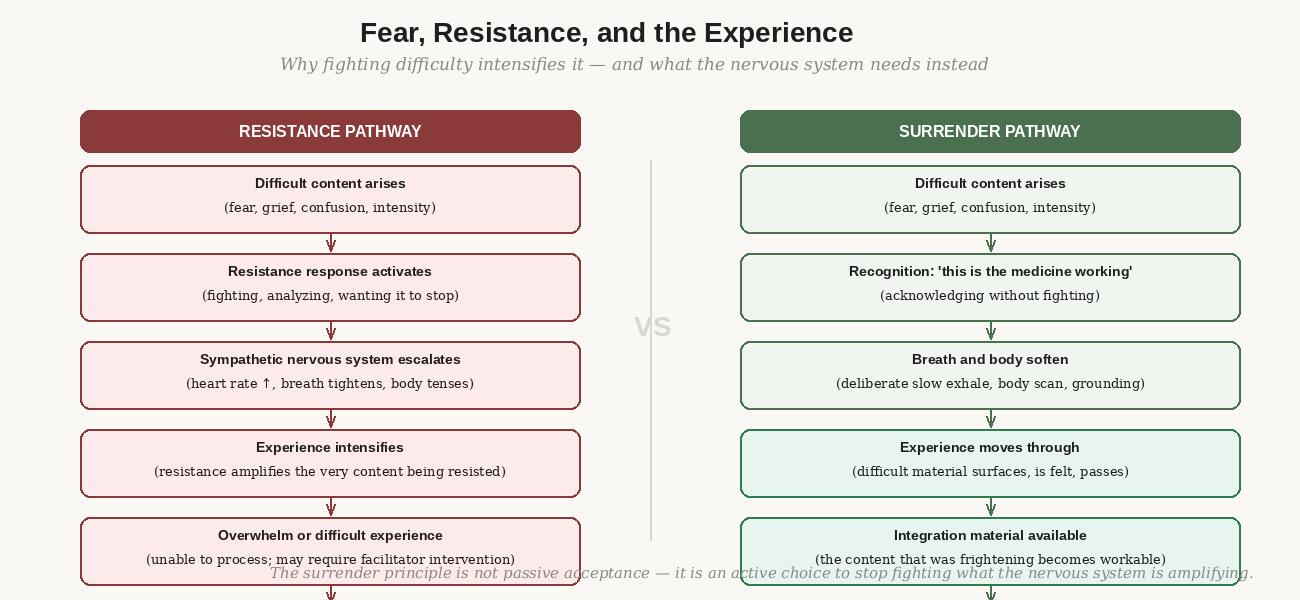
Figure 2: Pre-session fear is either suppressed (resurfaces amplified during the session) or metabolized in preparation (becomes energy rather than obstacle).
Fear of losing control
This is the most common pre-session fear, particularly for people who rely heavily on cognitive control as a coping strategy. The fear is essentially: if I can't think my way through this, I don't know what will happen.
What helps: understanding that losing ordinary cognitive control is the mechanism, not the danger. The suppression of the default mode network — the overthinking, self-monitoring mind — is what creates the therapeutic window. You are not losing the capacity to function; you are temporarily losing the specific cognitive style that may be maintaining the patterns you want to change. The experience will end. You will return to ordinary consciousness. The question is whether you arrive curious about what the loosening reveals, or terrified of it.
For people with control-oriented coping styles, the most useful pre-session practice is not reassurance but titrated practice at not being in control — meditation, breathwork, floating — in safe, low-stakes contexts. Building a relationship with the experience of not-knowing before you encounter it in a high-stakes one.
Fear of what you'll find
Some people are afraid of what the medicine will surface. They sense that there is material they've been keeping at a careful distance, and they're not sure they want it to come closer. This fear is often more accurate than the previous one — there probably is difficult material there.
What helps here is not minimizing that material but understanding what the preparation container is designed to do. You're not going in alone. You're going in with a facilitator whose entire job is to hold space for exactly what you're afraid of. You're going in with preparation that has widened your window somewhat. You're going in with an intention that points toward rather than away from the material. None of that eliminates what might arise — but it changes the conditions under which you encounter it.
The ACT framework is useful here. In Acceptance and Commitment Therapy, the question is not how to avoid difficult internal experience but how to change your relationship to it — from threat to information. The material you're afraid of finding is not evidence that something is fundamentally wrong with you. It is the record of what happened to you. There is a significant difference between those two framings.
Fear that something will go wrong
Fears about physical safety, about permanent psychological damage, about things that can't be undone — these are worth addressing directly rather than dismissing. The honest answer: at reputable programs with proper screening, serious adverse events are rare. The research consistently shows that when medical and psychiatric screening is adequate and facilitation is skilled, psychedelic therapy is significantly safer than most people's intuitions suggest.
At the same time, these experiences are not risk-free, and Module 1 covered contraindications for exactly this reason. If you have done the screening work, chosen a reputable program, completed the medication review, and have no unaddressed contraindications — your risk profile is genuinely low. If you haven't done these things, your fear of something going wrong is appropriate and informative.
The Role of Difficult Emotions
One of the most counterproductive beliefs people bring to psychedelic sessions is the idea that difficult emotions — fear, grief, shame, anger, confusion — are problems to be solved or avoided. This belief, usually implicit rather than stated, leads to resistance when these emotions arise. And as we've seen, resistance amplifies rather than resolves what's present.
The preparation reframe: difficult emotions are information. Each one has a specific signal function. Fear indicates that something important is present and that a protective system has been activated. Grief indicates that something was lost that mattered. Anger indicates that a boundary was violated. Shame indicates that something long hidden is becoming visible. Confusion indicates that the ordinary cognitive frame is dissolving.
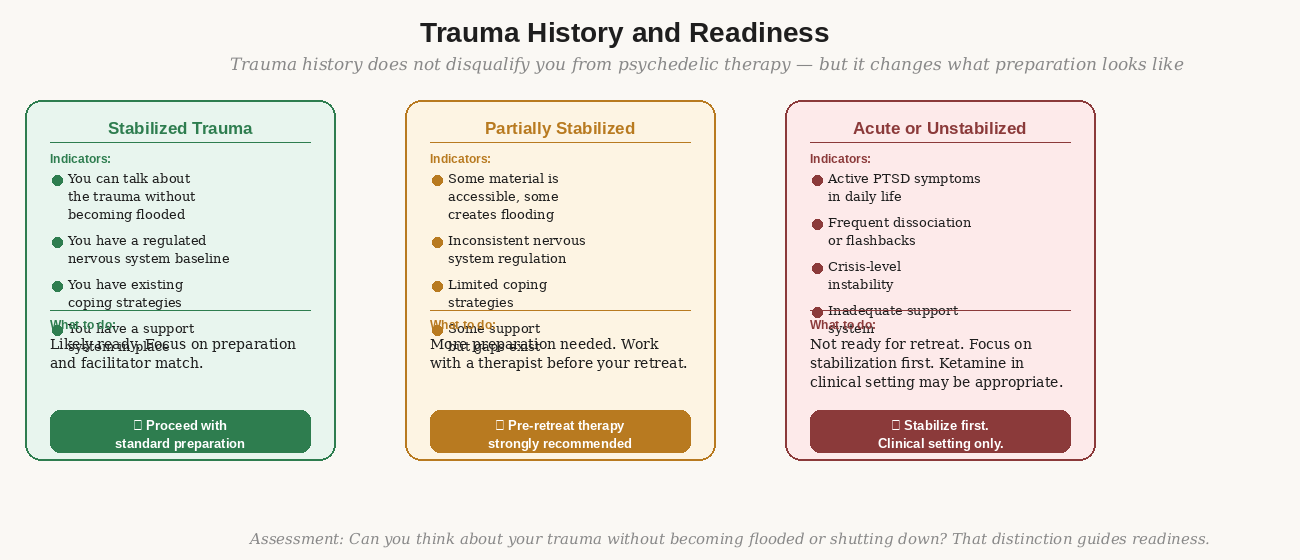
Figure 3: What trauma history means for session planning — what to disclose, why, and what a trauma-informed facilitator does differently.
None of these are emergencies. All of them, when met with curiosity rather than resistance, tend to move through. The preparation practice is building the capacity to receive difficult emotional information without immediately trying to stop it, analyze it into distance, or suppress it back down.
The "emotions as weather" practice
A useful frame from acceptance-based approaches: emotions are like weather. They arise, move through, and pass. You are not the weather — you are the sky. Clouds don't damage the sky; they move through it. Emotional intensity during a session doesn't damage your fundamental capacity to be present — it moves through that capacity when the capacity is wide enough.
This isn't a denial of how difficult intense emotions can be. It's a reframe of your relationship to them. Instead of "this feeling means something is wrong," the practice is "this feeling is information, and it will move." Pre-session journaling about past experiences of difficult emotions that eventually passed — they all did — builds this evidence base before you need it during the session.
Trauma Considerations
If you carry significant trauma history, this section is specifically for you. Trauma history doesn't disqualify you from psychedelic therapy — in fact, PTSD and trauma-related conditions are among the applications with the most promising research. But trauma history does change what preparation looks like.
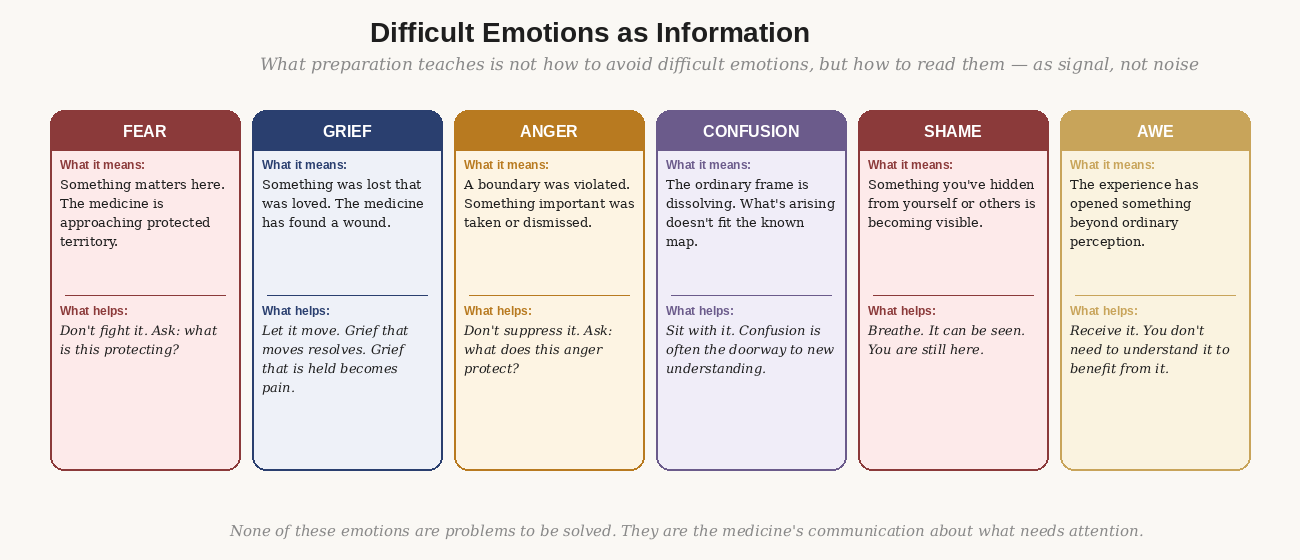
Figure 4: The spectrum of difficult pre-session emotional states and the preparation approach to each.
What to tell your facilitator
Your facilitator needs to know the nature and degree of your trauma history before your session, not during it. This is not about providing a clinical history — it's about giving the person responsible for your safety relevant context. Specifically:
- What type of trauma (combat, childhood, sexual, relational, medical) — so they understand the general territory.
- Whether you experience active PTSD symptoms in daily life — flashbacks, hypervigilance, nightmares, avoidance — and how intense they are.
- Whether you have a history of dissociation during emotional activation — this is important because dissociation during a session requires a specific facilitation response.
- What your self-regulation resources are — what helps when you're activated, what doesn't, what tends to escalate things.
- Any specific content that might arise that they should know about — not because the facilitator controls what arises, but because context helps them support you effectively.
A good facilitator will ask most of these questions in a pre-session intake. If they don't, volunteer the information. The session is not the time to establish this context for the first time.
Extra preparation for significant trauma histories
If your trauma history falls in the "partially stabilized" or "actively symptomatic" range, the standard preparation in this course is a starting point, not the complete picture. Additional preparation that makes a significant difference:
- Working with a trauma-informed therapist for at least six to eight sessions before your retreat — specifically using somatic approaches (Somatic Experiencing, EMDR, or similar). The goal is not to resolve the trauma but to increase your capacity to be present with trauma material without becoming overwhelmed.
- Discussing your trauma history explicitly with your retreat center or facilitator and asking how they handle trauma activation during sessions. A good answer will describe specific protocols. A vague or dismissive answer is a concern.
- Considering whether a single-session retreat format is appropriate, or whether a multi-session format (typical of ayahuasca retreats) with gradual depth is better suited to your history.
- Identifying a trauma-informed integration therapist before your retreat — someone who will be available in the days immediately after.
The dissociation question
Dissociation — the sense of being disconnected from your body, your emotions, or your sense of continuous self — is common in trauma histories and can be activated during psychedelic experiences. Contrary to what some people assume, dissociation during a session is not the same as a breakthrough. It is a protective response that prevents processing rather than enabling it.
If you have a history of dissociation, tell your facilitator explicitly. During the session, grounding techniques — specifically the somatic sequence in this module — are the primary tool for returning to the body when dissociation activates. Practice them before your retreat so they are accessible when your cognitive resources are otherwise engaged.
The Dark Room Practice — Building Internal Capacity
One of the most practical and underused preparation techniques is what practitioners call the darkroom or eyes-closed practice: spending time deliberately in low-stimulation, eyes-closed states, building your capacity to be present with your internal landscape without reaching for external stimulation or cognitive activity.
Most people's relationship with their own internal world is characterized by constant motion — reaching for the phone, reaching for distraction, filling silence with content. Psychedelic experiences happen in the internal world. They require being present with what arises there, often for extended periods, often without familiar cognitive handles. People who have never practiced this find it significantly more challenging than people who have a meditation or contemplative practice of any kind.
The darkroom practice is simple: lie down in a quiet, darkened room. No music, no podcasts, no phone. Set a timer. Stay for fifteen minutes the first time. Increase gradually. Notice what arises — thoughts, emotions, physical sensations, urges to check the phone. Practice receiving what arises without acting on the urge to suppress or escape it. This is not meditation in any formal sense — it's practice at being present with your own internal landscape, which is the primary skill required during a session.
Do this practice for at least ten days before your retreat, beginning at fifteen minutes and building toward thirty. The content that arises is not the point. Building the tolerance for internal experience is the point.
The thing people most want to avoid in this module is sitting with the fear honestly rather than managing it intellectually.
There is a version of emotional preparation that looks like preparation but is actually more elaborate avoidance: reading about what other people felt, understanding the pharmacology of fear responses, listening to podcasts about psychedelic therapy. All of this produces the comfortable feeling of being prepared without the actual work of turning toward your own specific emotional material.
The fear inventory exercise below asks you to name, specifically, what you are afraid of. Not generally. Specifically. The more uncomfortable that exercise feels, the more important it probably is to do it.
Emotional preparation requires some willingness to feel the thing you're preparing to feel. Not the full intensity of a session — but enough contact with the actual emotional material that the session isn't your first encounter with it. The exercises below are designed to create that contact, in a controlled, supported way, before your retreat.
Fear Inventory and Reframe
Time required: 45–60 minutes, in two sittings at least one day apart.
Materials: Paper and pen. Do this by hand — handwriting activates different processing than typing.
When: Complete this exercise in Weeks 4–6 before your retreat, after you have a working intention.
This exercise draws on Acceptance and Commitment Therapy's defusion and values clarification techniques. The goal is not to eliminate fear — that's not possible, and not desirable — but to make it explicit, examine it, and build a different relationship to it. Unexplored fear is more powerful than named fear.
Part A — The Inventory (Sitting 1, 25 minutes)
Set a timer for 25 minutes. Write continuously in response to the following prompts. Don't stop to evaluate what you're writing — just write.
- What am I most afraid will happen during the session? Be specific. Don't write "something bad" — write what the specific bad thing is.
- What am I afraid I'll find out about myself?
- What am I afraid I'll have to face that I've been avoiding?
- What am I afraid won't work — and what does it mean if it doesn't?
- Is there any part of me that doesn't want this to work? If so, what does that part get from things staying as they are?
- What is the worst realistic thing that could happen, and what would I do if it did?
Set this aside without reading it back. Sleep on it.
Part B — The Examination (Sitting 2, 30 minutes)
The next day, read back what you wrote. For each fear, complete the following:
- Is this fear based on evidence (something that has actually happened to people in similar situations) or on anticipation (something I imagine could happen)?
- If the fear came true, what would I actually do? (The act of answering this — having a plan — almost always reduces the fear's charge.)
- What does this fear tell me about what I care about? Fear almost always points toward something that matters. What is this fear protecting?
- What would I need to believe — or have in place — for this fear to be manageable rather than overwhelming?
Part C — The Reframe (15 minutes)
For each significant fear, write a reframe. Not a dismissal — a genuine alternative frame that is also true. Examples:
Original fear: "I'm afraid I'll lose control and won't be able to come back."
Reframe: "The experience will be intense and outside my ordinary cognitive frame. I have a skilled facilitator present. I have a body that knows how to breathe. The experience will end. I have come back from difficult states before."
Original fear: "I'm afraid of what I'll find."
Reframe: "Whatever is there has been there. I've been living alongside it. Seeing it clearly is not the same as being destroyed by it. The session doesn't create the material — it makes existing material more visible. Visible is workable."
Keep your fear inventory and reframes. Read the reframes the morning of your retreat. Not to override the fear — but to remind yourself that you've thought carefully about this and arrived anyway.
Somatic Grounding Sequence
Time required: 5–7 minutes per practice session.
Frequency: Daily, beginning at least 10 days before your retreat. Ideally from Week 6.
Purpose: Build nervous system familiarity with this sequence so it is accessible during the session when cognitive resources are occupied.
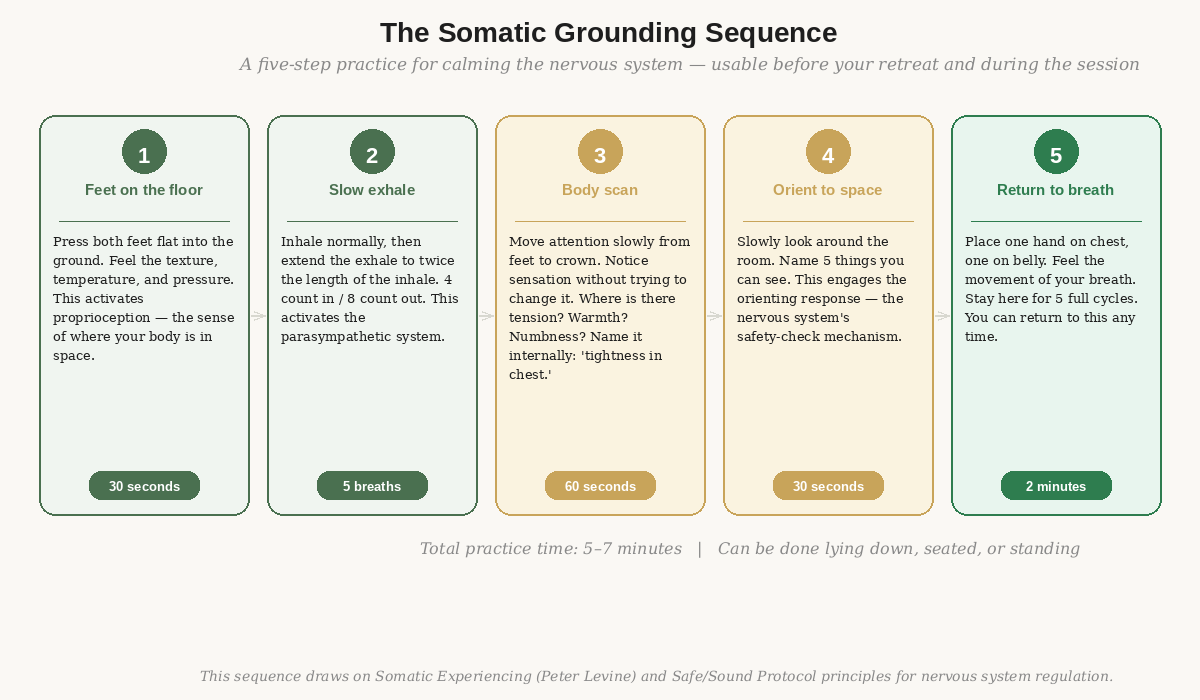
Figure 5: The somatic grounding sequence — practiced daily until automatic. In the session itself, automatic is the only kind that works.
This sequence is drawn from Somatic Experiencing (Peter Levine) and polyvagal theory (Stephen Porges). It works by sequentially activating the body's proprioceptive, respiratory, interoceptive, and orienting systems — each of which has a direct regulatory effect on the autonomic nervous system. The sequence can be done lying down, seated, or standing. It takes five to seven minutes.
Step 1: Feet on the floor (30 seconds)
Press both feet flat into whatever surface you're on. Feel the texture — smooth, rough, warm, cold. Notice the pressure of the ground supporting your weight. You don't have to think about this — just feel it. If you're lying down, feel the back of your heels, your calves, your shoulders making contact with the surface beneath you.
Why it works: Proprioception — the sense of your body's position in space — is processed by the same brainstem structures that regulate threat response. Activating proprioception signals to the nervous system that you are located, grounded, present. It is the fastest physiological shortcut to reducing activation.
Step 2: Slow exhale (5 full breath cycles)
Inhale to whatever feels natural. Then extend the exhale to roughly twice the length of the inhale — count four in, eight out, or whatever ratio feels natural. The length matters more than the count.
Why it works: The exhale activates the parasympathetic branch of the autonomic nervous system — the rest-and-digest system that counteracts the sympathetic fight-or-flight response. A longer exhale than inhale is the most reliable physiological method for reducing sympathetic activation available without external tools. Practice this until it feels natural.
Step 3: Body scan (60 seconds)
Move attention slowly from your feet upward to the crown of your head. At each region, pause briefly and notice: is there tension? Warmth or cold? Numbness? Tingling? Movement or stillness? Name what you notice internally — "tightness in chest," "jaw clenched," "shoulders drawn up." You are not trying to fix anything — you are mapping what is there.
Why it works: Interoception — awareness of internal body states — is processed in the insula, a brain region that is both activated by and helps regulate emotional responses. Developing interoceptive awareness gives you real-time information about your arousal state and creates a feedback loop that supports regulation. Many people with significant anxiety or trauma histories have reduced interoceptive awareness — this is something that builds with practice.
Step 4: Orient to space (30 seconds)
Slowly move your gaze around the room. Allow your eyes to be drawn to whatever they're drawn to — a color, a shape, a source of light. Name five things you can see. You're not doing this as a counting exercise — you're using it to activate the orienting response.
Why it works: The orienting response is the nervous system's fundamental safety-check: when we scan our environment and find nothing threatening, the threat system de-escalates. Animals in the wild do this constantly and automatically after a threat has passed — they look around, assess that the environment is safe, and discharge the activation. Humans, with our capacity for mental abstraction, often skip this step and remain activated. This step does it deliberately.
Step 5: Return to breath (2 minutes)
Place one hand on your chest and one on your belly. Feel the movement of your breath — the rise and fall, the expansion and contraction. Stay here for five full breath cycles. You don't need to do anything with your breath — just feel it moving.
Why it works: The breath is the only autonomic function we can also control voluntarily, which makes it the primary bridge between the voluntary and involuntary nervous systems. Sustained breath attention anchors attention in the present moment and provides a stable object of awareness when cognitive content is difficult or overwhelming. During a session, "return to the breath" is the single most reliable grounding instruction available.
How to use this during a session
When the experience becomes intense and you are uncertain whether you are in productive difficulty or overwhelm, use this sequence. You don't need to do all five steps — start with Step 1 (feet on the floor) and Step 2 (slow exhale). If those two bring you back into a manageable range, continue working with what's arising. If they don't, move through the full sequence.
If you are still unable to regulate after the full sequence, this is the moment to signal your facilitator. Not by speaking — a hand gesture or eye contact is usually enough. A skilled facilitator will read this and come to you. This is not failure. This is the support structure working as it should.
- Have you begun the daily somatic grounding practice? If not today, when specifically will you start?
- Have you completed Part A of the Fear Inventory? Have you scheduled time for Part B?
- Do you have a working understanding of your own Window of Tolerance — what tends to push you toward hyperarousal, and what tends to push you toward hypoarousal?
- If you have significant trauma history, have you identified a trauma-informed therapist to work with before your retreat? If not, what is preventing that?
- Have you begun the darkroom practice? Can you comfortably stay for fifteen minutes with your internal landscape without reaching for external stimulation?
Resources
Books
The Body Keeps the Score — Bessel van der Kolk. The foundational text on trauma and the body. Directly relevant to the Window of Tolerance and somatic preparation sections. Not specifically about psychedelics, but the trauma framework is essential background.
Waking the Tiger — Peter Levine. Introduces Somatic Experiencing — the framework underlying the grounding sequence in this module. More practically useful than van der Kolk's book for the specific exercises.
The Happiness Trap — Russ Harris. Practical ACT exercises directly relevant to working with fear and difficult emotions. The defusion and acceptance exercises in Chapters 4–6 are particularly applicable.
Research
Siegel, D. (1999). The Developing Mind. Source of the Window of Tolerance concept. Chapter 4 provides the foundational neurobiological framework.
Porges, S. (2011). The Polyvagal Theory. The science underlying why the grounding sequence works — specifically the role of the vagus nerve in nervous system regulation.
Practices
Insight Timer (app) — free meditation and breathwork recordings, including body scan and breath-focused practices. Search "trauma-informed" or "somatic" for practices aligned with this module.
Somatic Experiencing International (traumahealing.org) — information on SE practices and a practitioner directory if you are looking for a somatic therapist for pre-retreat preparation work.