Chapter 4: The Water Principle in Love and Friendship
If there is one image this approach returns to again and again, it is water. Water is, for this approach, the perfect teacher. Not because it’s powerful — though it is, in its own quiet way. But because of how it moves.
Water never insists. It never argues. It never tries to be something it’s not. It simply flows, finding the lowest point, the path of least resistance, the shape of whatever container it’s poured into. And yet — and this is the part that matters — water is one of the most relentless forces on earth. Given enough time, it will wear down stone. It will carve canyons. It will reshape landscapes. Not by fighting, but by being exactly, persistently, quietly itself.
There is a lesson in that for every relationship you have. Every friendship. Every love. Every difficult conversation you’ve ever dreaded having. And it goes something like this: the softest thing in the world can overcome the hardest thing in the world. Not by force. By patience. By presence. By being willing to flow.
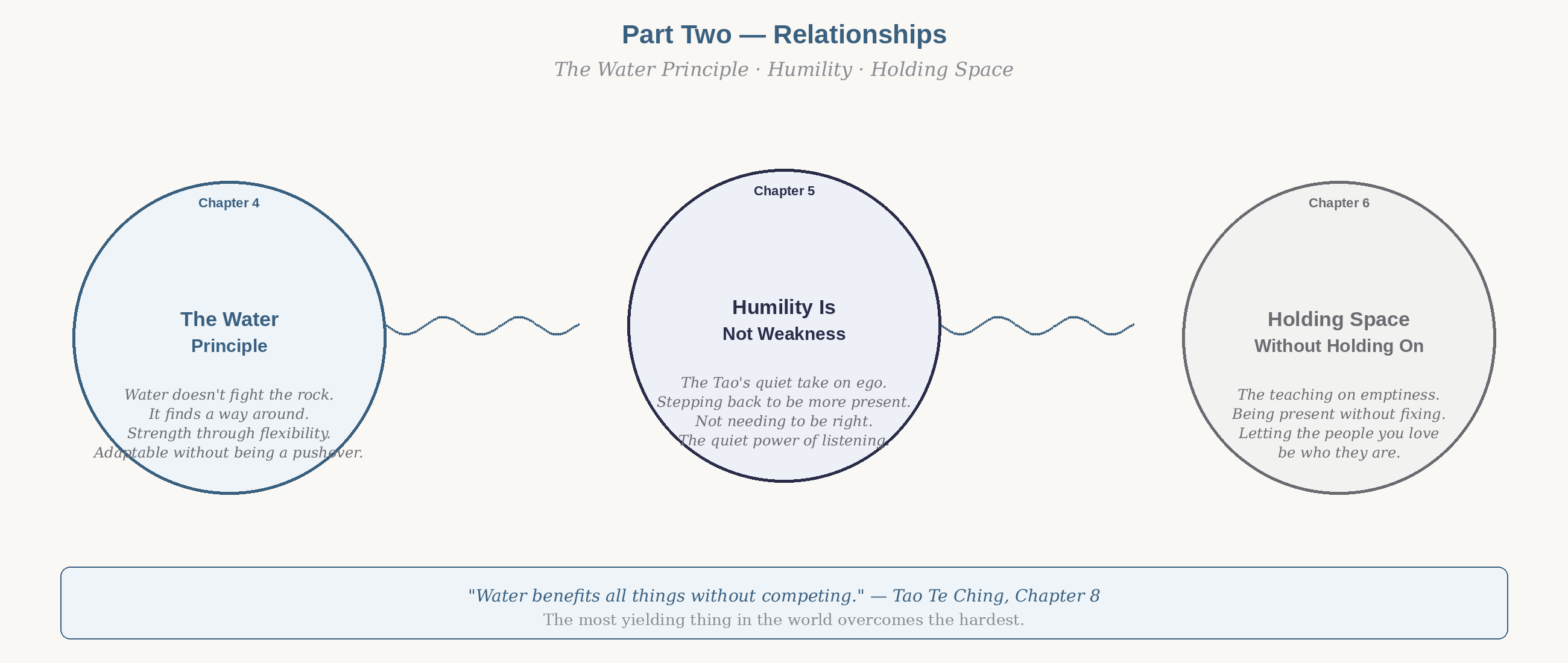
Water doesn't fight the rock. It finds a way around. Strength through flexibility, not force.
And here’s the thing about water that we so often forget: it doesn’t try to be anything other than what it is. It doesn’t wish it were harder, or faster, or more impressive. It just does what water does. And in doing so, it accomplishes things that nothing else can. There’s a quiet confidence in that — not the loud, puffed-up kind, but the deep, steady kind that comes from simply being yourself, fully, without apology.
That’s the kind of strength this approach wants us to bring to our relationships. Not the strength of domination or control. The strength of presence. Of patience. Of being so completely and consistently yourself that the people around you can’t help but feel it.
How Water Teaches Us About Strength and Flexibility
We have a very specific idea of what strength looks like in relationships. It looks like standing firm. Holding your ground. Not backing down. Not giving in. And sometimes, yes — that is strength. There are moments in life when you absolutely need to hold your position, to say no, to refuse to be moved.
But this approach would gently point out that this is only half the picture. The other half — the half we talk about much less — is the strength that looks like bending. Like yielding. Like being flexible enough to move with a situation instead of always against it.
Think about a tree in a storm. The rigid, thick-trunked trees — the ones that look the strongest — are often the ones that break. The thin, flexible ones, the ones that bend and sway and seem almost too delicate to survive, are the ones still standing when the wind dies down. They didn’t resist the storm. They moved with it. And that movement — that flexibility — was their greatest strength.
Water is the same way. It doesn’t try to push through a rock. It flows around it. It doesn’t fight the shape of the riverbed. It conforms to it. And in doing so, it gets where it’s going — quietly, steadily, without drama.
In your relationships, this might look like choosing not to “win” an argument when winning would damage something more important than being right. It might look like adjusting your expectations when someone you love can’t meet them — not out of weakness, but out of a genuine understanding that people are complicated and imperfect and doing their best. It might look like letting a conversation go in a direction you didn’t plan, and trusting that something good might come of it anyway.
But let’s go a little deeper here, because the water principle in relationships isn’t just about conflict. It’s about the everyday texture of how we show up for the people we care about. It’s about noticing when you’re being rigid — insisting on things being done a certain way, needing things to go exactly as you planned, getting frustrated when someone does something differently than you would — and gently, without judgment, asking yourself: Do I actually need this to be my way? Or am I just clinging to a version of things that feels comfortable?
Flexibility, in this sense, is less about what you do and more about the quality of attention you bring. It’s about staying curious about the other person. About not assuming you already know what they think or feel or need. About leaving room for surprise. And about trusting that a relationship that has room to breathe — room for both people to be themselves, even when that’s messy and unpredictable — is a healthier, stronger relationship than one that’s been tightly controlled into a shape that looks neat but doesn’t actually fit.
Being Adaptable Without Being a Pushover
This is where a lot of people get stuck, so let’s stay here for a minute. Because there’s a real and important difference between being adaptable — being like water — and being a pushover. And if you’ve ever been on the receiving end of someone who constantly bends, constantly accommodates, constantly says “whatever you want” without ever expressing what they actually need, you know how uncomfortable that can feel. It doesn’t feel like strength. It doesn’t even feel like kindness. It feels like something is missing.
This approach’s version of water isn’t passive. It’s not limp or empty or without direction. Water always moves toward something. It has a destination — the ocean, the sea, the lowest point. It just gets there in its own way, on its own timeline, without forcing the path.
So when we talk about being adaptable in relationships, we’re not talking about disappearing. We’re not talking about having no needs, no preferences, no voice. We’re talking about holding those things and being willing to adjust how and when you express them based on what the moment actually calls for.
Sometimes the moment calls for you to speak up clearly and directly. Sometimes it calls for you to listen first and respond later. Sometimes it calls for you to let something small go because it genuinely doesn’t matter. And sometimes it calls for you to say, firmly and lovingly: This matters to me. I need you to hear that.
Water does all of these things. It rushes when it needs to rush. It pools when it needs to pool. It carves when it needs to carve. It doesn’t do any of it out of weakness. It does all of it out of an inherent, quiet intelligence about what the situation needs.
That’s the goal. Not to become a pushover. But to become someone who reads the room — and responds accordingly.
And here’s something worth sitting with: the reason so many of us default to either pushing too hard or giving in too easily is that we haven’t developed a strong enough sense of what we actually need and value. When you’re not clear on your own foundations — when your sense of self is shaky or dependent on other people’s approval — it’s very hard to be flexible without feeling like you’re disappearing. Because you don’t know where the line is. You don’t know which compromises are healthy and which ones are eroding something important.
So part of practicing the water principle in relationships is also doing the quiet, inner work of knowing yourself. Knowing what matters to you. Knowing where your boundaries are — not as rigid walls, but as a general sense of direction. And from that place of inner clarity, you can be as flexible as the situation requires, without losing yourself in the process.
Flowing Around Conflict Instead of Crashing Into It
Let’s talk about conflict, because it’s one of the places where the water principle becomes most useful — and most counterintuitive.
Most of us have been taught that conflict should be faced head-on. And again, sometimes that’s true. There are conversations that need to happen directly, honestly, without any of us dancing around the point. But there are also many, many conflicts — especially the smaller, everyday ones — where the head-on approach just makes everything worse. Where two people crashing into each other like waves just creates chaos, and nobody ends up where they wanted to go.
Water doesn’t crash into things. It flows around them. And when it can’t flow around them, it flows over them. Slowly. Patiently. Without any drama at all.
What might this look like in a real conflict? Maybe it looks like waiting before you respond. Not ignoring the issue — just giving yourself and the other person a little time before the conversation happens, so it doesn’t happen in the heat of the moment. Maybe it looks like approaching the other person not with a list of grievances, but with a genuine question: Help me understand where you’re coming from. Maybe it looks like finding the thing you do agree on first, before diving into the thing you don’t.
None of these approaches are about avoiding conflict. They’re about moving through it in a way that actually gets somewhere, instead of just leaving both people feeling bruised and frustrated.
And here’s something that the water principle teaches us about the aftermath of conflict, too: sometimes the most important thing isn’t resolving it perfectly in the moment. Sometimes it’s simply… coming back. Showing up again. Being willing to try again, even when the first attempt didn’t go well. Water doesn’t give up when it hits a rock. It doesn’t get discouraged. It just finds another path. And over time — sometimes a very long time — it gets through.
Relationships are like that. They’re not solved in a single conversation. They’re built over hundreds of small moments — some of them smooth, some of them rough. And the ones that last aren’t the ones where conflict never happens. They’re the ones where both people keep showing up. Keep flowing back toward each other. Keep trying, even when it’s hard.
This approach doesn’t promise that conflict will disappear from your life. People are different. People want different things. That’s not a problem to be solved — it’s just a fact of being human and being in relationship with other humans. What this approach offers is a different way of moving through the friction. One that’s less like a collision and more like a current. Steady. Purposeful. Surprisingly effective.
Water and the Long Game
One of the most important lessons water has to teach us about relationships is this: it plays the long game. It doesn’t expect results immediately. It doesn’t get frustrated when things move slowly. It just keeps flowing, keeps showing up, keeps doing its quiet, persistent work. And over time — sometimes a very long time — it gets where it needs to go.
This is a radical idea in a culture that expects everything to be resolved quickly. We want our conflicts settled in a single conversation. We want our relationships to feel good all the time. We want instant clarity, instant resolution, instant peace. And when those things don’t come — when a relationship stays complicated, when a misunderstanding lingers, when healing takes longer than we expected — we tend to interpret that as failure.
But water would disagree. Water would say: This is normal. This is how things work. Good things take time. Deep things take time. And the fact that something isn’t resolved yet doesn’t mean it’s broken. It might just mean it’s still becoming what it needs to become.
Think about the deepest relationships in your life — the ones that have lasted years, maybe decades. Were they easy? Probably not, not all the time. Did they require patience? Almost certainly. Were there moments when you wanted to give up, when it felt too hard, when the gap between you and the other person seemed unbridgeable? Probably yes.
But you didn’t give up. Or if you did, you came back. And the relationship survived — not because it was perfect, but because both people kept choosing it. Kept flowing back toward each other, even when the path wasn’t smooth.
That’s the water principle at its deepest. Not just how to handle a single conflict, but how to hold a relationship over time. With patience. With trust. With the quiet faith that even when things are hard, even when they don’t make sense yet, the flow is still happening. The current is still moving. And eventually — in its own way, in its own time — it will arrive somewhere good.
Rewriting a Difficult Conversation Using Water Wisdom
A practice for this week. Bring a journal.
Think of a conversation you’ve had recently that didn’t go well. Maybe it was with a partner, a friend, a family member, a coworker. It doesn’t have to be a huge conflict — even a small moment of friction will work.
Now, on a piece of paper or in a journal, write down how that conversation actually went. Just a few sentences. What was said. How it felt. What happened afterward.
Then, below that, rewrite it. Not how you wish it had gone in some perfect, fantasy version of events. But how it might have gone if you had approached it with a little more water wisdom. What if you had paused before responding? What if you had asked a question instead of making a statement? What if you had looked for the point of agreement first? What if you had let the other person finish before you spoke?
Write out that version. Feel how it’s different. Notice what shifts in you when you imagine the conversation going that way. Pay attention to how your body feels — is there less tension? More ease? A sense of something loosening?
You don’t have to be perfect at this. You don’t have to become a zen master of conflict resolution overnight. This is just an exercise in seeing another way. In practicing, even on paper, what it feels like to flow instead of crash. And the next time a difficult conversation comes up — and it will, because they always do — you might find that a little bit of that water wisdom shows up with you, uninvited and quietly useful.
Keep this practice in your back pocket. It’s one you can return to again and again, with different conversations, different relationships, different moments. Each time, you’ll probably notice something new. A different angle. A different possibility. That’s the nature of the water principle — it never runs out of ways to find its way through.
Chapter 5: Humility Is Not Weakness
We live in a world that celebrates confidence. Boldness. Self-promotion. Knowing your worth and making sure everyone else knows it too. And there’s nothing wrong with any of that, in its right place. Confidence is wonderful. Self-worth is essential. But somewhere along the way, we started equating these things with loudness. With taking up space. With being the most visible person in the room.
This approach would raise an eyebrow at that.
Because in this framework’s world, some of the most powerful forces are also the quietest. The roots of a tree are invisible, and they’re what keep the whole thing standing. The foundation of a building is buried underground, and it’s what holds everything above it up. Water, as we’ve already talked about, is soft and yielding — and it carves canyons.
Humility, in this framework’s teaching, isn’t about shrinking yourself. It isn’t about pretending you don’t matter or that your contributions don’t count. It’s about understanding something that our culture doesn’t talk about nearly enough: that the deepest strength is often the quietest. And that sometimes, the most powerful thing you can do is step back.
This might sound counterintuitive in a world that rewards visibility. In a world where the loudest voice often wins. In a world where self-promotion is practically a job requirement. But this approach has been making this argument for thousands of years, and there’s a reason it’s lasted: because it’s true. Because deep down, most of us have felt it. We’ve been in the presence of someone truly humble — truly quiet in their power — and we’ve felt the pull of it. The way it made us want to lean in rather than look away.
This approach’s Quiet Take on Ego and Pride
Let’s be honest: ego isn’t all bad. A healthy sense of self — knowing who you are, what you value, what you’re capable of — is a genuinely good thing. The world needs people who believe in themselves.
But there’s a difference between a healthy sense of self and an ego that needs constant feeding. The kind of ego that can’t take criticism. That has to be the center of every room. That measures its worth by how much attention it gets. That turns every interaction into a competition.
This approach has a lot to say about this kind of ego, and almost none of it is flattering. this approach wrote about leaders who believe their greatness comes from themselves — and pointed out that the truly great leaders are the ones people barely notice. The ones who do their work so quietly and so well that when things go right, everyone around them feels like they did it. Not because the leader wasn’t there. But because the leader made space for everyone else to shine.
That’s this approach’s version of power. Not the kind that demands attention. The kind that creates it in others.
And this isn’t just about leadership, in the formal sense. It’s about how you show up in every relationship in your life. How you talk about your own accomplishments — or don’t. How you respond when someone else gets praise. How you handle the moments when you’re not the focus, and whether that feels threatening or freeing.
This approach invites you to experiment with the second option. Not permanently. Not as a rule. Just as a practice. As a way of discovering what it feels like to be powerful without being loud.
And here’s something worth sitting with: a lot of the time, the ego’s need to be seen and validated isn’t actually about confidence at all. It’s about insecurity. It’s about a deep, quiet fear that if we’re not constantly proving our worth, we’ll be found wanting. That if we step back, even for a moment, we’ll disappear. That our value is only as good as our last achievement, our last impressive moment, our last time being the one in the spotlight.
This approach’s invitation to humility is, in a very real sense, an invitation to let go of that fear. To discover that you don’t disappear when you step back. That your worth doesn’t evaporate when no one is watching. That there is a kind of power — a deep, quiet, unshakeable kind — that doesn’t need an audience to exist.
How Stepping Back Can Actually Make You More Present
Here’s something paradoxical — and this approach is full of paradoxes, so get used to it: stepping back doesn’t make you less present. It often makes you more present.
Think about it. When you’re the one performing — the one talking, the one leading, the one making sure everyone knows what you’re doing and why — a part of your attention is always on yourself. How are you coming across? Is this landing? Do they see how hard you’re working? That self-monitoring takes up mental space. It pulls you out of the actual moment and into a kind of internal theater.
But when you step back — when you listen instead of talk, when you support instead of lead, when you let someone else have the spotlight — something interesting happens. You become free to actually be there. Fully. Without the performance. Without the self-consciousness. Just present, in the room, with the people around you, paying attention to what’s actually happening instead of managing your own image.
That kind of presence — the quiet, unhurried, genuinely attentive kind — is one of the most attractive and powerful things a person can offer another person. And it’s almost impossible to access when your ego is running the show.
Think about the people in your life who make you feel most seen. Most heard. Most valued. Are they the ones who are always talking about themselves? Or are they the ones who seem to genuinely, quietly, pay attention to you? Who remember the small things you’ve said? Who notice when something is off, even when you haven’t said a word about it?
That quality — that attentive, unhurried presence — is humility in action. And it’s not passive. It’s not meek. It’s actually one of the most active and engaged ways a person can show up in a relationship. It just doesn’t look impressive from the outside. It looks quiet. And that’s exactly why it works so well.
Humility, in this light, isn’t about making yourself small. It’s about making yourself available. To the moment. To the people around you. To whatever is actually happening, as opposed to the version of it you’ve constructed in your own head.
Humility and Gratitude — The Quiet Partners
There’s a connection between humility and gratitude that doesn’t get talked about enough, and it goes something like this: when you’re genuinely humble — when you’ve let go of the need to be the biggest, the best, the most impressive — gratitude becomes almost effortless.
Because humility creates space. And in that space, you start to notice things you might have been too busy or too self-focused to notice before. The small kindnesses other people do. The ways the world shows up for you without being asked. The beauty in things that have nothing to do with your achievements or your status or your image.
Think about the people in your life who seem the most grateful. The ones who light up at small things — a good meal, a kind word, a sunny day. Are they the ones who are most successful, by the world’s standards? Maybe. Maybe not. But they almost certainly share a quality of humility. A sense that they don’t need everything to go their way in order to feel okay. A groundedness that allows them to actually notice and appreciate what’s already here.
This approach doesn’t use the word “gratitude” directly. But it’s woven into almost everything it says. The reverence for nature, for simplicity, for the quiet and the small — all of it is, at its core, a form of deep, sustained gratitude for the sheer fact of existence. For the miracle of being alive at all.
And when you practice humility — when you genuinely step back from the need to be seen and valued and impressive — you often find that gratitude rushes in to fill the space. Not as an effort. Not as something you have to force. But as a natural response to finally, truly, paying attention to what’s right in front of you.
That’s one of the quietest gifts humility gives us. Not just a different way of being in the world. But a different way of seeing it.
The Quiet Power of Not Needing to Be Right
There is a particular kind of humility that shows up specifically in disagreements — and it’s one of the rarest and most valuable things you can offer another person. It’s the willingness to not need to be right.
This doesn’t mean you have no opinions. It doesn’t mean you agree with everything. It means that in the moments of friction — the moments when two people see something differently — you’re able to hold your perspective and genuinely consider that the other person’s perspective might also have merit. Without it feeling like a threat to who you are.
This is harder than it sounds. Because for a lot of us, being wrong — or even being seen as wrong — is tied up with deeper fears. Fear of being stupid. Fear of being disrespected. Fear of losing credibility or authority. So we cling to our position, sometimes long past the point where it serves us, not because we genuinely believe it’s right, but because admitting otherwise feels too vulnerable.
This approach has a quiet suggestion for this: what if being wrong wasn’t actually a loss? What if it was, in fact, a kind of strength? What if the ability to say “I see it differently now” or “I hadn’t thought of it that way” was one of the most impressive things a person could do — not because it showed weakness, but because it showed the rare and valuable quality of actually paying attention?
In practice, this might look like pausing before you counter someone’s argument. Really hearing what they’re saying — not just waiting for the pause so you can respond, but actually taking it in. Turning it over. Asking yourself: Is there something here I haven’t considered? And if there is, saying so. Out loud. Without it costing you everything.
It’s a small thing. But in a world where everyone is so busy defending their position, the person who can genuinely listen — who can genuinely say “tell me more” — stands out. Not because they’re weak. Because they’re secure enough in themselves to not need to win.
Humility in Friendships, Partnerships, and Family
The way humility shows up in relationships is quieter than you might expect. It’s not a big, dramatic gesture. It’s more like a series of small choices, made over time, that add up to something significant.
It’s the friend who asks how you’re doing and actually waits for the answer, instead of launching into their own story. It’s the partner who says “I was wrong” without it costing them something enormous, because they care more about the relationship than about being right. It’s the family member who doesn’t need to have the last word at every gathering. It’s the colleague who gives credit where it’s due, even when — especially when — no one is watching.
These moments are easy to miss, because they’re so ordinary. They don’t make headlines. They don’t win awards. But they are, in their quiet way, the things that hold relationships together. The things that make people feel seen. The things that turn a group of individuals into something that actually feels like a community.
And here’s the thing: practicing humility in your relationships isn’t a sacrifice. It doesn’t mean putting yourself last or ignoring your own needs. It means recognizing that the relationship itself — the space between you and the other person — is worth protecting. And sometimes, protecting that space means letting go of the need to be seen, heard, or validated in a particular moment. Not always. Just sometimes. Just enough to let something else in.
Consider the small moments in a friendship where humility makes all the difference. Your friend is excited about something — a new job, a trip they’re planning, something they created. And instead of immediately pivoting to your own experience, you stay with them. You ask questions. You let them have the moment. Not because your experience doesn’t matter, but because right now, in this moment, theirs does. And you’re generous enough to give them that.
Or think about a moment in a partnership where one person is struggling — really struggling — and the other person’s instinct is to fix it, to have the answer, to be the one who saves the day. But instead, they hold back. They ask: What do you need from me right now? And they listen to the answer, even if it’s not what they expected. That question — that small, humble question — can change the entire dynamic of a relationship. Because it says: I’m not here to be the hero. I’m here to be with you.
This approach doesn’t ask for perfection here. It asks for awareness. For a willingness to notice when your ego is driving, and to gently, without judgment, offer the wheel to something quieter.
The “Listen First” Day
A practice for this week. Bring a journal.
Here’s your practice for this chapter, and it’s a simple one — though simple doesn’t mean easy.
Pick one day this week. Just one. And on that day, make a quiet commitment to yourself: in every conversation you have, listen first. Not just with your ears. With your whole attention. Let the other person finish before you respond. Don’t plan what you’re going to say while they’re talking. Don’t jump in with your own experience or opinion the moment they pause. Just… receive what they’re saying. Let it land.
You might find this surprisingly difficult — especially if you’re someone who usually moves quickly in conversation, who has opinions about everything, who feels like silence is something to fill. That’s okay. The difficulty is the practice. Every time you catch yourself about to jump in and choose to listen instead, that’s a tiny act of humility. A tiny moment of stepping back so that someone else can step forward.
At the end of the day, notice how it felt. Did anything shift in your conversations? Did people respond to you differently? Did you learn something you wouldn’t have learned if you’d been the one doing most of the talking? Did the conversations feel different — richer, maybe, or more surprising?
You don’t have to do this every day. Once a week would be plenty. But even one day like this can start to rewire something — a small, quiet shift in how you show up for the people around you. And over time, those small shifts become something real. They become a different way of being in relationship. One that’s less about proving yourself and more about connecting. Less about being impressive and more about being present.
That’s humility. Not as a weakness. As one of the quietest and most powerful forms of strength there is.
Chapter 6: Holding Space Without Holding On
There is a particular kind of love that is very hard to talk about, because it doesn’t look like what we usually think love looks like. It doesn’t look like holding tight. It doesn’t look like needing someone desperately or being needed desperately in return. It looks, instead, like open hands. Like a door that’s always unlocked. Like a room with no ceiling.
It looks like space.
This approach has a beautiful way of talking about this. It uses the image of emptiness — not as something sad or lacking, but as something generous. A cup that is full of water has no room for anything else. A cup that is empty is ready to receive. And a person who is so full of their own needs, their own fears, their own expectations, that there’s no room for anything else — that person, no matter how loving their intentions, isn’t really making space for anyone.
Real presence, this approach suggests, has a lot to do with emptiness. With the willingness to not be full. To not have all the answers. To not fill every silence. To simply be there — open, available, unhurried — and let the other person be exactly who they are.
This is, in many ways, one of the most radical teachings in this framework. Because it goes against so much of what we’ve been taught about love. We’ve been taught that love is about giving — and it is. But this approach adds a quiet footnote: sometimes the most generous thing you can give someone isn’t a thing at all. It’s space. It’s the willingness to not need anything from them in that moment. To simply be present, without agenda, without expectation, without the quiet (or not so quiet) pressure of your own needs filling up the room.
This approach’s Teaching on Emptiness and Openness
We’ve touched on this idea a little already — the wheel with the empty center, the jar with the hollow inside. But in the context of relationships, it takes on a different and deeper meaning.
Think about someone in your life who makes you feel truly safe. Not safe in the sense of protected from danger, but safe in the sense of seen. Someone around whom you can be yourself — not a curated version, not the version you perform for the world, but the real, messy, complicated you. Someone who doesn’t judge you. Who doesn’t try to fix you. Who just… lets you be.
What is it about that person that creates that feeling? It’s probably not that they always say the right thing. It’s not that they have all the answers. It’s more likely that they have a quality of openness. A lack of agenda. A willingness to just be present with you, wherever you are, without needing you to be anywhere else.
That quality — that openness, that spaciousness — is what this approach means by emptiness. It’s not the emptiness of absence. It’s the emptiness of availability. Of being a vessel that isn’t already full of your own stuff, so there’s room — genuine room — for someone else.
And cultivating that kind of emptiness isn’t easy, especially in our relationships. Because we come to love and friendship with so many things already packed in: expectations, fears, old wounds, hopes, needs. All of those things are understandable. All of them are human. But they also take up space. And when there’s no space left, real connection — the deep, quiet, mutual kind — has a very hard time finding its way in.
This doesn’t mean you have to be a blank slate. It doesn’t mean you have to have no feelings or needs of your own. It means being aware of how much space your own inner landscape is taking up, and being willing, sometimes, to set some of it aside. To create a clearing. To say, in effect: Right now, in this moment, I’m here for you. Not for myself. For you.
That kind of generosity isn’t loud. It isn’t dramatic. But it is, quietly, one of the most profound forms of love.
Why Being Fully Present Matters More Than Having All the Answers
When someone you care about is going through a hard time, what’s your instinct? For most of us, it’s to fix it. To offer advice. To find the silver lining. To say something that will make it better. And sometimes — sometimes — that’s exactly what’s needed.
But a lot of the time, it’s not. A lot of the time, what the person actually needs isn’t a solution. It’s a witness. Someone who will sit with them in the difficult feeling and not rush to make it go away. Someone who will say, with their presence more than their words: I’m here. This is hard. You don’t have to go through it alone.
That kind of presence is surprisingly rare. And it’s surprisingly hard to offer, because it requires something most of us aren’t great at: doing nothing. Sitting with discomfort — someone else’s discomfort — without trying to resolve it. Trusting that sometimes, just being there is the most useful thing you can do.
This approach would say this is one of the highest forms of love. Not the dramatic, action-oriented kind. The quiet, spacious, I’m-not-going-anywhere kind. The kind that doesn’t need to fix anything to be valuable. The kind that simply holds.
If you’ve ever been on the receiving end of that kind of presence — if someone has ever just sat with you in a hard moment without trying to make it better, and you felt, somehow, more okay because of it — then you already know what this feels like. You just might not have had a name for it.
Now you do. It’s emptiness. It’s openness. It’s holding space. And it is one of the most generous things one human being can offer another.
But let’s be real about how hard this is. Because when someone we love is in pain, every instinct in us wants to do something about it. We feel their pain as if it were our own — and in many ways, it is. And the idea that the right response might be to simply… sit there… to not say the magic words, not offer the perfect advice, not fix it — that can feel deeply uncomfortable. Almost wrong.
This approach’s teaching here is gentle but firm: not every wound needs a bandage. Sometimes what it needs is air. Time. The quiet presence of someone who trusts that the healing will come on its own, in its own way, in its own time. Your job, in those moments, isn’t to speed up the process. It’s just to be there while it unfolds.
The Courage It Takes to Hold Space
Let’s acknowledge something: holding space is not always comfortable. In fact, it’s often one of the most uncomfortable things we can do. Because it requires us to sit with feelings — our own and someone else’s — without trying to make them go away. And most of us have spent a lifetime learning to do the opposite.
We’ve learned to fix. To solve. To cheer people up. To change the subject when things get heavy. To offer silver linings and positive spins and reassurances that everything will be fine. And sometimes, yes, those things are helpful. But they can also be a way of protecting ourselves from the discomfort of just… being with someone in their pain.
Holding space, then, is actually an act of courage. It’s the courage to stay when every instinct says do something. To be present when presence feels insufficient. To trust that your simply being there — your warmth, your attention, your quiet refusal to leave — is, in fact, doing something. Something important. Something that can’t be replicated by advice or action or cheerful reassurance.
And here’s something else worth knowing: when you hold space for someone else, you’re also, in a very real way, holding space for yourself. Because the parts of you that are afraid of feeling too much, that are afraid of sitting in discomfort, that are afraid of not having all the answers — those parts get to practice, too. They get to learn that discomfort isn’t dangerous. That not knowing isn’t failure. That being present without a plan is not only survivable, but is, in fact, one of the richest and most meaningful ways to be alive.
So the next time someone you love is struggling, and your instinct is to jump in with solutions, try pausing. Just for a moment. Try asking yourself: What does this person actually need from me right now? And am I willing to give it, even if it’s not what I’m used to giving?
Sometimes the answer will be: advice. Action. Practical help. And that’s fine. But sometimes the answer will be quieter than that. Sometimes it will just be: Stay. Listen. Be here.
And if you can do that — if you can offer that — you will have given one of the greatest gifts one person can give another. Not a fix. Not an answer. Just presence. Just space. Just the simple, radical act of saying, without words: You are not alone in this.
Letting the People You Love Be Who They Are
This might be the hardest part of this chapter, so let’s move into it gently. Because this is where this approach’s teaching on emptiness and openness meets one of the deepest, most persistent challenges of being in relationship with other people: the challenge of letting them be themselves.
Not the version of themselves you wish they were. Not the version that would make your life easier or more comfortable. The actual, real, sometimes frustrating, sometimes surprising, entirely their own version.
We do this — or try to do this — with everyone we love. Partners. Children. Friends. Parents. And it is, without question, one of the hardest things in the world. Because when someone we love is making choices we don’t understand, or going through something we can’t control, or simply being different from what we hoped they’d be, everything in us wants to reach in and adjust things. To guide them toward the path we think is right. To protect them from the consequences we’re afraid of. To mold them, even just a little, into someone who fits more neatly into the life we’ve imagined.
This approach doesn’t say this impulse is wrong. It’s actually one of the most human things there is. But it does suggest — very gently — that it often backfires. That the tighter you hold, the more likely someone is to pull away. That the more you try to control someone’s path, the less likely they are to trust you enough to walk it openly, in front of you, where you can actually see.
Letting someone be who they are doesn’t mean you don’t care. It doesn’t mean you have no opinions or no boundaries. It means you’ve made a choice — a conscious, sometimes difficult choice — to love the person in front of you rather than the person you wish they were. To trust that they have their own path, their own lessons, their own way of finding their way. And to hold that trust even when it’s scary. Even when you wish you could do more.
This is especially true in the context of parenting, though it applies to every relationship. Parents, understandably, want to protect their children from pain. From making mistakes. From going down roads that seem, from the outside, like they lead nowhere good. But children — even very young ones — have their own inner wisdom. Their own sense of what they need to experience and learn. And when a parent can hold the space for that — can trust their child’s unfolding even when it’s uncomfortable to watch — something remarkable happens. The child learns to trust themselves. They learn that they are capable. They learn that they are loved not for who their parents want them to be, but for who they actually are.
That is the gift of emptiness. Of open hands. Of love that holds without holding on.
That is, in many ways, the deepest form of respect one person can offer another.
The Empty Cup Meditation
A practice for this week. Bring a journal.
This is a short, simple practice — five minutes or less. You can do it anywhere, though a quiet spot is nice if you can find one.
Sit down. Close your eyes, or soften your gaze. Take a few breaths to settle in. And then, in your mind, picture a cup. It can be any cup — a coffee mug, a teacup, a beautiful ceramic bowl. Whatever feels right.
Now, imagine that the cup is completely empty. Not sad-empty. Just open. Ready. Available.
Hold that image for a minute or so. Just the empty cup. Nothing going into it, nothing coming out. Just space.
Now, gently, bring to mind one person in your life — someone you love, someone you find challenging, someone you’re in any kind of relationship with. And as you hold them in your mind, imagine that the cup is your heart. And that the only thing in it right now is space for them. Not expectations. Not judgments. Not hopes or fears or disappointments. Just space. Open, quiet, unhurried space.
Stay with that for a minute. Notice what it feels like. It might feel peaceful. It might feel a little uncomfortable — like something is missing, like you should be doing more. Both responses are fine. Just notice.
When you’re ready, open your eyes. Go about your day.
You might want to try this practice with different people on different days. Notice how it feels to hold space for someone you find easy to love — a child, a close friend, a partner on a good day. And then, when you’re ready, try it with someone more challenging. Someone you’re in conflict with. Someone who frustrates you. Someone you’ve been holding tightly, trying to change or fix or understand.
The practice isn’t about forcing yourself to feel a certain way about that person. It’s about creating, even for a moment, a space inside yourself where they can simply exist. Without your commentary. Without your agenda. Without the weight of everything you think they should be doing differently.
This isn’t a practice that will change everything in one sitting. But if you come back to it — even once a week, even just for a minute — it starts to shift something. A quiet loosening of the grip. A small, gentle opening. And in that opening, there is room for something real. Something you couldn’t have planned or predicted. Something that could only arrive in the space you created for it.